-
Featured
- #241


So you have a new harness or adapter for the throttle body? Just to rule it out plug your factory throttle back up and see if the codes go away.
Follow along with the video below to see how to install our site as a web app on your home screen.
Note: This feature may not be available in some browsers.

Already got it out of the attic. I had the same idea. Will try it with the Whipple wire extension and without. It could be a bad harness also.So you have a new harness or adapter for the throttle body? Just to rule it out plug your factory throttle back up and see if the codes go away.
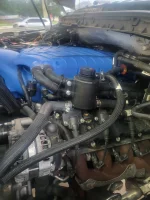
On another note. Here is the Fathouse reservoir mounted.
Me to! Now That no leaks are present I really want to do away with all this rubber hose. Some I'm cool with but Not everywhere.I like the durability factor of the metal can.
Yep - throttle body wiring is the most common issue I've seen that sets off all the bells and whistles. I assume by manifold you meant throttle body? (i realize that harness connects to both)I might have gotten lucky. I took the oem intake manifold and connected it to the throttle wire harness. I first did a continuity check on the Whipple harness extension and all 6 terminals checked. I fired up Forscan and cleared all the DTC codes and then reran the DTC check. All but 2 disappeared but most importantly, both P0600 and P168E which are PCM related, are cleared. I think I got a bad electronic throttle control. The only 2 DTCs left are IPNA and ABS. Those won't clear but are U codes. I sent the info to Whipple so I'm waiting to hear back. Kind of explains why all of a sudden the truck wouldn't start as I didn't do anything to it and it was running great.
View attachment 209867
Yea It's all connected as I didn't take the TB off the oem manifold. A new TB is on the way but still have 2 U codes that won't clear, ABS and IPNA. I hope the TB's are more reliable than this as it would ground you for a while if on a trip. Can't go to the local Ford dealer for a new TB.Yep - throttle body wiring is the most common issue I've seen that sets off all the bells and whistles. I assume by manifold you meant throttle body? (i realize that harness connects to both)

What is “flared” shifting?The Whipple doesn't work quite like that. The engine remains Normally Aspirated up until the point you call for Boost. Then a valve opens and allows the supercharger to put a lot more air in. When running the truck empty, boost only happens ~2 - 3% of the time, usually during acceleration events. The reason you get additional power, even with the engine running under the NA situation 97 - 98% of the time, is the intake configuration change (the Whipple Intake), a larger throttle body (150MM?) and a tune on 91 octane along with larger injectors. This significantly increases the stock motor output without the added boost. From my experience during normal driving, even with fairly aggressive acceleration, the boost rarely kicks in.
So under normal operations and when I was experience the flare shift was very light throttle and lower speeds; at these levels there is not much difference from the engine output and performance than a stock motor.
Whipple Tune does include transmission optimization.
The flare shift in the 3 - 4; 4 - 5 is a common complaint in 7.3's with the 10 speed. Mine developed it in the 8 - 10k range. In many of the complaints I read, people would take it to the dealer, it would run great afterwards and then develop the goofy shifting again 100 - 1000 miles later. So it would shift great until the Adaptive Learning would "learn" and start modifying shift strategies. After watching many, many videos on 10R80 and 10R140 rebuilds, problems and understanding how they work, especially with the valve body configuration, it started to point to the adaptive learning process doesn't properly account for transmission break-in and pressure differences causing some of these flares. Shutting the Adaptive learning off is easy with ForScan. You can reset it and then stop it from the ForScan App on your phone.
The best way to describe it is a noticeable increase in engine RPM during a gear change. It feels like a slip or delay that occurs when the transmission fails to engage the next gear quickly or firmly. Its a slipping sensation or soft delayed shift.What is “flared” shifting?

Shit, my stock truck does a flared shift occasionallyThe best way to describe it is a noticeable increase in engine RPM during a gear change. It feels like a slip or delay that occurs when the transmission fails to engage the next gear quickly or firmly. Its a slipping sensation or soft delayed shift.
Since the Whipple calibration update, my transmission only experiences flared shifts on rare occasions when it is cold and it is almost exclusively the 3 - 4 - 5 (3 - 4 or 4 - 5) shift range. If it happens, it only occurs once shortly after startup and is normal after
And that is the source of the tuned flared shift. It carriesShit, my stock truck does a flared shift occasionally
The issue in the Whipple calibration is an artifact of the stock tune. Ford needs to resolve the base file to fix it basicallyShit, my stock truck does a flared shift occasionally
Shit, my stock truck does a flared shift occasionally


![What did you do to your Tremor today? [2026 edition]](https://www.fordtremor.com/data/files/featured_images/featuredimages_thumb_4.webp?1791706811)
![[2023+] Tremor Wheels & Tire Size/Offset Photo Thread](https://www.fordtremor.com/data/files/featured_images/featuredimages_thumb_5.webp?1791706812)