Winching Brake

Easy, when the right line is pulled up 1ft, the winch is going to move up 1ft with it. You now have 2ft of slack line to spool in. So 1ft forward direction = 2ft of spooling. 2:1 ratio.
Only 1 ft moved the load the other foot of rope was to remove the slack the system would have generated had the winch mechanism not moved itself closer.
 
Truly not trying to be disrespectful at all, just want you to see the error in your reasoning and have a better understanding of self recovery so as not to spread bad information. If you still disagree, I implore you to test on your own. Can use a fish scale, weight, snatch block (pulley) and rope to rig up a simple system. Just place the fish scale connected to one end of the rope and the other end of fish scale to the weight, other end of rope through the snatch block (attached snatch block to rafters or something up high), and attach directly to the weight. The fish scale will read approximately half of the weight (not exactly accurate scale). The fish scale represents the winch in this case.
Try this experiment and get back to me if you are confident in it. The scale will read the same as the weight.
 
Something to quickly add (again, I'll come back to the physics discussion later today), @Mike Alcocer, is that the Army even more explicitly acknowledges that the load being the source of effort is an exception to the fixed pulley rule. From the 1962 manual, page 13 (emphasis added):


So the Army's document fully agrees with the Navy's document. It just includes a special case that the Navy document doesn't; likely because this special case isn't relevant to Navy operations.
You really have to wrap your head around accounting for the winch moving. If you tensioned a rope and stepped 1ft forward the rope would be slack. You would need to bring in 1ft of rope to get it back in tension before trying to move any load on the other side. The double line pull is moving the load equal distance while also changing its location an equal amount.

I get that they say that but the diagram doesnt show that.

Figure 5 shows equal force in and out but the pulley is in the same configuration as the double line pull in question.

Figure 6 shows a true 2:1 the pulley is on the load and the effort is split between to moving lines. In this figure if you were to move the mechanism forward while its working would you also count the distance it moved forward as mechanical advantage? You wouldn't. Thats why the double line pull isnt a 2 to 1.

I did test today that I can isolate and read the amperage draw of the winch. I didn't do it while the winch was under load so all I saw was the in rush current and some minimal draw as it spooled.

Could we agree that if we removed all the variables of surface, line position on the drum etc that a straight pull should draw a given current at constant voltage?

Then assuming a double line pull provided mechanical advantage and reduced the load on the winch then we should see roughly half the current at the same voltage?

I can probably test this next week after I get through my shifts this weekend. I don't have access to load cells large enough for a winch operation. But since we are talking about reducing the effort of the winch I think that measuring current of the winch in operation is a more accurate thing to measure. If you had a rigging system that created MA then the winch would draw less amperage.
 
Last edited:
Could you answer the question? Does the picture represent a 1 to 1 system?


I move the left rope from the red dot to the green dot and the right rope will move the same distance from its red dot to green dot. Correct?

Does it change anything if the left rope instead of moving straight down was instead wraped around a drum with a circumference of 12 inches and the center line of that drum was at the location of the red dot?

Now with out anything else moving. Take the drum towards the pulley 1 ft, Would the line be slack? How would we deal with that slack? If we weraped the slack around the drum would it move the load?

Answer these simple questions to move yourself closer to the correct answer.
Again the concept is going over your head. Your picture is a 1:1. Your picture is NOT the same as a winch on a bumper with the line going to a snatch block anchored and back to the bumper.

The difference between those 2 examples is that your picture is redirecting the pulling force and the distance between the pulling force and the pulley remains static. With the winch and block the force returns to the source and the distance becomes shorter.

I’ll say it again there is a difference between a pulley redirecting and a pulley being reeved to create a gear reduction.

As was said earlier when you have the winch go through a block and back to the bumper both sides of the line get shorter when you pull it in since the distance between each connection gets closer. If you are 20 feet from the block you have 40 feet of line to pull in before they meet.

Now let change it to be like the picture. You anchor a block to a tree and have the line go through it and anchor it to another tree or anything other than what you’re trying to move.

Again 20 feet from the block but this time you only have 20 feet of line between the winch and the block so when you pull in 1 foot you get 1 foot closer.

The difference is where the forces begin and terminate. First example the forces starts at the winch goes through the block and returns to the same thing the winch is on. Second example the force starts at the winch gets redirected through the block and terminates at the other tree or anchor.
 
Both times you incorrectly quoted me. Its there for folks to see.

I have already tested this extensively which is why I am confident in my answer. Every book and document I have linked states that a fixed pulley gives no mechanical advantage. Show me how to grab one spot on a rope and pull 2 ft of rope around a pulley while the rope on the other side of the pulley only moves 1 ft.

If I pull a rope with 2000lbs of force on one end and 2000lbs of force on the other end how much force has been exerted on the rope?

Would you agree that in a straight pull that a winch would draw a given amperage at constant voltage?

Then if a double line pull the winch should have roughly half the amperage draw if your scenario were correct since the winch picked up some mechanical advantage?

Can we agree that this would be the best way to accurately measure the winches effort in a given pull?

This of course assuming we pull over the same even terrain and the winch line is in the same spot on the drum, ie the same length out
As to quoting or misquoting, much like Newton’s equal and opposite reactions, you and I are not going to agree. I am fine leaving the accuracy of my quotes in the court of public opinion.

I don’t know what you have extensively tested, though I doubt you have played out this exact scenario and not confirmed the position of myself and others. As @ccw provided reference for (and I asserted earlier) the scenario where the source of power is part of the load being moved is the exception to the fixed pulley rule you keep going back to.

Yes, in a massless frictionless system, the tension in the rope is constant over its length. In the double line scenario, both ends of the rope are exerting a force of 2,000lbs each, acting on the truck, with a resultant force on the truck of 4,000lbs. A free body diagram easily supports this. To aid in this, see the WLL limit markings on this mountaineering pulley. In this diagram, 3kN of tension in the rope, acting on both sides of the pulley, results in a 6kN force acting through the eye of the pulley. It is the same at the bumper end of the system we are debating—two lines, each acting with tension (T) on the truck results in a total force on the truck of 2T.

4D267E5F-7C15-4831-ACCB-60231F26D52A.webp


When the winch is part of the load being moved, the repositioning you refer to is not a “free” move. Again, discounting friction losses, the winch only moves when the load moves. The load (and winch) moving require work. The 2ft of line displaced moves the load/winch 1ft—there is not ‘zero work slack repositioning’ or whatever you are choosing to call it.
 
I have already tested this extensively which is why I am confident in my answer.
To clarify, have you tested the exact scenario in question - rope going from source of effort through a fixed pulley back to the source of effort? Or did you test a fixed pulley where the load and source of effort are distinct?

I know you're saying they're the same, but one of the biggest and most respected winch manufacturers (Warn), a major winch accessories manufacturer (Safe-Xtract), US Army (consistently over 6 decades!), along with a ton of of the off-road community across the internet (written and video format) are saying they're different based on direct experience and/or math (those are the sources I've cited, and I'm sure there's tons more out there). Also my neighbor who has personal experience self-recovering his rig off-road, where he states he needed the extra pulling power from the double-line pull (yes, he's by far my weakest source :p).

I'm not saying that definitively proves you're wrong. But I do believe that means if you've only tested a similar scenario, but not the exact scenario in question, then saying you've tested it doesn't make sense as an argument.

(To be clear: by scenario I'm referring to the configuration of effort, load, pulley, connections, etc. Doesn't need to literally be a winch on a truck. It could be a representative scale model or, as was mentioned earlier in the thread, even a platform being lifted vertically.)

You really have to wrap your head around accounting for the winch moving. If you tensioned a rope and stepped 1ft forward the rope would be slack. You would need to bring in 1ft of rope to get it back in tension before trying to move any load on the other side. The double line pull is moving the load equal distance while also changing its location an equal amount.
I understand and agree with your statement that the winch moving forward is the reason there's extra rope to move. What I don't agree with is that proves the system is a 1:1 mechanical advantage. It's an observation, not proof of a conclusion.

Figure 5 shows equal force in and out but the pulley is in the same configuration as the double line pull in question.

Figure 6 shows a true 2:1 the pulley is on the load and the effort is split between to moving lines. In this figure if you were to move the mechanism forward while its working would you also count the distance it moved forward as mechanical advantage? You wouldn't. Thats why the double line pull isnt a 2 to 1.
Correct. The diagrams I cited don't show the 2:1 mechanical advantage in the double-line pull. I included them because they are referenced in the text I quoted, thus I consider them part of the complete quote. Figures 5 and 6 also aren't referenced when the Army states the special case to the fixed pulley rule, so they aren't intended to show it. They're intended to help explain the first two general rules where they're referenced.

Not including a diagram for their special case doesn't disprove their words, or demonstrate a contradiction. It just shows the authors, for whatever reasons, didn't feel it was necessary/worthwhile to include a diagram for the special case.

I did test today that I can isolate and read the amperage draw of the winch. I didn't do it while the winch was under load so all I saw was the in rush current and some minimal draw as it spooled.

Could we agree that if we removed all the variables of surface, line position on the drum etc that a straight pull should draw a given current at constant voltage?

Then assuming a double line pull provided mechanical advantage and reduced the load on the winch then we should see roughly half the current at the same voltage?

I can probably test this next week after I get through my shifts this weekend. I don't have access to load cells large enough for a winch operation. But since we are talking about reducing the effort of the winch I think that measuring current of the winch in operation is a more accurate thing to measure. If you had a rigging system that created MA then the winch would draw less amperage.
I agree that would be a valid test. I'm going to go mess with my winch this weekend for a bit, experimenting with whether setting my parking brake in 4x4 is enough to make me traction limited (the original intent of this thread :ROFLMAO:). I'll bring a clamp-on ammeter and see if I can find a good spot to give this test a try as well. Though I still encourage you to try it. The more the merrier. :D

(Physics response coming next. Will take me a bit to write.)
 
If you want to learn about recovery, get into a class with this company. They have great instructors and real world experience. https://overlandexperts.com/

I would highly argue for not using the vehicle in park. They taught us that in class. I understand it’s designed for holding the vehicle with a trailer but when winding it splits a different force than being parked.


Use the technique in this video to help anchor the vehicle
Interesting to hear of a class instructing not to leave the vehicle in park! Thanks for the context. And I would love to take a class on winching one day.

As for that technique, I have two thoughts:
  1. Love it, though don't quite know how to achieve it without being able to isolate the front and rear brakes. I know Matt has his rigs setup so he can have only the front or rear brakes activate at a time.
  2. A lot of the terrain I'm on is fairly hard surface - hard packed dirt, rocks, etc - so I can't really count on being able to dig in. Worthwhile if I can, for sure, but not something I want to count on. I still want to be able to maximize the truck's inherent ability to stop itself from moving.
 
I have created this with force gauges and at no time will a non moving pulley create mechanical advantage. We needed to test making MA systems attached to our aerial ladder for the purpose of rescuing people from confined spaces and other technical rescues. It was pretty crucial that we get this science correct. Our systems involved MA as much as 9:1 and multiple changes of direction.
This is super cool! Can you explain how it was setup? What was the winch attached to? What was the load being lifted?
 
A lot of the terrain I'm on is fairly hard surface - hard packed dirt, rocks, etc - so I can't really count on being able to dig in. Worthwhile if I can, for sure, but not something I want to count on. I still want to be able to maximize the truck's inherent ability to stop itself from moving.
Should have gotten the snowplow prep package so you could have a blade to dig into the ground! ;):LOL:
 
I think your almost there with the capstan idea. The amount of rope coming out of the capstan would be equal to the load movement if the capstan didn't move itself while it was working. Want the load to move 1ft then 1ft of rope will come out the back. It will do that through a fixed pulley or on a straight pulley the same.

Now just think to pick that capstan up and move it towards the pulley while its hauling. In order to keep the line tight it needs to move the same distance of line through itself as the machine itself is moved in addition to the length of line used to move the load. So yes the capstan is closer but only because if it didn't move more line through the line would be slack.

You can't give credit for work done if the machine doing work only moved the rope to compensate for its change in location.

Can we agree on this simple idea?
View attachment 61696
Does this picture display a 1 to 1?

I move the left rope from the red dot to the green dot and the right rope will move the same distance from its red dot to green dot. Correct?

Does it change anything if the left rope instead of moving straight down was instead wraped around a drum with a circumference of 12 inches and the center line of that drum was at the location of the red dot?

Now with out anything else moving. Take the drum towards the pulley 1 ft, Would the line be slack? How would we deal with that slack? If we weraped the slack around the drum would it move the load?
Have done a bunch of mulling over this, and I agree there's an inconsistency in my calculations. The inconsistency, as you called out, revolves around the distances I used and what they were measured against. Between the two equations, I changed my frame of reference.

When looking at the Work done to the rope, my frame of reference was that of the winch. The amount of rope moved through the winch is what I used for d.

When looking at work done to the vehicle, my frame of reference was now the surface the whole system is on (i.e. the Earth). The amount the vehicle moved over the Earth was what I used for d.

Like you say, if I maintain a consistent frame of reference - in this case the only one that applies to both is the Earth - then the rope moves the same distance as the winch, in the opposite direction. Once the distances are the same, so are the forces, and thus a 1:1 mechanical advantage is shown.

(Worth noting that because Work is a scalar value, it doesn't matter for the math that the movement was in opposite directions.)

Now, I haven't personally observed this configuration in action yet; however, I'm more than willing to take the experiences of others (see the many sources I've cited) and use those as a proxy for my observation, and thus consider the 2:1 mechanical advantage as observed. I'm trying to use physics to explain why the observed 2:1 mechanical advantage exists.

So I want to walk through to my current logical conclusions of the physics based on those observations. First, let's setup the equations again, but with a bit more detail.

W_r = F_r * d_r
W_v = F_v * d_v

Where the _r suffix indicates a value for the rope, and _v suffix indicates a value for the vehicle.

Now for my assumptions:
  1. Energy, and thus W, is conserved, as a result of conservation of energy.
  2. The force applied onto the vehicle is exactly twice the force applied to the rope by the winch, as a result of observed behavior.
By the first assumption, W_r = W_v. Following from that, we can set the equations equal to each other:

F_r * d_r = F_v * d_v

With the second assumption, we know the following:

F_v = 2 * F_r

Substituting into our equation:

F_r * d_r = (2 * F_r) * d_v

Now we can solve for one of the distances (doesn't really matter which one, but let's solve for d_r to avoid fractions):

d_r = (2 * F_r * d_v) / F_r

Simplifying (the F_r's cancel out):

d_r = 2 * d_v

Thus showing that, in order for the math to describe our observations, the distance the rope travels, as measured for the Work equation, must be twice the distance the vehicle moves. This means one of three things:
  1. My original approach, involving two different frames of reference, was correct. If this is the case, then I don't understand the application of W = Fd well enough to say why that's correct and need to learn more about it.
  2. There's some other way to calculate the distances that uses a constant frame of reference, yet results in d_r = 2 * d_v. I have no idea what this other way would or could be, but I can't rule it out.
  3. The assumption that F_v = 2 * f_r is false, and a 1:1 mechanical advantage is actually what's observed.
My next steps are to:
  1. Confirm the observations through experiment. If you perform the winch amperage experiment before I do, Mike, then I'll consider that confirmed for me. :)
  2. Better understand how W = Fd is applied, distance is measured for it, and how it all relates to frames of reference.
Both next steps are valuable as I still want to understand the physics behind this scenario.
 
Mike,
I think you are getting confused by comparing the picture of a simple haul with the mechanics of a winch on a vehicle going through a snatch block and back to the vehicle. Try your picture with a directional pulley where the 3 arrows are, you would then get a two to one pull because that pulley is moving along with the other end of the rope towards the fixed pulley. The winch would be the directional pulley. Took me a little while to think that through.
Simple Haul redirected.png
 
At the Tremor meet up today, this thread came up in conversation, and we all agreed it would be safest to have a quick release to let go of the load on the winch line and say sayonara. 😅 @legmar
 
Last edited:
Today I got a chance to get out and play with my winch. I set out with two goals:
  1. On a high traction surface (i.e. pavement), compare the holding power of the service and parking brakes under winching load (going back to my original question at the beginning of this thread)
  2. Compare the winch's current draw between single and double line pulls.
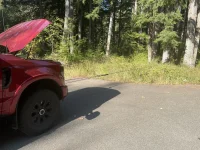
To do this I found a paved pull-out that was fairly far into the woods (despite still being paved). This pull-out had multiple large trees not very far out one end of it to winch from. You can see the setup here:

15C78E9A-D32E-449E-96C3-44844AB92165.webp


For 1, this was a maximum strength single line pull, as the winch rope was almost completely extended from the drum (of course leaving the final layer on). The truck was in 4x4 high, front hubs manually locked (to ensure they never unlocked momentarily while moving the truck back and forth between pulls) the whole time. When pulling, the truck was in neutral.

I was surprised to find that even the service brakes, with me standing on the pedal, couldn't hold the tires from turning! Instead of skidding like I expected, the tires slowly rolled. Now, this was an extremely hard pull, but still surprised me how great traction was, and how weak the service brakes were.

When using the parking brake, not unsurprisingly with the results of the service brakes, the tires rolled under the load from the winch. It's worth noting that while I applied the parking brake firmly, I didn't stand on it like the service brakes as I don't want to artificially stretch out the cable.

In both situations I could only evaluate the effectiveness by ear, listening to how strained the winch sounded. Without question the winch sounded less strained with the parking brake; however, I was surprised by how similar it sounded overall. As a result, my escalation path going forward will be as such:
  1. Apply parking brake in 4x4.
  2. If I don't need to be outside to monitor things, or if I have a helper available, stand on service brakes.
  3. Use wheel chocks. I carry a set of wheel chocks from WeighSafe anyways for use when jacking.
  4. Use an anchor if available.
Obviously I can skip steps if I feel the situation warrants it, or it's simpler for whatever reason. But that's my escalation path for holding my truck while winching someone/something else. I will not be carrying a brake depressor or looking into other solutions at this time.

Thank you for all of the suggestions and help in this thread, everyone!


For 2, I'll still describe my setup...but it all ended up being for naught with regards to current measurement. I didn't realize until I was out there with the winch fully setup that the amp clamp I have will only measure AC current, not DC. Was still fun to configure and used more of my winching gear than I originally expected, so I'm calling it good practice. :D

The setup:
  • Truck in 4x4 high, neutral, parking brake partially applied such that it was applying resistance, but not so much that I couldn't still move the truck in gear.
  • Tree saver was wrapped around a tree, with a soft shackle holding the ends together.
  • The ends of my winch rope extension were both attached to the soft shackle, creating a basket attachment. This extended the attachment point for my winch out from the brush and onto the pavement. This served to make my life easier by not having to trudge through the brush as much, but also ensured I could perform both single and double-line pulls while keeping the truck on the pavement. Without the extension, I wouldn't have had enough rope to perform the double-line pull from on the pavement.
  • In the case of the single line pull, I attached my winch hook directly to the extension rope.
  • In the case of the double-line pull, I used a soft shackle to attach my rope retention pulley to the extension rope. My main winch rope went through the pulley and attached back to a tow hook on the truck with a soft shackle. Yes, I could have hooked directly to the tow hook, but this way there was no risk of damaging the paint on the tow hook and I had the soft shackle available.
Total winching accessories used:
  • 1x Tree saver
  • 3x soft shackles
  • 1x winch extension rope
  • 1x rope retention pulley
Here's pictures of the setup:

5E6183AC-2810-42F5-93CD-9C47C4C6ADD0.webp


A1BBECA8-7484-43AF-80FB-8DAAAA41C437.webp
 

Attachments

  • BC67CA29-E3EE-45C9-8BCE-96E0B5A35942.webp
    BC67CA29-E3EE-45C9-8BCE-96E0B5A35942.webp
    575.5 KB · Views: 45
At the Tremor meet up today, this thread came up in conversation, and we all agreed it would be safest to have a quick release to let go of the load on the winch line and say sayonara. 😅

I’d be extremely careful releasing a line under load. Lots of stored energy there to hurt you or mess something up.
 
Not sure what you’re trying to achieve with the above test?…..,
 
Looks like he's trying to break parts. Of course the truck was going to move, the tree wasn't. That's a lot of strain on the winch line and the truck.

It seems quite a few people ordered the winch. I bet less than 25% will ever need or use it. More of a status symbol than anything.
 
Back
Top Bottom