Two errors in your setup to start.
The first is the way you are using the work equation. Its not what is being discussed especially with keeping the W as a constant. Using your equation:
F = 120J / d lets run some numbers by that to see if it make sense for our purpose.
F = 120J / (12 inches) answer of 10N of force to move it 12 inches
F = 120J / (24 inches) answer of 5N of force to move it 24 inches!?!
F = 120J / (6 inches) answer of 20N of force to move it 6 inches!?!
This all makes sense if you remember that force is equal to mass times acceleration.
F = m * a or 1N = 1kg * 1m/s2
This equation doesn't work the way you are thinking. The work equation is fine for figuring out the total energy to do something but doesn't put the time scale into perspective. As an example if I applied 10N to go 10m it would require 100 joules of energy. But we could be talking about moving 10kg at 1 m/s or 5kg at 2 m/s or 1kg at 10m/s. Work fails to account for time and direction, its just total effort.
From the wikipedia article "Work is a
scalar quantity,
[2] so it has only magnitude and no direction."
I agree that Work is scalar and doesn't take time into account; however, F = ma is also somewhat irrelevant in this case. Once the load is moving at a constant speed, a Force is still needed to maintain movement, the mechanical advantage (whether it's 1:1, 2:1, or whatever) still applies, yet we have no acceleration. Because it's moving at a steady speed.
So despite having no acceleration, we still have force and, assuming the vehicle moves, we still have distance. Thus we still perform work.
As for your examples of applying the equation I established, I do think they make sense for our purposes. The Force generated by the "winch" inside the tape measure is constant, the distance the tape moved is constant, thus the energy put into the system is constant. This is represented by the fact that the current consumed (assuming the internals of this tape measure are electrically powered) would be constant.
Now, if that constant energy - applied over any length of time! - is only able to move an object a very short distance, that means the force must have been very high. Picture an object with lots of resistance to movement (inertia, friction, etc). An example is I burn 100 calories pushing on my truck. I might be able to move it with 100 calories, but it won't move very far and I will have applied a large amount of force, proportional to the energy exerted.
On the other hand if that constant energy is able to move an object a very far distance, that means the force required to move the object must have been very small. Let's say I burn 100 calories pushing a model truck. I would likely be able to move it a very long ways before I burn 100 calories because of how light it is! But the force I apply would be very small to get it to move.
There's many ways the force could be applied with regards to time, but the total energy remains constant.
The second error in your equation is that you are not accounting for negative displacement or the that the winch has to move in the opposite direction that it is applying force (when it is attached to the load) thus changing the displacement formula and then account for total distance traveled. You can get into displacement on wikipedia and see that concept. I don't mind quoting wikipedia as long as the sources are linked for the subject. This stuff is all basic physics but most of us don't understand all of the components of basic physics enough to understand a complex system. The specifics of the physics here are Force, specifically tension force and mechanical advantage. The principals will apply the same for all loads so we can use a constant mass and the pull time can be constant as well. So what we really need to know is the distance a line would need to be pulled through a system to move any given load a certain distance. If we had a 2:1 mechanical advantage then the line would need to be hauled 2ft to move the load 1ft. We would have to go twice as far with half the force to achieve the results.
So lets get some basic common ground established to move the debate along. The winch is a mechanism for creating force. It displaces a mass or moves a weight a given distance in a given time. The amount of force a winch can deliver is a factor of available electricity and the leverage point of the drum among other smaller variables. We can agree that we remove those variables and the winch is always got enough energy and is pulling from the same location internally to equate to the same leverage. Or in more simple terms the winch is pulling the line in towards itself from a point exactly at the face of the winch and that direction of pull is always towards the rear of the vehicle. The winch wont work if it tries to go the opposite direction with the line.
This is necessary because we are evaluating the effects of the rigging system on the work performed and not on the internals of the winch mechanism. So we want to answer how much work is done at the winch not in the winch. We will call positive displacement towards the winch. We can agree that negative displacement, the opposite of the direction drawn, then the winch will not move any load. As the rope goes into the winch instead of moving towards the rear of the vehicle it is instead bent around the drum. We will also assume everything is in the horizontal plane to eliminate the force of gravity on the system.
Agreed with all of these assumptions.
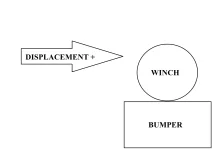
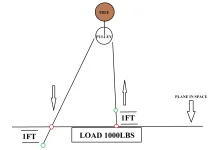
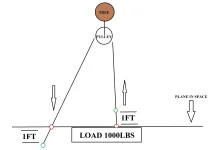
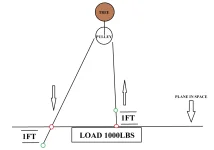
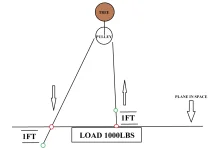
So lets look at the rigging we use to get the load moving. I want to move the load 1ft towards my anchor point. Then the line has to move 1ft towards the pulley. This is 1 to 1 so there is no mechanical advantage (MA). The direction the load is moving is in the positive displacement direction.
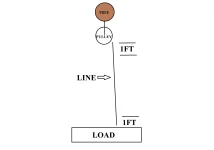
Next look at how the line moves through the pulley. 1ft of line into the pulley equals 1ft of line out of the pulley in a new direction. This is 1 to 1 so there is no mechanical advantage (MA). The line is still traveling in the same direction, positive displacement towards our mechanism of force thus the load is moving in the same direction. This establishes that neither the line between the load and pulley or the pulley itself have any sort of MA.
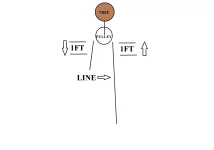
Now lets see the direction that force needs to be applied to create positive displacement of the load. Holding the same location on the haul line we move the load 1ft in the positive direction. The haul line moves 1ft in the positive direction. I moved 1 to 1 so there is no MA in this system. The rope is moving in the same positive direction, from the load to the pulley, around the pulley to the mechanism applying force (haul). However in our spatial plane the ending location of the load (green circle) and the haul (green circle) are 2ft apart each having moved 1ft of positive displacement from their starting location. They are opposing directions in the spatial plane but are the same direction relative to the rope from the load.
Now what happens when the haul is done from the load? In a nut shell the haul point has to move in a negative direction while also moving the load in the positive direction. So to move the load 1ft in the positive direction it has to haul in 1ft of line. While its doing that the winch itself is moving in the negative displacement direction of the load. It will haul 1ft of load and then move itself 1ft back along the line in the negative direction. The total displacement along the line is 2ft but 1ft of that was for hauling the load the other 1ft was repositioning along the line. Sure it hauled in more rope but an equal portion of that was because it shortened the overall length of the rope while it moved the load an equal distance. The line only moved 1ft from its original location to move the load 1ft. Where did that line go? Its wrapped around the drum but it may as well be at a point 1ft directly behind the plane it started at.
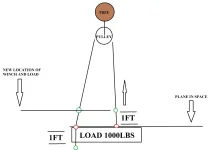
In the end the pulley attached to a non moving location never imparts mechanical advantage. If anything when you calculate the true effects of adding that pulley to your winch system you are only creating more friction and drag and the system in question and it would take more force to move a given load than a straight pull.
So I believe you're conflating the load and the rope in this case. I started my Work calculations with calculating the work performed on the tape (or rope, in the winch example). This is entirely independent of the work performed on the winch, vehicle, or anything else. In fact, the winch is a part of the load! Just more mass that work needs to be performed on.
As you state in your diagrams and your words, the rope happened to be wound around the winch, but effectively could have been moved behind the winch. It would be a really funky setup for a vehicle, but this could be replicated with a capstan winch bolted to the vehicle and the tailings from the rope laid out straight backwards as they come off the winch. The additional length of rope laid straight backwards is the rope moved through the system, and that length is the distance I used in my Work equation to work out the energy imparted.
The second calculation looked at how far the tape measure body (or vehicle in this case, including the winch!) moved, which we know from observation. The fact this is in an opposing direction to the rope is irrelevant. All that matters to the equation is that the object we're using the equation on moved a certain distance. A certain amount of energy caused that movement, and a force was imparted by that energy.


 en.wikipedia.org