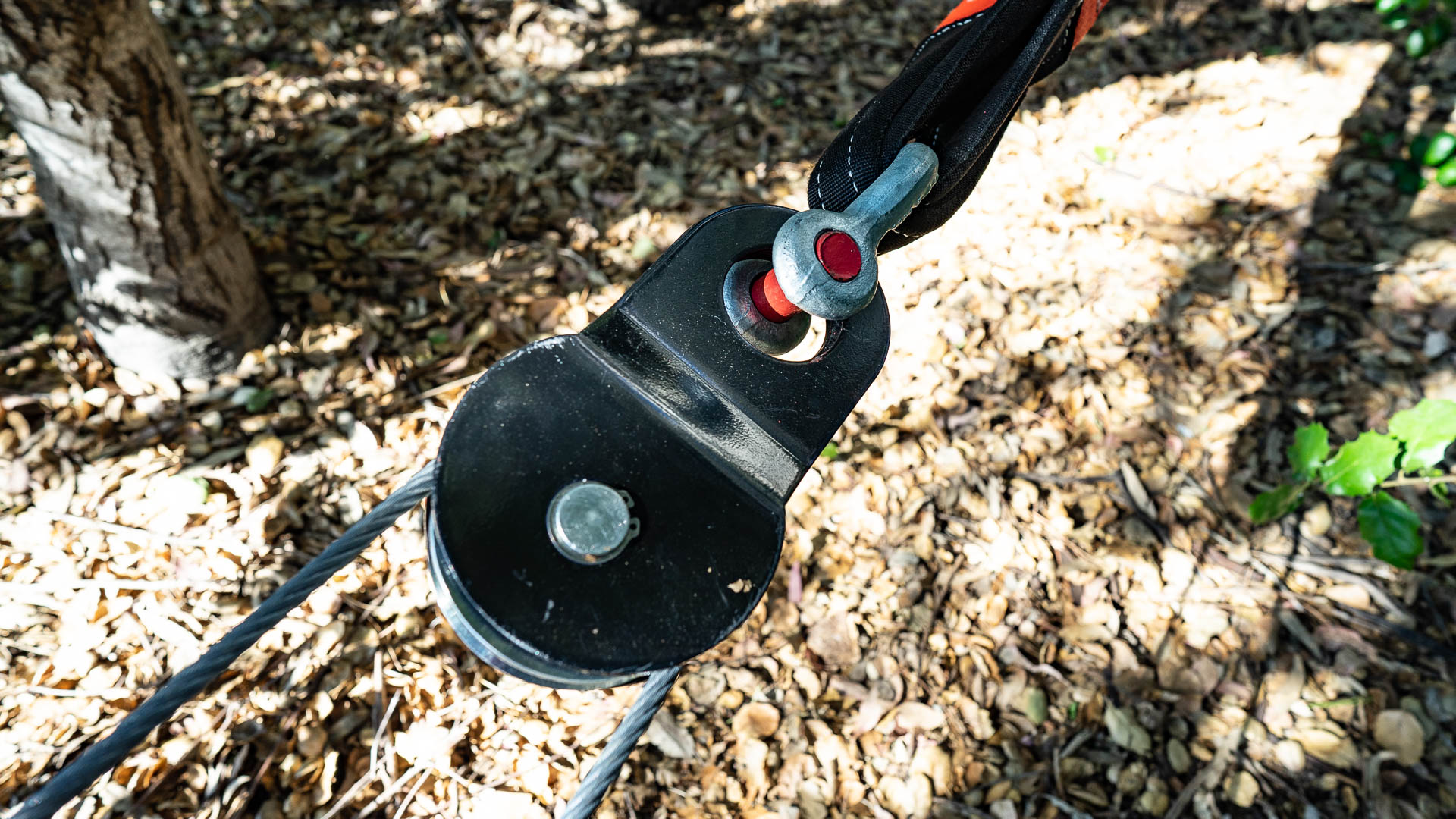
Absolutely. Though it does increase burden of proof for contradictions. Here's another source stating it doubles the pulling power of the winch, from none other than Warn:
Really stuck? A double-line pull can double your winch's pulling power. WARN explains how to rig a snatch block for twice the force when a single-line pull isn't enough.

www.warn.com
Possible they're wrong? Of course. Likely they're wrong? No. And even less likely when corroborated by many, many other sources. I also still don't have the knowledge/understanding to claim you're wrong at this point in my post.
I read the chapter and it still didn't address the situation where the load and source of force are the same. What was stated in the book makes complete sense, just doesn't address the situation at hand directly, and I think the situation at hand can present forces that are different than discussed in the book.
I think your example is great, first of all. And it is helping to clarify my understanding...though I think in opposition to you lol. Towards the end I'm going to come at this from an energy standpoint instead of mechanical advantage. First I want to present two thought experiments that don't prove anything, but I think are interesting to consider.
First is imagine you want to vertically lift yourself upwards. If you have a rope attached to the roof, hanging down, it takes a fair bit of effort to lift yourself up. Instead, if you hang a pulley from the roof, run the rope through the pulley and attach it around your waist, then pull on the loose end, I intuitively believe that would require significantly less effort to lift yourself.
Second thought experiment is, in these situations where the winch rope attaches back to the winch, what's the difference between:
- The pulley being stationary and the vehicle being pulled towards it.
- The vehicle being stationary and the pulley being pulled towards the vehicle.
I feel like those are the same, just different frames of reference. But I believe what you're saying is that because the pulley is fixed in the first scenario, but moving in the second, mechanical advantage only exists in the second one?
Now on to my interpretation of your example, but in terms of energy.
Setting the stage from your example, assume the end of the tape measure is attached to the body of the tape measure and the tape measure is locked (won't auto-retract). Then, picture some outside force moves the body of the tape measure forward 6 inches; you would have slack on both sides of the tape. To take up that slack, the tape measure would then need to retract a total of 12 inches of tape - 6" for each side of the pulley.
Put another way, if, instead of an outside force, the tape measure was moving by retracting itself it would need to consume 12" of tape to move itself forward 6".
I believe I've restated what you said in the first two paragraphs of what I quoted, just in a different way, and we're on the same page so far.
Now, flipping over to energy. First, the definition of Work:

en.wikipedia.org
(Yes, I'm quoting Wikipedia. But that's a foundational definition in physics. It's just well written on Wikipedia, but can be cited from many, many, many physics textbooks.

)
So, W = Fd is the formula we're working with. Where W is work, which is energy imparted; F is Force applied to an object; and d is how far the object was displaced.
Let's assume the tape measure retracts with 10N of force (this represents the force our winch can pull with). This force is imparted into the tape first (we'll get to the force ultimately imparted to the body of the tape measure). Using the formula above, if we pull in 12 inches of tape, the work done is: (10 Newtons) * (12 inches) = 120 Joules.
That is the total amount of energy moved in the system (ignoring heat losses, etc, etc), thus we know how much energy was imparted on the body of the tape measure as a result of conservation of energy. Thus, reworking the formula above, we can work out the force applied to the body of the tape measure as such:
W = Fd
W / d = F
F = W / d
F = (120 Joules) / d
We'll pull in that 12 inches of tape in two scenarios, working out the force ultimately applied to the body of the tape measure using the formula we've created for Force:
- The end of the tape is attached to the anchor.
- The end of the tape passes through a pulley and attaches to the body of the tape measure.
Scenario 1:
This is a straight pull, thus the body of the tape measure moved 12". Applying our formula, this means: (120 Joules) / (12 inches) = 10N of force was applied to the body of the tape measure. As expected, this is the same as the force applied to the tape.
Scenario 2:
This is the double-line pull under contention. As established above (assuming we're in agreement above), the body of the tape measure will only move 6" forward when 12" of tape is retracted. Applying our formula, this means: (120 Joules) / (6 inches) = 20N. Despite applying only 10N of force to the tape, the amount applied to the body of the tape measure is doubled. This logically makes sense as, to have imparted the same amount of energy over a shorter distance, more force had to have been applied.
I can't map this back to fundamental pulley math/equations yet, and that irks me; but I do trust my energy math pretty strongly. I also know that I'm not satisfied with any of the sources I've found for pulley fundamentals as, like I've said, they don't address this exact scenario.













 ), but no need to reinvent the wheel.