Winching Brake

Not if you are measuring from the same location on the rope. You are crawling up the rope as you also haul the rope.

View attachment 61688

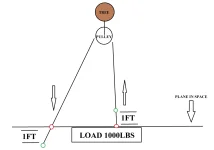
In your example the rope has to move 1 ft back for the load to go one foot forward. At no time can a rope pass through a fixed pulley and come out the other side at a different speed or force. Yes If I inched my hands up the rope as I moved it backwards I would stay in the same plan as the load (ie winch) but the sliding my hands forward in location on the rope does not count for any advantage. Its just a change of location. Every movement through the fixed pulley provides an equal and opposite movement on the other side of it. No one has been able to explain how I move a fixed location on the haul side a different distance from its starting point then the distance the load moves.

View attachment 61689

What parts of this line and pulley are acting like a gear? Is whats displayed a 1 to 1 system?

Apparently these concepts go way over your head.
 
If you want to learn about recovery, get into a class with this company. They have great instructors and real world experience. https://overlandexperts.com/

I would highly argue for not using the vehicle in park. They taught us that in class. I understand it’s designed for holding the vehicle with a trailer but when winding it splits a different force than being parked.


Use the technique in this video to help anchor the vehicle
 
Ok, so reverse the thought process. What if you mounted the winch to a plate, then ran the cable through a pulley that was attached to a vehicle, then back to the winch plate. Now anchor the plate to a tree. Spool in the winch. You now have a moving pulley setup and the winch would see half the load the vehicle is exhibiting, with the other half going down the other line. The tree sees the full vehicle load.
Now, the winch is on the vehicle and the line goes through a pulley that is mounted to a tree, and back to the vehicle. Still the same, winch sees 1/2 of the load, with the vehicle mount point the line is attached to seeing the other half. The tree sees the whole load.
First example is a true mechanical advantage. Second example half the distance moved has to account for the winch itself moving the other half from the load moving. See the example above.
 
So you opine above that Force is inverse to distance, but then say an increased force results in always the same distance....you don't add up.

I am hesitant to pose this guess, but I think you are getting tripped up on the differences between your FD rigged hoisting systems and a winching scenario where the source of power is part of the object being moved. These are not the same.
Thats not what I said at all. I said an increased force will result in an increased speed. Speed is a factor of time and distance. If distance remains the same then the time would need to be shorter. This is the second time you have twisted words around and claimed I said something I didn't. This is counterproductive to the discussion.

As to your second comment I'm assuming based on your inability to understand the rest of my statements that you should go and reread what I actually wrote. Do it several times to make sure. It doesn't matter if your winch is attached to the load or not. If its attached to the load half the distance traveled will always be for moving the load and the other half will be for moving itself to aa different location on the rope as the winch itself moves forward, the change of location doesn't account for work done. See above for the break down.
 
Apparently these concepts go way over your head.

Just point to the part of the system that creates this gear effect then. Does this picture demonstrate a 1 to 1 system?


Simple Haul.webp
 
Last edited:
Just point to the part of the system that creates this gear effect then. Does this picture demonstrate a 1 to 1 system?


View attachment 61716
Read what I said and quit putting words in where they weren’t. Again these concepts go over your head.

Your picture is not the same as a winch on a load and a snatch block anchored somewhere.
 
Thats not what I said at all. I said an increased force will result in an increased speed. Speed is a factor of time and distance. If distance remains the same then the time would need to be shorter. This is the second time you have twisted words around and claimed I said something I didn't. This is counterproductive to the discussion.

As to your second comment I'm assuming based on your inability to understand the rest of my statements that you should go and reread what I actually wrote. Do it several times to make sure. It doesn't matter if your winch is attached to the load or not. If its attached to the load half the distance traveled will always be for moving the load and the other half will be for moving itself to aa different location on the rope as the winch itself moves forward, the change of location doesn't account for work done. See above for the break down.
In both cases, I quoted your words along with my comment so that all could see both. The inability to understand and counterproductivity is on your end. As I had said earlier, I recongize that it is a fool's errand to try and convince you, but that I entered this discussion more in an attempt to keep others from being swayed my your incorrect assertions.

I sincerely beg you, if you still have access to load cells, to take an opportunity on a crew training day or even independently by yourself, to recreate the exact scenario in this diagram you discounted earlier. If someone could make load cells available, I'd even travel within 150 miles of VaBch to conduct and film this myself!

1664465161915.png


The two required load cells are the ones in red, attached between the pulley and anchor to the left and between the winch line and bumper/tow hook on the right. If you accept that the tension in the rope is constant, less the frictional losses around the pulley, the blue load cell is not necessary.

Sir Isaac Newton, myself, and many others believe that you will find that this diagram is correct and that it breaks down the physics (and 2:1 mechanical advantage) of the double-line self recovery. Each segment of line will have roughly 1/2 the load force exerted on the anchor and the force acting on the winch vehicle will be twice the tension in the rope.

If not, I guess I would need to return my state engineering board certification--good thing I'm recently retired.
 
When you learn how to rig a redirected pull you’ll also learn that this use of a pulley does notmultiply the power of the winch, nor does it halve the line speed. The easiest way to figure out whether or not you are multiplying winch power in any situation is to count how many lines are shortening when you engage the winch. For example, in the illustration below labelled Double-line Pull, both the line from the winch to the pulley and the line from the pulley back to the vehicle will shorten as the winch pulls, thus the power is multiplied by two.

0F769DE4-BC49-4853-A366-9B717DBC2F4D.webp
 
Just point to the part of the system that creates this gear effect then. Does this picture demonstrate a 1 to 1 system?


View attachment 61716
Easy, when the right line is pulled up 1ft, the winch is going to move up 1ft with it. You now have 2ft of slack line to spool in. So 1ft forward direction = 2ft of spooling. 2:1 ratio.
 
Just point to the part of the system that creates this gear effect then. Does this picture demonstrate a 1 to 1 system?


View attachment 61716
Truly not trying to be disrespectful at all, just want you to see the error in your reasoning and have a better understanding of self recovery so as not to spread bad information. If you still disagree, I implore you to test on your own. Can use a fish scale, weight, snatch block (pulley) and rope to rig up a simple system. Just place the fish scale connected to one end of the rope and the other end of fish scale to the weight, other end of rope through the snatch block (attached snatch block to rafters or something up high), and attach directly to the weight. The fish scale will read approximately half of the weight (not exactly accurate scale). The fish scale represents the winch in this case.
 
Quickly chiming in to say that I haven't forgotten about this thread, I still have many thoughts, and I will get back to it. Yesterday evening was busy and I'll have a busy day today so won't get back to it until this evening. Formulating thorough responses takes time lol.

Also want to say: I think comments like "clearly this is over your head" or the like are uncalled for and unnecessary. Let's keep the thread friendly.

I think it's clear that Mike has good intentions, and has a lot of rigging experience and knowledge. He certainly has dramatically more than me! I do disagree with Mike in this particular scenario, but I also greatly appreciate the discussion. It's helping me learn far more than I would without the discussion, and forcing me to think through my arguments at a deep level. And I love it! :love:
 
Something to quickly add (again, I'll come back to the physics discussion later today), @Mike Alcocer, is that the Army even more explicitly acknowledges that the load being the source of effort is an exception to the fixed pulley rule. From the 1962 manual, page 13 (emphasis added):


b. Blocks are classified as to their use in rigging.
  1. When a block is fastened to a stationary object, it is called a fixed block or leading block. A fixed block permits a change in direction of the rope but does not affect mechanical advantage (fig. 5).
  2. A running block or traveling block is fastened to the object to be moved and moves with the object. The running block will produce a mechanical advantage (fig. 6).
  3. An exception is made to the general rules stated in (1) and (2) above when the source of power is a part of the object to be moved. For example, when the cable from a truck winch is passed through a block and the end of the cable is returned and fastened to the truck, the block will offer mechanical advantage.
1664474510498.png

1664474542651.png

So the Army's document fully agrees with the Navy's document. It just includes a special case that the Navy document doesn't; likely because this special case isn't relevant to Navy operations.
 
Read what I said and quit putting words in where they weren’t. Again these concepts go over your head.

Your picture is not the same as a winch on a load and a snatch block anchored somewhere.
Could you answer the question? Does the picture represent a 1 to 1 system?


I move the left rope from the red dot to the green dot and the right rope will move the same distance from its red dot to green dot. Correct?

Does it change anything if the left rope instead of moving straight down was instead wraped around a drum with a circumference of 12 inches and the center line of that drum was at the location of the red dot?

Now with out anything else moving. Take the drum towards the pulley 1 ft, Would the line be slack? How would we deal with that slack? If we weraped the slack around the drum would it move the load?

Answer these simple questions to move yourself closer to the correct answer.
 
In both cases, I quoted your words along with my comment so that all could see both. The inability to understand and counterproductivity is on your end. As I had said earlier, I recongize that it is a fool's errand to try and convince you, but that I entered this discussion more in an attempt to keep others from being swayed my your incorrect assertions.

I sincerely beg you, if you still have access to load cells, to take an opportunity on a crew training day or even independently by yourself, to recreate the exact scenario in this diagram you discounted earlier. If someone could make load cells available, I'd even travel within 150 miles of VaBch to conduct and film this myself!

View attachment 61718

The two required load cells are the ones in red, attached between the pulley and anchor to the left and between the winch line and bumper/tow hook on the right. If you accept that the tension in the rope is constant, less the frictional losses around the pulley, the blue load cell is not necessary.

Sir Isaac Newton, myself, and many others believe that you will find that this diagram is correct and that it breaks down the physics (and 2:1 mechanical advantage) of the double-line self recovery. Each segment of line will have roughly 1/2 the load force exerted on the anchor and the force acting on the winch vehicle will be twice the tension in the rope.

If not, I guess I would need to return my state engineering board certification--good thing I'm recently retired.
Both times you incorrectly quoted me. Its there for folks to see.

I have already tested this extensively which is why I am confident in my answer. Every book and document I have linked states that a fixed pulley gives no mechanical advantage. Show me how to grab one spot on a rope and pull 2 ft of rope around a pulley while the rope on the other side of the pulley only moves 1 ft.

If I pull a rope with 2000lbs of force on one end and 2000lbs of force on the other end how much force has been exerted on the rope?

Would you agree that in a straight pull that a winch would draw a given amperage at constant voltage?

Then if a double line pull the winch should have roughly half the amperage draw if your scenario were correct since the winch picked up some mechanical advantage?

Can we agree that this would be the best way to accurately measure the winches effort in a given pull?

This of course assuming we pull over the same even terrain and the winch line is in the same spot on the drum, ie the same length out
 
Last edited:
When you learn how to rig a redirected pull you’ll also learn that this use of a pulley does notmultiply the power of the winch, nor does it halve the line speed. The easiest way to figure out whether or not you are multiplying winch power in any situation is to count how many lines are shortening when you engage the winch. For example, in the illustration below labelled Double-line Pull, both the line from the winch to the pulley and the line from the pulley back to the vehicle will shorten as the winch pulls, thus the power is multiplied by two.

View attachment 61724
But the location of the winch is changing and thus for every inch of load it pulls in it also has to move in 1 inch of slack to keep up with the load.

ou can't give credit for work done if the machine doing work only moved the rope to compensate for its change in location.

Can we agree on this simple idea?
Simple Haul.png
Does this picture display a 1 to 1?

I move the left rope from the red dot to the green dot and the right rope will move the same distance from its red dot to green dot. Correct?

Does it change anything if the left rope instead of moving straight down was instead wraped around a drum with a circumference of 12 inches and the center line of that drum was at the location of the red dot?

Now with out anything else moving. Take the drum towards the pulley 1 ft, Would the line be slack? How would we deal with that slack? If we wraped the slack around the drum would it move the load?
 
Back
Top Bottom