Noco Battery charger/maintainer

Back a bit ago I ran a Batter Tender (https://www.batterytender.com/battery-chargers?additional-features=Water-Resistant) for a LONG time on my 2006 6.0L with no issues. Placed it in a protected area in the grill, hung the plug down near the block heater. No issues. Worked great, easily tops off the batteries overnight.

I posted a link to the site which now shows two versions as much as 5A.
i ran a similar on my 6.0 excursion for years after upgrading the charging system. Happy FICM is a Happy lol.
 
I looked your refrigerator up and it's rated at ~4-5 amps at 12.6 volts. There may be other extenuating factors as well, such as surge current. The charger has to put out at least that much, maybe a little more depending on circumstances, to keep up with charging and running the Refrigerator and other accessories at the same time. But there is a possible downside.

One thing to keep in mind, if you use this type of charger and still maintain a load on the battery you are trying to charge, you could get a timeout error, (depending on the load and charger) indicating that your battery is not coming up to full charge within a specific time. (See spec code inserted for the NOCO Genius GENPRO10X1)

This varies on the type of charger, I added the noco 10A charger error code pages to show what I'm talking about. In some instances, the charger may think the battery will not charge properly. This exact issue happened to me with a DualPro charger trying to charge both batteries in the truck when they were very low. (Did not run for a couple weeks and pulled battery down) Other times, when I simply plugged them in, they charged up normally. Basically, it took too long to come up to full charge with the charger and errored out indicating my battery was defective. It did charge back up with the engine running.

Ideally, some kind of power source with a battery backup would be best for your situation. A UPS would work, though it generally has its own internal battery and would only backup a short period of time, or a more elaborate system as that used in a pellet stove source backup. It runs the stove and keeps a large battery charged, and when the power is disrupted, switches to the battery. Your truck could be the "backup battery". Lots to consider here as well, it could still drain your truck batteries if AC is not present for any length of time.

And yes, they are all big. Typically, bigger the capability, bigger the physical size. (We could do a whole conversation on the magic math from vendors...)

Example of pellet stove BU power supply:

This may be way more than you want to get into and if so, the Noco may work so long as the batteries will charge even under a constant load of your accessories and not time out. Incidentally, you can still use a dual port battery charger and the two outputs will complement each other, giving you twice the current to charge. (Some limitations may prevail such as max current at any given time depending on the charger.) In a boat, this is a common practice, two batteries, two port charger, whether they are in series or parallel. However, this also varies from charger to charger in that some will supply a limited current until one battery is charged, then switch over to the next one. I don't know the logic in the Noco but would guess it would supply equal current due to the batteries hooked up in parallel.

I don't mean to confuse, but these chargers are not really designed to have a constant load and keep running for an indefinite time. But if it works, it's much cheaper than the above. I personally run a separate, manually switched, house battery for accessories when the truck is not running. Charge it with an onboard DualPro charger when AC is available. I can also use it as an emergency source to unlock my truck in the unfortunate event the truck batteries go dead.

Hope this helps.
Awesome!!! I really appreciate the input and info. Of course with everything on my truck this can’t just be straight forward and easy haha. I have a question though. For my set up this is a set up that does not stay permanent in the truck. The fridge and other accessories only get put in when I go on camping trips which is every once in a while. I also have a EcoFlow delta max that I bring with me and keep those devices plugged into the EcoFlow and then the EcoFlow is plugged into the truck. So with that being said is the issue of my truck batteries not really reaching a full charge still a concern? Or would the on board chargers work for short camping trips like that where the camp site has power available and I plug my truck in over night or for a few days while at the site? Sorry I’m not very knowledgeable yet when it comes to power systems. I’m still trying to learn.
 
Back a bit ago I ran a Batter Tender (https://www.batterytender.com/battery-chargers?additional-features=Water-Resistant) for a LONG time on my 2006 6.0L with no issues. Placed it in a protected area in the grill, hung the plug down near the block heater. No issues. Worked great, easily tops off the batteries overnight.

I posted a link to the site which now shows two versions as much as 5A.
Battery tenders are good for your type of activity whereby you simply want to top off a battery, (actually a nice addition in most cases, may do this myself since the truck can sit days at a time not started) however, the OP implied running accessories at the same time as charging. 800 m-amps or even 5 amps, would not suffice in this situation. There's a lot to consider here, depending on how the OP is actually going to operate his refrigerator at any given time and to what extent of additional accessories are added. Just more things to ponder.
 
i ran a similar on my 6.0 excursion for years after upgrading the charging system. Happy FICM is a Happy lol.
The struggle was as real as it gets! 🤣 🤣
 
Awesome!!! I really appreciate the input and info. Of course with everything on my truck this can’t just be straight forward and easy haha. I have a question though. For my set up this is a set up that does not stay permanent in the truck. The fridge and other accessories only get put in when I go on camping trips which is every once in a while. I also have a EcoFlow delta max that I bring with me and keep those devices plugged into the EcoFlow and then the EcoFlow is plugged into the truck. So with that being said is the issue of my truck batteries not really reaching a full charge still a concern? Or would the on board chargers work for short camping trips like that where the camp site has power available and I plug my truck in over night or for a few days while at the site? Sorry I’m not very knowledgeable yet when it comes to power systems. I’m still trying to learn.
These are well thought out questions! The EcoFlow is a great way to run things for short periods, (short is relative to load requirements and time away from an AC source) and as long as you have AC at the campsite, easy to keep charged up for occasional jaunts in the wilderness. (Solar backup would be good here as well, though expensive, and need much more time for charging.) Having the truck as a backup charging network for the EcoFlow will still have the same battery discharge conditions. In other words, if you run the EcoFlow down to where it relies on the truck batteries to recharge or run, it would still drain the battery. Charging them back up with the Noco (or any other charger) must equal the demand.

Power demand is straight forward, you need more power to create less power. Essentially, no matter what means you use to transfer power, batteries, AC, BU generator, etc., it will require more power to maintain each device in the string. (Solar is the exception, this just needs time as the medium)

If it was me setting this up, I would use a battery tender type device (AC or Solar) on the truck batteries to maintain the charge, but I would be using the EcoFlow as my primary power source. I would have it plugged into AC (if available) or solar if the power demand is low enough to keep my accessories running and have enough capacity to maintain the charge on the EcoFlow. The truck is a good backup if none of the other devices are not available, but I would occasionally start the truck and recharge everything.

Current demand can be calculated that whatever your accessory needs are, you need that much energy plus the energy to run the generation function. Every time there is a "transfer" of energy, it requires that much more energy for the transfer function to work, as well as the load. (AC to DC, DC to AC, or DC to DC.)
 
If you already have an Ecoflow- let it run the fridge. When you get to camp, charge up the eco flow from the AC power pole at the camp site. It'll suck up way more power than using a trickle charger on the truck.

Also, power the fridge from the DC output on the eco flow. Otherwise you're converting DC to AC TWICE! That's a huge loss of energy. The battery in the eco flow is DC and the compressor in the fridge is DC.
 
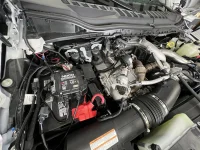
Here is my Noco 5 amp on my 2017 F250 (not a tremor). It's hard to see, but I have it zip-tied around the metal strap the bolts the battery into place. There are notches on the side of the box to make the zip ties fit easily.

1.webp


2.webp


For comparison, this is the 2 amp version (much smaller) I initially bought but decided it might not be enough. I'll find something else to put it on. Of note, the 2 amp box has a pretty short cord to plug in to an extension cord. It will NOT be long enough to go down behind the grille without some extension. The 5 amp has a much longer cord.

3.webp


And this is how I have the 5 amp charger running across the engine bay to go behind the grille. I have it just dangling behind the bumper because I didn't want to drill a hole to mount a plug thingy.

4.webp
 
I installed mine because that truck is not my daily driver and will sit for 1-2 weeks without driving. My battery drains due to dashcam, Viper, and audio amp always on, plus any usual Ford stuff that remains on all the time... remote start sensor, etc.
 
Here is my Noco 5 amp on my 2017 F250 (not a tremor). It's hard to see, but I have it zip-tied around the metal strap the bolts the battery into place. There are notches on the side of the box to make the zip ties fit easily.

View attachment 112511

View attachment 112512

For comparison, this is the 2 amp version (much smaller) I initially bought but decided it might not be enough. I'll find something else to put it on. Of note, the 2 amp box has a pretty short cord to plug in to an extension cord. It will NOT be long enough to go down behind the grille without some extension. The 5 amp has a much longer cord.

View attachment 112513

And this is how I have the 5 amp charger running across the engine bay to go behind the grille. I have it just dangling behind the bumper because I didn't want to drill a hole to mount a plug thingy.

View attachment 112514
I liked this idea so much that I bought one and installed it. Then the weird stuff started. It will charge until the green light is solid. As soon as I open the truck door it will go back to a pulsing 25% light and start over. I can’t for the life of me figure out what is goin on. Any problems like this with yours?
 
Not sure if this has been discussed, but I’ll throw it out there in case it helps any of you 6.7 guys or dual battery 7.3ers. My understanding of parallel charging a dual 12v system (same 12v output but double the amp hours) is that you hook up the positive charge cable to positive post on battery number 1 and run the negative wire over to the negative post on battery number 2. Either that or have 2 separate chargers hooked up to each battery. Am I correct in understanding if 1 charger is hooked up to just 1 of the batteries, it isn’t actually charging the second battery?

Here is an older video from noco that discusses it.

 
I liked this idea so much that I bought one and installed it. Then the weird stuff started. It will charge until the green light is solid. As soon as I open the truck door it will go back to a pulsing 25% light and start over. I can’t for the life of me figure out what is goin on. Any problems like this with yours?
I've been noticing this exact issue also. It stays green for a few days even opening my door is fine. But if I crank the engine and let it idle, the charger goes back down to 25-50%. So I just got a 10 amp version to see if it's truly just underpowered running 2 large batteries. It might be a couple weeks before I have time to install it and see.
 
Not sure if this has been discussed, but I’ll throw it out there in case it helps any of you 6.7 guys or dual battery 7.3ers. My understanding of parallel charging a dual 12v system (same 12v output but double the amp hours) is that you hook up the positive charge cable to positive post on battery number 1 and run the negative wire over to the negative post on battery number 2.

Here is an older video from noco that discusses it.

Hmm interesting. I would have thought that would be for series, kinda like how my boat trolling motor is hooked up.
 
I liked this idea so much that I bought one and installed it. Then the weird stuff started. It will charge until the green light is solid. As soon as I open the truck door it will go back to a pulsing 25% light and start over. I can’t for the life of me figure out what is goin on. Any problems like this with yours?
I have the 2Ds hooked up to my boat and tremor batteries and have had great success with them maintaining my batteries for winter storage in cold temperatures. When I discharge one of these batteries even a little, the chargers wake up and pulse red and then return to solid green. I think the chargers wake up and diagnose/ charge the batteries back up when they detect a drain, as when I switched my boat batteries on to do a software update on my chart plotter or when you opened your truck door. Does your charger return to green led after a bit? Mine do and that’s how I think they are supposed to work. It’s not clear from what you are reporting that there is anything wrong unless I’m missing something?
 
I have the 2Ds hooked up to my boat and tremor batteries and have had great success with them maintaining my batteries for winter storage in cold temperatures. When I discharge one of these batteries even a little, the chargers wake up and pulse red and then return to solid green. I think the chargers wake up and diagnose/ charge the batteries back up when they detect a drain, as when I switched my boat batteries on to do a software update on my chart plotter or when you opened your truck door. Does your charger return to green led after a bit? Mine do and that’s how I think they are supposed to work. It’s not clear from what you are reporting that there is anything wrong unless I’m missing something?
It takes a while to build back up after I open the door. As though it was starting over. It was just surprising that the lights would go from 100% charge down to 0%. Maybe I just need to do a longer test.
I have a normal Duracell 4 amp charger with alligator clips that charges to a full charge and then just stays there. I was expecting the Noco to do the same thing. Maybe the technology is different.
I think I'm gonna try a 2-bank charger to charge both batteries separately like a do with my bass boat which has a 4 bank charger for 4 batteries.
 
I think I'm gonna try a 2-bank charger to charge both batteries separately like a do with my bass boat which has a 4 bank charger for 4 batteries.
Both of the You Tube videos are close to target, but many YouTube explanations do not include the reasons "why" you hook up batteries and chargers in the manner described. There is a science behind this, and they don't go into the finite detail. This is important to understand when trying to determine if you need one or dual bank chargers for the truck.

I'll give the short version of an answer here:

Two batteries wired correctly in parallel will result in the exact same voltage when measured with no load, at either battery connection. The reason is because they are essentially equal to each other due to no current drawn by the load, (Truck in this case) and the wire size, which is never mentioned in the articles above, which is an important factor here, which I'll cover in a bit.

The batteries in the truck are indeed in a parallel configuration and the reason they both charge with the alternator at the same time while running. (Two alternators, if you have that configuration, do the same thing.) The batteries do not have, nor do they need independent chargers when hooked up in a parallel configuration and same age, in good condition.

Longer explanation:

As one of the videos above mentioned, it is important for both batteries to be the approximate same age (and style) due to deterioration over time, even though one battery can fail before the other. If only one battery goes bad, several things can happen. One battery may charge normal and the other may never come to full charge, whereby the charging system (alternator or external charger) can work very hard trying to equalize the batteries, which can over time result in one of the batteries overheating and evaporating water, the charger can overheat and break down, one battery will remain low, and you will lose starting "total" current, and possibly throw codes related to the batteries or even "false" unrelated codes due to a low voltage drop at the computer. Several other possible issues related to the starting sequence. This is why you always test the batteries unhooked so they are not in parallel. One good battery can mask the bad one.

In a starting situation, where the starter draws a LOT of current, if one of the wires of the batteries was loose or bad, or one battery was bad, most of the current demand would come from one battery. The capacity may not be enough to start correctly. This is especially true in the 6.7.

To address the charger:

When these batteries are in the truck wired with the heavy gauge wire that is used, (4gauge or better) they will be equal to each other due to the ultra-low resistance of the connection, and you really only need one charger for both batteries. Trickle charging or maintenance charge as I call it, is not a demanding operation. The NoCo video above is closest to the correct manner to hook up the charger, but remember, the negative is also the chassis, and these connections are using heavy gauge wires, so electrically, they are at the same potential. You CAN hook up a dual bank charger, and you CAN run a separate wire to each battery plus and negative, but it is not necessary in this case due to the heavy wire and conduction between the two batteries, and the ultra-low demand from a trickle charger. But running a dual bank charger, doubles the charge capacity if that's important to you. If your batteries go dead often and you need to fully charge them, this may be a good option to have.

In the second video, the gentleman is talking about the dual charger "testing" the batteries independently in a parallel configuration. Sorry, this is not true for the situation he has. When you have the two banks wired together in this manner, the "testing" built into the computer in the charger can be fooled by the good (or bad) battery and falsely accept or keep charging the bad battery (and good battery). In other words, if one battery is defective and they are in parallel with a large gauge wire, (this is an important factor) the charger computer cannot distinguish which battery is causing the reading due to the low resistance of the parallel wiring.

In a boat, it can be a very different scenario depending on age of the batteries, wire length between the batteries, wire size, how much they have been drawn down via electronics and the trolling motor, and the manner of the hookup. In a boat with a greater than 12 volt trolling motor, the batteries will be in series and MUST have independent charge networks. If using a 12-volt trolling motor and two batteries are used in parallel to increase the overall capacity, you can use a two-bank charger, in parallel, and they will charge just fine. They will also charge with one charging bank so long as the connection between the two are heavy gauge wire. (Albeit slower) The most important thing to remember here is that in a boat, the battery draw needed to charge, will be much higher than the trickle charge in the truck, to maintain the batteries.

I too, have a boat with four batteries and a quad charger. This is a must for this situation. I have also experienced many of the described issues above due to faulty batteries, chargers, and wiring. Side note, I recently updated my boat charger with a newer model and found out I was recycling batteries much sooner than necessary due to the old charging technology.

I run a 2-amp NoCo charger for both batteries in the truck and it keeps the batteries charged up for days. (Probably longer, but I can't help it, I have to take it out once in a while,) I know my total draw from the accessories on board do not draw more than 2 amps and therefore, don't need a heavy charger to maintain them. And yes, my green light of the NoCo comes on after completing the maintenance charge and as soon as I open the door, it resets the charge cycle due to the instantaneous current draw but finishes the cycle in a matter of minutes. That's all I ask of it. just maintain the battery to full. I did recently test my batteries (disconnected and independently tested) and they are still both equal and have plenty of capacity after one plus year now.

Modern day chargers have sophisticated electronics in them and not like the old chargers that tend to overcharge batteries. They are great for this scenario for people that have their truck sit for days or weeks at a time without running.

I hope this helps, I tried to avoid all of the ohms law explanations.
To add, with these modern vehicles equipped with the battery monitoring systems, you do NOT want to wire the negative terminal of the charger directly to the battery. You should connect it to a ground connection on the body. If you truly feel the need to connect directly to the battery, you will need to connect the negative to the passenger side battery with the negative cable going through the Hall sensor (round black thing with the battery negative cables running through it) in the correct orientation as the battery cables, so that the system can “see” the charge going into the battery.
 
Back
Top Bottom