- OP 🔹
- #61


Your in trouble now!!Are you trying to deflate the girl I got you!?
@Chris-DTA could use some "oversand".
View attachment 183526
Follow along with the video below to see how to install our site as a web app on your home screen.
Note: This feature may not be available in some browsers.
Your in trouble now!!Are you trying to deflate the girl I got you!?
@Chris-DTA could use some "oversand"
View attachment 183526


Now that's priceless!! Must have been a private partyAre you trying to deflate the girl I got you!?
@Chris-DTA could use some "oversand"
View attachment 183526



I'm not saying a word!Now that's priceless!! Must have been a private party


The air pressure for a blow up doll is personal preference to be decieded mutually between yourselves!Interesting old thread popping up that I missed the first time around. The Colay valves look very cool, but what about the TPMS sensor? Isn't it going to be bouncing around in the tire? That seems bad to me for several reasons. @OhamaBravo did you have TPMS in your old truck and did you run for 6 months with the sensor loose in the tire?
I think that we are going to need a separate thread to discuss the ideal air pressure for a blow up doll.

I did have TPMS. I guess my sensors were bonded to the wheel and not held on by the valve stem b/c the only noise i heard when rolling the tire was the rubber chunk sound of the leftover stem we shoved in.Interesting old thread popping up that I missed the first time around. The Colay valves look very cool, but what about the TPMS sensor? Isn't it going to be bouncing around in the tire? That seems bad to me for several reasons. @OhamaBravo did you have TPMS in your old truck and did you run for 6 months with the sensor loose in the tire?
had to think through this for a second but it makes sense (at least to me) for this reason:i have some similar
only thing i had an issue with was setting them at the elevation you'll use them.
set them for 20psi at home, 500ft elevation. got them out, all ready to be slick as a whistle in Colorado. aired me down to 15psi. only thing i could figure was the elevation difference.
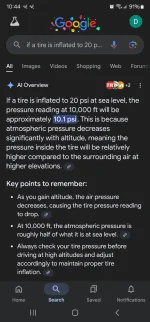
I am not going to claim that I am smarter than you, but I think I disagree with you. The spring in the Staun would behave exactly like the spring in a tire gauge. They are both measuring gauge pressure (PSIG) which is the difference between the absolute pressure (PSIA) in the tire and absolute atmospheric pressure. Absolute atmospheric pressure at sea level is about 14.7 PSIA and at 10,000 feet it is about 10.1 PSIA. If you set you pressure with a gauge or a Stauns at sea level then go to 10,000ft and check the pressure at the same temperature, it will read 4.6 PSI higher because the absolute pressure in the tire is the same but the atmospheric pressure went down. If you put the Stauns back on, they should drop 4.6 PSI out of the tires, but would still match the gauge.had to think through this for a second but it makes sense (at least to me) for this reason:
forces at play are Pressure inside tire, spring inside the stahn AND atmospheric pressure
Deflated Tire PSI = Stahn spring force + atmospheric psi
Since you didnt adjust your Stahns the spring force remained the same and therefore with a drop in atmospheric... the Deflated Tire PSI at the end should be lower.
Anyone SMRT'er than me... please weigh in if the above is not correct. I AM assuming the stahns use a simple spring to set the pressure.
you're correct but backwardsI am not going to claim that I am smarter than you, but I think I disagree with you. The spring in the Staun would behave exactly like the spring in a tire gauge. They are both measuring gauge pressure (PSIG) which is the difference between the absolute pressure (PSIA) in the tire and absolute atmospheric pressure. Absolute atmospheric pressure at sea level is about 14.7 PSIA and at 10,000 feet it is about 10.1 PSIA. If you set you pressure with a gauge or a Stauns at sea level then go to 10,000ft and check the pressure at the same temperature, it will read 4.6 PSI higher because the absolute pressure in the tire is the same but the atmospheric pressure went down. If you put the Stauns back on, they should drop 4.6 PSI out of the tires, but would still match the gauge.
Isn't that what I said?you're correct but backwards
the bleed off valves are set against outside ambient pressure.
setting at sea level the bleed-off valves have less ambient pressure pushing back at elevation, therefor more air is released to reach the set pressure balance.
Isn't that what I said?


Google is wrong. Have you ever had a shampoo bottle blow its lid open when you go up in elevation? It makes a mess. Have you seen how potato chip bags look in a store at 10k ft? They are all puffed up. You can even see this with water bottles in your Tremor as you go up and down mountains.so, google says a tire at 20psi at sea level will read 10.1 psi at 10k ft.
) shampoo bottle can't handle the expansion, doesnt mean the internal pressure increased. it means without the higher external pressure supporting the bottle, couldn't expand without bursting.
No, the air inside the tire does not know what the air on the outside is doing.I'm thinkin, internal pressure goes down at altitude because the external pressure is less.
Correct, the internal pressure is the same if the temperature is the same.just because your cheap(
Correct, internal pressure is the same, external pressure is lessit means without the higher external pressure supporting the bottle, couldn't expand without bursting.
No, volume is for all practical purposes exactly the same if the temperature is the same. Tires don't stretch like balloons.also, take a given volume of gas expanding the internal pressure would have to decrease because the same volume of gas is now expanded to a larger volume of space????