Slow starting and battery replacement leads to confusion...

Parksoffroad

Tremor Fiend
Joined
Mar 24, 2021
Messages
278
Reaction Points
549
Location
Sonoma County CA
Current Ride #1
2020 F-350
2020, 7.3, dual battery / alternator.

So for the last week or two I started to notice the truck starting slower and slower, not yet to the point where I thought oh no will it not start this time, but noticeably slower than normal. Came out on Monday morning and turned on one of my radios that has a voltage gauge and its sitting below 12v, something like 11.68. Open the hood, the drivers side battery the eye is dark, passenger side battery the eye is showing green. I figure that being 4 years old and hearing all the horror stories about the factory batteries that the drivers side one must be going bad, and its pulling the passenger side down as they try to equalize when the truck is off.

So, get two new batteries and go to change them tonight. I make note of the voltage before I disconnect the drivers side, thinking that it will go up when the "load" of the dying battery is removed from the good battery, but when I disconnect it the voltage actually goes down. I replace the drivers side battery first, then move on to the passenger side. The passenger side battery looks like there is some moisture on the top, like it leaked out a little bit but not too much, otherwise visually everything looks fine before I take it out. When I remove the positive lead there is a pretty good amount of corrosion inside the battery clamp that was not really visible before it was taken apart, this post is on the half of the battery with the moisture on it.

Clean up the battery clamp really good, install second battery and spray all of the posts with the anti-corrosion spray.

With both factory batteries both out and in the garage now they are both reading around 12.5 volts.

So what the heck is going on? Could the corrosion cause what was happening? How does corrosion on the passenger battery make the drivers look low and drag the whole system down?

I have a dash cam that is always powered, it connects to the drivers side battery. My understanding is that both batteries are linked together like one big battery so if that is correct it would technically be powered by both at the same time, so it would not just be draining the drivers side although the amount of power is uses must be quite small. Nothing else it powered when the truck is off and parked.
If you got 4 years from OEM batteries, you need to get a lottery ticket!! So how are the new batteries? Did you replace with AGM'S,,?
 
2020, 7.3, dual battery / alternator.

So for the last week or two I started to notice the truck starting slower and slower, not yet to the point where I thought oh no will it not start this time, but noticeably slower than normal. Came out on Monday morning and turned on one of my radios that has a voltage gauge and its sitting below 12v, something like 11.68. Open the hood, the drivers side battery the eye is dark, passenger side battery the eye is showing green. I figure that being 4 years old and hearing all the horror stories about the factory batteries that the drivers side one must be going bad, and its pulling the passenger side down as they try to equalize when the truck is off.

So, get two new batteries and go to change them tonight. I make note of the voltage before I disconnect the drivers side, thinking that it will go up when the "load" of the dying battery is removed from the good battery, but when I disconnect it the voltage actually goes down. I replace the drivers side battery first, then move on to the passenger side. The passenger side battery looks like there is some moisture on the top, like it leaked out a little bit but not too much, otherwise visually everything looks fine before I take it out. When I remove the positive lead there is a pretty good amount of corrosion inside the battery clamp that was not really visible before it was taken apart, this post is on the half of the battery with the moisture on it.

Clean up the battery clamp really good, install second battery and spray all of the posts with the anti-corrosion spray.

With both factory batteries both out and in the garage now they are both reading around 12.5 volts.

So what the heck is going on? Could the corrosion cause what was happening? How does corrosion on the passenger battery make the drivers look low and drag the whole system down?

I have a dash cam that is always powered, it connects to the drivers side battery. My understanding is that both batteries are linked together like one big battery so if that is correct it would technically be powered by both at the same time, so it would not just be draining the drivers side although the amount of power is uses must be quite small. Nothing else it powered when the truck is off and parked.
Variables everywhere. There are several assumptions that could make this scenario happen. Yes, the corrosion can cause false voltage measurements due to several factors. If you measured while the batteries were in the vehicle and they both had a bad state of charge, then yes, both will measure low, depending on where you made the connection to the meter, and the current state of charge.

Without trying to figure out how you made the measurements, I'll explain why the corrosion can cause a false reading. The corrosion can be considered a "resistor" in series with the battery and the load. If a load is put on past the corrosion point, (any load in the truck) the voltage will have some drop across the corrosive area. This may result in a lower than real voltage measured near the load, due to the drop. (Voltage in a series resistance circuit will have a total drop across all resistance points, each point of drop determined by the current, which remains constant in a series circuit.)

So, if the corrosion is part of the circuit, then removed and measured direct without a load, the battery voltage will be the actual float voltage while not loaded. It will read higher.

The reason both batteries measured low in the truck is because they are parallel in the circuit, both supplying current for the load. Once one voltage source is removed, the battery remaining may indicate a drop, because the current supply just dropped. The battery is not a "load" on the other battery, it's all about current and voltage drops in the load.

Even though the battery measured 12.5 Volts, it does not tell you the capacity. A slight load can cause it to drop considerably depending on the state of charge. Generally, if the corrosion was present on one or both batteries, they were likely never charging properly. Still, a battery that's 4 years old is on the brink of failure anyway.
 
If you got 4 years from OEM batteries, you need to get a lottery ticket!! So how are the new batteries? Did you replace with AGM'S,,?
Coming up on that milestone here, the truck has a build date of 01/06/21. Getting kind nervous, seems like the truck goes into deep sleep mode faster than it use to.
 
If you got 4 years from OEM batteries, you need to get a lottery ticket!! So how are the new batteries? Did you replace with AGM'S,,?
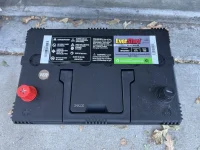
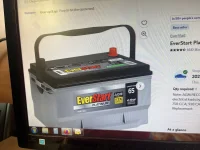
From what I have read around here I think I did OK, they may still be good and if they are they may find themselves hooked up to a solar array yet! I went with this walmart AGM. The actual batteries say 775cca vs the 750 the ad says, but they have 4 year free replacement and were pretty reasonably priced. Guess I will find out how they do!
 

Attachments

  • IMG_2526.webp
    IMG_2526.webp
    324.7 KB · Views: 53
  • IMG_2519.webp
    IMG_2519.webp
    374.1 KB · Views: 52
  • IMG_2518.webp
    IMG_2518.webp
    302.7 KB · Views: 52
Variables everywhere. There are several assumptions that could make this scenario happen. Yes, the corrosion can cause false voltage measurements due to several factors. If you measured while the batteries were in the vehicle and they both had a bad state of charge, then yes, both will measure low, depending on where you made the connection to the meter, and the current state of charge.

Without trying to figure out how you made the measurements, I'll explain why the corrosion can cause a false reading. The corrosion can be considered a "resistor" in series with the battery and the load. If a load is put on past the corrosion point, (any load in the truck) the voltage will have some drop across the corrosive area. This may result in a lower than real voltage measured near the load, due to the drop. (Voltage in a series resistance circuit will have a total drop across all resistance points, each point of drop determined by the current, which remains constant in a series circuit.)

So, if the corrosion is part of the circuit, then removed and measured direct without a load, the battery voltage will be the actual float voltage while not loaded. It will read higher.

The reason both batteries measured low in the truck is because they are parallel in the circuit, both supplying current for the load. Once one voltage source is removed, the battery remaining may indicate a drop, because the current supply just dropped. The battery is not a "load" on the other battery, it's all about current and voltage drops in the load.

Even though the battery measured 12.5 Volts, it does not tell you the capacity. A slight load can cause it to drop considerably depending on the state of charge. Generally, if the corrosion was present on one or both batteries, they were likely never charging properly. Still, a battery that's 4 years old is on the brink of failure anyway.
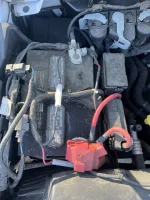
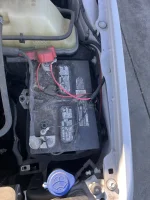
So maybe I will take that one terminal back apart in the very near future and clean it again with water/baking soda and brush it again. Did a really thorough brushing the first time, but the liquid bath should get all the little nooks and crannys. Will play with the old batteries maybe next week and see what they do, if they seem good will repurpose them with some solar panels and get some more use out of them!
 
These were the old batteries.
 

Attachments

  • IMG_2525.webp
    IMG_2525.webp
    282.3 KB · Views: 68
  • IMG_2524.webp
    IMG_2524.webp
    205.7 KB · Views: 66
You guys are making me nervous! My original batteries are coming up on 4 years. No corrosion or anything. It sat for 2 weeks not too long ago when I was on vacation and fired right up when I got home no problem. I never received a deep sleep warning from the FordPass app or anything but the app has been trash lately! (What happened to having access to a digital copy of the manual through the app?) I have noticed on my Banks iDash the battery voltage is at 14 volts. Shouldn’t it be a little higher like 14.6 volts?
 
You guys are making me nervous! My original batteries are coming up on 4 years. No corrosion or anything. It sat for 2 weeks not too long ago when I was on vacation and fired right up when I got home no problem. I never received a deep sleep warning from the FordPass app or anything but the app has been trash lately! (What happened to having access to a digital copy of the manual through the app?) I have noticed on my Banks iDash the battery voltage is at 14 volts. Shouldn’t it be a little higher like 14.6 volts?
Batteries can be unpredictable as to whether they will go bad or not over any given time and conditions. I had one of my original batteries start leaking in less than a year. The other one did not leak at all. However, when I replaced them with the AGMs, no problems at all. (Going on around a year now.)

The voltage monitor may be a source of inaccuracies as well, depending on where it hooks up. Typical voltage while running right after startup is around 14.2-14.6. This can drop depending on the state of charge, all monitored and controlled trough a computer. 14 volts isn't necessarily bad, but as I pointed out, a little lower than what I'm used to seeing. It could be the battery is at a good state of charge and not being charged at the time you looked at it. Personally, I would use a digital voltmeter to make the measurement (I use Fluke meters solely for the accuracy) and see if the Banks agrees with it. You don't have to use Fluke; any good voltmeter will do.
 
When the engine is running in steady state, the voltage is controlled by the charging system and has nothing to do with the condition of the batteries. If the batteries are deeply discharged, the voltage may be a little low until the charging system has a chance to charge them and therefore reach steady state. This could take 15 minutes of running, but after that the voltage has nothing to do with the condition of the batteries. The charging system sets the voltage when the engine is running, not the batteries.
 
I wonder if the trailer system sets different voltage output. I was getting 13.3 through the 5th wheel plug but 14.1 on the monitor and at the battery.
 
I wonder if the trailer system sets different voltage output. I was getting 13.3 through the 5th wheel plug but 14.1 on the monitor and at the battery.
Leads to more questions; do you have a regulator between the truck and trailer? If so, it could be the "desired" voltage for the trailer based on the regulators set output, also may be adjustable, depending on the type of regulator.

If no regulator, then the "load" in the trailer can cause the voltage to drop over the wires. Just as described in the corrosion description, the wires have resistance. And the voltage drop across them will be determined by the wire resistance and the current required to run that load. Ex: Refrigerator in the trailer, lights on the trailer, etc.
 
You guys are making me nervous! My original batteries are coming up on 4 years. No corrosion or anything. It sat for 2 weeks not too long ago when I was on vacation and fired right up when I got home no problem. I never received a deep sleep warning from the FordPass app or anything but the app has been trash lately! (What happened to having access to a digital copy of the manual through the app?) I have noticed on my Banks iDash the battery voltage is at 14 volts. Shouldn’t it be a little higher like 14.6 volts?
You're doing good when you get +4 years from batteries. But the end is coming, start setting aside some of that beer money and get you some AGM's. The prices on them has come down significantly.
 
Leads to more questions; do you have a regulator between the truck and trailer? If so, it could be the "desired" voltage for the trailer based on the regulators set output, also may be adjustable, depending on the type of regulator.

If no regulator, then the "load" in the trailer can cause the voltage to drop over the wires. Just as described in the corrosion description, the wires have resistance. And the voltage drop across them will be determined by the wire resistance and the current required to run that load. Ex: Refrigerator in the trailer, lights on the trailer, etc.
Only thing plugged in is a 5th wheel to cig adapter for my 80q cooler/fridge. Voltage wasn't that low a few weeks ago and it was even hotter outside.
 
Exactly. It's normal. This is not an indicator that the battery is bad. You have a definite load if the following is true:

The cooler will draw current. It will vary whether the compressor is running or not. The cooler has resistance. The wire has resistance. The plugs have resistance. Switches have resistance. The voltage is dropped across ALL resistance points. If the input is 14.1 (battery or voltage source is good) and the drop is to 13.3, and assuming you verified this with the same meter to eliminate meter accuracy, and assuming you have an average of 6 amps (equal to a 53-quart cooler), based on the voltage source at 14.1, then the resistance total is 2.35 ohms. Most of this will be the refrigerator itself. So, the calculation is approximately .8volt drop for the remaining resistance points. That equates to approximately .34 ohms in the run, about 2.01 ohms in the cooler, for a total of 2.35. 340 milliohms is very typical for a smaller gauge wire on a long run. There are more variables to consider getting an accurate measurement, but this is it in a nutshell.

For less drop in the run, use larger wire, check all connections, make sure you are monitoring with an accurate meter, and you're good to go.

It's normal.
Holy shit that's awesome. I love math.

I tested it again coming home. I still think BMS for the trailer is doing something potentially in combo with my adapter. The cooler voltage readout will show 14.1 v (or mirror my cts3monitor) while sitting there doing nothing plugged into the 5th wheel. Watched it for 10 min and stayed constant. As soon as I get in and start driving it'll drop down to 12.7-13v per the app (verified matches the readout on the lcd display at the cooler).

I even tried selecting no trailer and reconnecting the adapter (I programmed a midget trailer, like 3'x3' or whatever the smallest is so I don't get BLIS deactivation warning).

I'm going to get a 20amp cigarette to bed harness and run it direct of the battery for a perm solution later.
 
You're doing good when you get +4 years from batteries. But the end is coming, start setting aside some of that beer money and get you some AGM's. The prices on them has come down significantly.
Not sure what they cost today but a pair of AGM’s for my boat ended up being like $700 2 years ago
 
Not sure what they cost today but a pair of AGM’s for my boat ended up being like $700 2 years ago
I was shopping in SoCal about the same time and they would set me back over $900. It wasn't until one of the batts died that I looked again and bought at around $300 each. There are some models at $280.

 
Only thing plugged in is a 5th wheel to cig adapter for my 80q cooler/fridge. Voltage wasn't that low a few weeks ago and it was even hotter outside.
What adapter are you using? I tried to find one, the one I found on amazon would not work on the ford trucks.
 
Back
Top Bottom