Fuel Pump recalls - 2020-2022 Models

Honestly, I am not confident if Ford knows who is it and who isn't. They don't seem to be very sure of anything pertaining to the cp4 issues. The can of worms comment I believe is if an employee of Ford is releasing unauthorized information or information that at this point is proprietary it could unnecessarily expose Ford to litigation which l believe is going to happen no matter what.
Fair assumption. However, it's the same thing the Ford dealer told me after looking at my vin, so no trade secrets.
 
Fair assumption. However, it's the same thing the Ford dealer told me after looking at my vin, so no trade secrets.
To be brutally honest, this entire CP4 issue has been beat to death. Bottom line if you take care of your maintenance properly and don't introduce foreign substances into your fuel, 99% of us on this forum will be fine. I personally cannot remember a forum member who has experienced a cp4 failure that 🤔 couldn't be attributed to operator error. ( I'm confident that statement will be fact checked )

Some of us have gone forward with a DCR install, I personally have a DPK and if a cp4 failure were to occur i will do the DCR then, as I am confident the DPK will protect all fuel systems downstream. Debate continues......
 
To be brutally honest, this entire CP4 issue has been beat to death. Bottom line if you take care of your maintenance properly and don't introduce foreign substances into your fuel, 99% of us on this forum will be fine. I personally cannot remember a forum member who has experienced a cp4 failure that 🤔 couldn't be attributed to operator error. ( I'm confident that statement will be fact checked )

Some of us have gone forward with a DCR install, I personally have a DPK and if a cp4 failure were to occur i will do the DCR then, as I am confident the DPK will protect all fuel systems downstream. Debate continues......
100%
 
I have a DPK ready to be installed. If and once that cp4 fails I’ll go with the DCR. A local ford dealer told me that they have installed a DCR in place of a failed cp4, by customer request.
That great, not sure how they claim the part on a warranty claim.
 
Resurrecting this thread. My Ford Pass app now says there's a fix for this (maybe it's been there awhile and I never noticed). Has anyone taken theirs in? Am I late to the party and it was already discussed on another thread?
Screenshot_20260123_232425_FordPass.webp
 
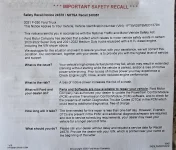
I didn't make it to the dealership due to the weather, I'll go on Monday. However, I received a letter in the mail today.
 

Attachments

  • 20260130_160420.webp
    20260130_160420.webp
    463.3 KB · Views: 46
Received my letter today as well. Curious as to what their fix is. Keep us updated.
 
Hmmm... looks to be the 6.7 solution. Wondering when the 7.3 will get some love.

There's this sayin'.....something like sitting in the corner with a pork chop tired around their neck. I can't recall how it goes specifically..... 🤣 🤣 🤣 🤣 🤣 🤣 :cool: :cool: 🇺🇲 🇺🇲 🇺🇲 🇺🇲
 
Just got my letter saying the parts and software are now available. It says they are updating PCM, TCM, and checking for DTCs. I am going to let this ride as I do not know how a program can fix hardware issue. I let others be the guinea pigs before I try it.
 
Just got my letter saying the parts and software are now available. It says they are updating PCM, TCM, and checking for DTCs. I am going to let this ride as I do not know how a program can fix hardware issue. I let others be the guinea pigs before I try it.
the only thing I can think is they are allowing more fuel to bypass by ramping up the supply (fuel tank pump) to add more flow and cooling to the cp4 or maybe reducing overall pressure from maximum 37k psi to something lower and less stressful. My money is by upping the flow to the cp4 and allowing the FMV to bypass more fuel.
 
My work truck is getting an oil change this Friday, I am going to ask the shop foreman who really helped my with my transmission issues and final replacement in my Tremor. Truck has really be running great, so I am just leery of messing with it.
 
I took it in on Monday. They said they could do it that day and they had one ahead of me. The service rep said it's an update, but Ford didn't say what parameters were changed. I got a call that afternoon and they said that after the tech did one truck in the morning he had issues with the software. Ford hadn't gotten back to them by that evening so I went and picked it up. I think I'm with you, Grabber, I have 120k miles and no issues. I'll wait and see if I'm dodging a bullet.
 
Since people are asking how PCM changes effect the fuel pump. I found this a bit ago, yes it's NOT about the 6.7L but the aspects of the info can show what happens with PCM changes.

This is copied from GDE, it does pertain to all GEN3 ecodiesel engines and might be useful for some.

The CP4 Bosch fuel pump has been in the field since 2008 model year with European OEMs in both 1-plunger (CP4.1) and 2-pluger (CP4.2) configurations. It came to the US market in the 2011 model year used by the North American OEMs. Over the years there have been many failures of this pump due to the plunger rotating in the bore leading to the roller bearing grinding on the cam lobe and sending metal throughout the system. The design of the roller-bearing and cam lobe create inertial force on the plunger to keep it in the proper alignment and it should never rotate if the roller wheel and cam always stay in contact. However, there are situations internal to the pump when there is not enough downforce on the plunger to keep it in contact with the cam lobe. This is the core issue of why these pumps can fail.

Now, let’s discuss the internal operation of the pump. There are three operating modes: MPROP control, PCV control (bleed valve on high pressure fuel rail) and coupled pressure control (CPC). The MPROP is Bosch’s name for the fuel metering inlet valve, this controls how much fuel is delivered to the plunger chamber. During MPROP closed loop control, the PCV is over-closed and MPROP delivers the proper fueling to achieve desired pressure in the fuel rails. This method has been used since 2001 on the CP3 pump and is robust. When the accelerator is released the MPROP closes to decrease flow and the PCV opens momentarily to relieve excess rail pressure as the requested pressure is decreased.

The next mode of operation is PCV control. Here the MPROP is fully open and delivering max fuel to the pump plunger and the PCV regulates the fuel rail pressure in closed loop control by closing only enough to reach the desired rail pressure. The downside to this mode is that the high volume of fuel that is pumped into the rail and then recirculated out thru the PCV consumes a lot of power inside the pump and also generates a higher amount of heat. OEMs generally use the PCV-only control method when fuel temps are cold, in order to heat up the fuel faster. This control strategy is also employed on the CP3 and CP1/CP1H pumps.

On high power-density small displacement applications it is necessary to size the high-pressure pump to meet the fuel flow requirements at rated power. On applications with solenoid injectors there is an additional margin that must be included, due to the constant leakage from the injectors thru the backflow line. However, these small displacement engines have a very low fuel rate at idle which means just a very small flow of fuel thru the metering unit given that the fuel rate is low and also the rail pressure is at its lowest point when idling.

With consideration given to component tolerance, sometimes it is not possible to govern properly via metering-unit only control the rail pressure at idle or when coasting with a max tolerance part. This happens because the metering unit at its very first opening position flows more fuel than is necessary to meet the required demand. In the days of the Bosch EDC16 controller several OEMs would make a switch back to the PCV mode at very low fuel rates including coasting, to let the metering unit be open into a more controllable area.

With the EDC17 era was possible also a new mode called CPC (Coupled Pressure Control). This mode allows to prescribe a desired value for both the metering unit flow and also the rail pressure controlled via the PCV valve, leading both actuators to be under closed loop control via PID-governors (proportial, integral, and derivative components). The purpose of this is to allow the metering unit to operate in a more controllable flow rate but not pay the penalty of power consumption and heat rejection by full PCV mode. You can think of this mode as the PCV one but with lower flow rate thru the metering unit.

The OE calibrations for the EcoDiesel 2014 thru the present (both Gen2 and Gen3) all use this CPC mode as part of their calibration strategy. If you rev the engine while parked with the hood open, as the engine speed comes back to idle is very common to hear a prominent noise akin to gravel in a rock crusher or to an engine with solid lifter camshaft that has an incorrect valve lash. This noise happens as the metering unit flow is varied (via CPC algorithm) thru the pump and generally lasts for a number of seconds, sometimes going away and other times persisting indefinitely.

We surmise that during this transition period of flow rate that the noise is generated by a clearance that forms between the roller wheel and the pump’s camshaft. During normal operation (with the factory calibration), the pump operates in MPROP mode generally when under load but constant makes the transition to the CPC mode in light load and coasting situations. During that transition the MPROP has to make a large change in delivery almost instantaneously, leading to a loss of motion control within the valvetrain of the pump.

In all Green Diesel Engineering tuning we turn off CPC mode for EcoDiesel applications (GEN2 and GEN3). This seems to have significantly reduced potential for the plunger to lift off the cam lobe. Due to a persistent backflow from the solenoid injectors to the tank we find it is not necessary to use the PCV mode for fuel heating. Thanks to additional learning functions inside the software we find it is 100% reliable to run in metering-unit only control in 100% of operation. This eliminates the pump noise you hear in light/no-load transitory operation and offers the least amount of energy to drive pump which aids in fuel economy. Minimizing pressure disturbances internally in CP4 is the best method to maximize fuel pump life and minimize a catastrophic failure.

GDE tunes exhibit a much lower failure rate in the field. The only failures of the fuel system we have heard about entail putting gasoline in the fuel tank, putting DEF in the fuel tank, high water content in diesel fuel or running the system out of fuel (pump loses lubrication).
 
Back
Top Bottom