DC to DC charger

I know very little about how electricity works but am trying to learn more.

Would it be able to supply a full (or close to it) 100a that the 1200w 120v inverter handles? If that's the case you could theoretically put 100a instead of 30a into the battery banks. That's a savings of 12.6 hrs to charge a 540a battery bank.
Bingo. Sounds like you understand it just fine. What's more is you can dial down the MultiPlus draw current to match your AC inverter in the truck. My Xantrex inverter/charger pulls max 8.5A@120V, which is why I was looking at 1000W AC inverters since they are smaller and cheaper. That's way more than 30A or even 50A over a DC cable.
 
Great discussion. @Raspy @Modman and @MrFancypants have great inputs in their discussion points. There is a tradeoff no matter which way you convert, and it will always require more energy, every time you convert. It just presents itself in a different form.

What is failing to be discussed is wattage. All energy can be converted to wattage for a neutral comparison. For example, 8.5A @ 120V is 1020 watts. 50A @ 12V is 600 watts. But here is the missing link in the discussion, overall system efficiency. Assuming 10% loss for every conversion, the max wattage out for an AC inverter with the above specs would be 918 watts. (However, [email protected] would be 1207 watts) To get the same wattage out of the trucks 12-volt system without any conversion, would be 76.5A. (Using 12 volts standard for comparison) To get that same power through a DC-DC converter would be (again, assuming 10% loss) is 84.15A. Now, throw in the efficiency of cable loss. If you run 84A through a long cable, the cable would have to be ginormous to reduce inherent loss due to resistance. However, if you run 120V through a long cable, the loss is minimal compared to the DC loss. (I=E/R where I is current, E (or V) is voltage, R is resistance of the wire. Watts is IXE.) But you pay for it with the conversion losses of the inverter/converters.

As I said earlier, it always takes more energy to produce less energy. The tradeoffs are usually cost of materials and efficiency of the converters. There is no free lunch.

A sine wave inverter for conversion generally requires more energy to run than a modified square wave inverter. Modified square wave converters can be cheaper, but the efficiency can be unbelievably inefficient, as high as 35 percent loss.

The output voltage of the sine converter is far superior to run sensitive devices. So, the tradeoff: cost of the inverter for better "device" efficiency with the sine inverter and cable expense. Don't forget, the AC conversion is actually DC to AC, then AC to DC to charge batteries. Twice the conversion loss of a DC-DC converter.

Always use the minimum number of converters and best wire for better efficiency in your setup.

A DC-to-DC converter is a necessity if you want to charge with the trucks 12V DC on a separate battery to maintain the charge within the designated specs by the battery manufacturer. (Especially true if running Lithium batteries) The tradeoff: heavier wire for better efficiency and minimum cable loss, cost of the wire, some loss in the converter requiring more current to be drawn than the total output. You would also require such a device for solar. (Voltage regulator)

Beware the marketing math associated with the sale of inverters/converters. They are typically marketed with unrealistic real-world specs. The questions should always be how many watts are required for your desired needs. This will then be the point where decisions are made for the type of system that best fits your setup. What's the efficiency of the converters, what kind of batteries are you using, how long do you intend to run the wires, will you have access to a generator, house voltage, shore power, and other connection issues that will be part of the equation.

If you are not familiar with all of the items discussed here, you should always consult with an installation/sales expert before making a decision on how you want to wire your trailer or toy hauler.

As always, hope this helps.
 
Great points Canyon Trekker.

One other point that seems to be lost in this discussion is the charging intent. It seems assumptions are being made that the only way to charge is at full amperage that exceeds any DC system of reasonable capacity. In my case, I am only using a 30 amp dc-dc charger. Pretty low output. It only needs about 450 watts, including 10% loss through conversion inefficiency. And the purpose of it is strictly to supplement the solar if and when needed, by charging when I am towing anyway. The important point here is "towing anyway". An example is the average miles covered per day on trips. Possibly 300 miles, for example, which means about six hours of charging time if needed, or 30 amps at about 13.5 volts = 405 watts for six hours, or 180 AH, if my numbers are correct. I plan to never run the truck just to charge the trailer batteries. And I have no intention of charging as fast as possible, which would be about 25% of the total AH of the house bank, or 275 amps. In the event of a solar failure, I can plug into shore power somewhere and charge up enough to last a week while I fix the solar, with the inverter/charger already in place, or the auxiliary charging system already in place that is designed to rescue the batteries from a low temp shutdown. So, the highest possible amperage through the charging wires supplying the dc-dc charger is about 450 watts, which is not a big factor and huge line losses are not present. I already have (2) #4 fine stranded conductors from the battery to the rear bumper, with a 60 amp breaker, and have used it on two previous trailers with great success. And any line losses there, are relatively meaningless because the truck is supplying the power and it is running wether or not charging is occurring. Remember, the truck is running anyway, not just to charge the batteries. Arguing that DC line losses are high, when we are only talking about less than 450 watts in a #4 fine stranded wire running about 35' total, seems ridiculous. Especially when supplied by a charging system capable of over 300 amps that is running anyway, wether charging or not. Assuming 50% efficiency of a modern alternator, supplying 450 watts, the load on the engine will be about 900 watts, or about 1.2 HP. Not enough to notice out of 435 available. Given all of that, simplicity looks more interesting than an extra inverter and repeated conversions from one voltage to another. And no huge welding cables are needed to combat DC line losses while trying to charge the batteries as fast as possible. Sometimes it is difficult to get to the bottom line on arguments made for certain methods being advocated. In my case, I am not interested in extremely high amperage and suffering huge line losses or designing a complicated system to compensate for a problem that doesn't exist. For me, being practical is always paramount. And that means matching the system to the intended use in the simplest way. My battery bank SOC is normally back to 100% by the end of the day, but if not, I can pump 30 amps into it while driving to my next destination and all I need is a Victron 30 amp dc-dc charger and an Anderson plug. OK, rant off. Thanks for wading through this lengthy post.
 
It was actually really helpful. I went back and read your earlier post about your setup and noticed you have over 1000Ah of LFP. You’ve clearly designed your system to cover each camp stop with solar and that big array and massive reserve means you can run at a deficit for several days.

Charging while driving makes a lot more sense for you, and is a totally different strategy than my system, which has a much smaller 200Ah reserve. I am looking for emergency short burst charging, which is rarely needed, and you’re looking to make use of “free power” wherever possible.
Thus, different strategies. Both valid. Neither one is wrong. So arguing that one is better than the other is ridiculous unless the intended purpose is made clear. Each one is appropriate in a certain situation. It's important to state the intended purpose before advocating one design over another, or pointing out a perceived weakness in the other based on assumptions.
 
It was actually really helpful. I went back and read your earlier post about your setup and noticed you have over 1000Ah of LFP. You’ve clearly designed your system to cover each camp stop with solar and that big array and massive reserve means you can run at a deficit for several days.

Charging while driving makes a lot more sense for you, and is a totally different strategy than my system, which has a much smaller 200Ah reserve. I am looking for emergency short burst charging, which is rarely needed, and you’re looking to make use of “free power” wherever possible.
When I got my Xplore X22 it had 380 watts of panels on the roof. But it could not even keep up with the fridge! I went up on the roof and just shook my head. I've seen the same types of problems on so many solar systems where the installer just doesn't understand the concept, or is careless. I eventually just tore the whole system off the roof and tossed it. Then installed 660 watts of solar and transformed the trailer into an off-grid trailer. It still had its limitations, but plugging in was not necessary, as long as a few compromises were made.

Even though solar is really a great thing, it is a limited power source. The best systems, the ones that perform, take every detail seriously. Every inefficiency, every problem or shortcoming is dealt with in some manner. For instance, I've had discussions with guys, trying to figure out why they did what they did, and finally began to realize they have no understanding of aperture angle, or even that the sun has to shine on the panels in order to produce power. Shading is not acceptable and even running wires over the collector galls me. My specialty is thermal systems, but applying the same strategies, goes a long way. One difference is the importance of keeping the collector temp as low as possible in thermal systems and understanding the difference between BTUs and temperature as a measure of output.

We are still in the dark ages with solar as it is often thought of politically. Some argue that solar is loved by folks that hate oil, or want the Country destroyed. I know one guy who spouts his opinion that anyone using solar should be forbidden from using oil. These opinions are so far from trying to understand how solar works and what it can do. The negativity sours the conversation and inhibits making solar more practical and available and efficient. Meanwhile many of us get it. Especially those with campers and battery powered equipment.
Excellent points about solar. I'm certainly not a solar hater, I love technology, electronics was my career for more than 50 years. I too hate the political assessment of solar replacing other forms of energy. With current technology, that's not possible but there are many research industries both on the generation and consumption reduction side, trying to overcome the shortcomings. Still by far the largest consumption of energy is in the form of heat generation. (As you mention above) Other energy sources are still viable and required to keep up with demand. They all have their place when required, all with tradeoffs for different reasons. Maybe someday, but not now.

Speaking of efficiency, I used to have a Xantrex automatic electronic switch to switch between my main and aux battery in my boat for charging. The problem was that even with an electronic switch, there is a loss. It would only switch to aux. when the charge side was higher than the load side. (About .2 volts sense) The issue came in that when the motor was shut off and main battery would fall lower than the aux battery, the switch would throw errors and had to be disconnected to recover. That became a pain, so I eliminated it and installed a manual switch. No loss.

So, I tried to wire this up in my old truck and had very similar issues. I also gave up on that and used a manual switch.

So in the Tremor, to avoid my truck batteries from draining if not turned on for a few days camping, I use the aux. battery in the back of my truck for camp lighting, accessory use, and minimum current draw devices that make the battery last several days without recharge. (Very few amenities, I can use it for a small heater but only lasts one night.) When I am done, I now run the truck, manually switch over to this battery and charge with the same internal system. I specifically chose another lead acid all-purpose battery over lithium to avoid the different charge rates required. (No DC-DC converter required) I also have an AC converter for using shore power instead to run accessories.
 
For me, being practical is always paramount. And that means matching the system to the intended use in the simplest way.
Totally agree. It is sometimes all too easy to get caught up in the possibilities that exist and way overshoot the functional requirement. That may be fine as long as you are doing it for the journey and have the money and time to burn. :p
It's important to state the intended purpose before advocating one design over another, or pointing out a perceived weakness in the other based on assumptions.
In my past life we were critically focused on getting the objective(s) correct and clearly stated at the beginning of the project. Sometimes this took much longer than initially expected. The time spent was worthwhile as we had a stable high level purpose to weigh all decisions against...

I've really enjoyed this thread and the ensuing conversations to understand how everyone is using their equipment for their own purpose. Very interesting!

A little more on how my decision materialized. At our current house, even though we have some acreage, we can't keep our TT on our property so we have it at a nearby storage lot. This is one of the reasons we are looking to move - get away from any HOA. To be honest, our streets are tight and it would be a bear to get it in and out, anyway. Our fridge is propane/AC and I'm not a believer in running the propane while traveling. I can appreciate the various opinions here, but am not looking to get into that debate. :)

As we develop our process for traveling one item became somewhat problematic - food and drink. If we had the ability to run our RV fridge on AC while traveling our process would look something like this:

1) Obtain groceries
2) Store in home fridge
3) Transfer to cooler for trip to RV storage
4) Transfer to RV fridge

Depending on the length of trip they could stay in the cooler until we get to our destination but at some point they would be moved to the RV.
With the Dometic which can run directly from the truck or AC, the process looks like this:

1) Obtain groceries
2) Store in Dometic (plugged into home AC)
3) Transfer to RV fridge at destination

So, because of our off-site storage, foregoing the other options actually makes for a simpler process. In fairness, there was an option that didn't require a purchase. Going to the RV ahead of time and cooling down the fridge and then turning it off for the trip. This takes a separate trip to the storage lot (really early) which I didn't like - although we did use that process once.

Sorry for the long winded explanation, but thought the added background would be consistent with the thread - at least as a counter to why I didn't go with a DC-DC charger!
 
I've enjoyed this thread too. It demonstrates how quality conversations require thought and assembly. And that quality comes from participants that are not on a soapbox or just repeating positions found elsewhere. It also demonstrates how there is more to solar than meets the eye at a casual glance. Thanks Modman for putting this site together.
 
Bingo. Sounds like you understand it just fine. What's more is you can dial down the MultiPlus draw current to match your AC inverter in the truck. My Xantrex inverter/charger pulls max 8.5A@120V, which is why I was looking at 1000W AC inverters since they are smaller and cheaper. That's way more than 30A or even 50A over a DC cable.
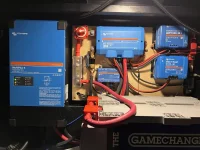
If I didn't already have the wire and most everything installed I would've gone this route. As it is, I am installing anderson connectors at the front and back of the truck anyways for my 12v ARB compressor and any jumping needs at worksites. I actually just finished the install last night. And in case you notice, yes I already know the Orion is wired wrong, just need to change it. That and wrap a couple more wire. Ok so it's not quite finished haha.

IMG_3819.webp
 
If I didn't already have the wire and most everything installed I would've gone this route. As it is, I am installing anderson connectors at the front and back of the truck anyways for my 12v ARB compressor and any jumping needs at worksites. I actually just finished the install last night. And in case you notice, yes I already know the Orion is wired wrong, just need to change it. That and wrap a couple more wire. Ok so it's not quite finished haha.

View attachment 127542
Looks like a very nice install. 👍
 

Latest Discussions

Back
Top Bottom