DC to DC charger

I'm not a guru at this stuff, but with a big honking alternator (and often two) mounted under the hood, why not hook up any "sump" batteries through an isolator and charge them off of the ac system. Wouldn't this be much more efficient and faster than charging through a dc/dc charger with its incumbent losses?

I have a similar setup for my auxiliary battery in my Land Rover. When truck is started, once voltage stabilizes both batteries are linked and charge as long as engine is running. IF I wish, at camp I can flip a switch and disconnect the auxiliary battery from the starting battery, or the isolator automatically disconnects them if the voltage falls below a certain threshold to protect the starting battery. My solar is also integrated into the setup to charge the auxiliary any time the sun is out.

This setup also gives the option to link both batteries any time for things like self-jump starting or winching.

Just a thought.

The AC system? Your alternators are DC unless you meant something else with AC? The DC-DC chargers are used like an isolator more or less but just boost the voltage to deal with line losses is all and/or provide proper stage charging for your battery.
 
That seems quite over priced vs DIY if you are mechanically inclined and have an intersest.
A reason I can think of to not run the power cable from an upfitter is wire gauge, even if you increase it from the harness back you've still got a smaller gauge in the harness, might as well run a dedicated wire of larger gauge. Just run an upfitter to the ignition input on the DC-DC charger to turn it on/off as desired or a relay, take your pick. Personally for boondocking use I whould have no need for a 40amp DC-DC charger, 99.99% of the time I'd drive more than enough in my wanderings for a 20amp charger to work for my uses/batteries. Unless you know you need 40amps (some do for larger battery banks or usage cases where they want to idle the truck to rapidly recharge) it seems overkill to me. You need to decide on which amp and how long the wire run will be before deciding on a wire gauge.
Makes sense on the upfitter wiring gauge! As far as price, the redarc 25 amp charger by itself is around $400 and the whole package with that charger is $730. So arouns $330 for the case, some 12v plugs, anderson connectors and it's already pre-wired. I could probably save a few bucks as a diy (or spend the same getting higher quality plugs) but not sure if is worth my time at that point unless I get bored and want a project to work on.

I'm leaning towards passenger side back of the bed to keep room around the trailer plug on the driver side. Front of the bed makes more sense for wiring but seems to defeat the purpose of portability.
 
Anybody hook up a dc to dc charger to their travel trailer. I was t looking at getting the Victron 30 amp or even 2 x 30 amps so I can charge going down the road. I already have a victron set up in the e trailer so it would not be to hard to integrate. Or even put a couple batteries under the bed cover and use them as a “sump” so I can get a charge while out for the day and hook up the bed batteries to the trailer at night?
I installed a dc-dc 30 amp Victron charger in my trailer to charge the trailer batteries from the truck. It is fed by an Anderson plug on the rear bumper with #6 wire running to one of the Tremor batteries and protected by a 60 amp breaker under the hood. This system is seldom used because I have 660 watts of solar on the trailer roof. My trailer is completely off-grid and we camp without hookups.

The reason a dc-dc charger is needed , as opposed to plugging i directly, is because of using Lithium batteries that do not need a float charge and do not want a charge voltage higher than 14.4 or 14.6. If you are using lead acid batteries in the trailer, you can eliminate the dc-dc charger and just plug into the truck's Anderson plug. The only downside to this is that it needs to be unplugged when not charging, or have a solenoid disconnect. Trying to charge with the conventional seven pin hot is a waste of time. An Anderson plug will supply approximately 25-50 amps when hooked up directly.

For a couple of years I was using (4) 100 AH lead-acid AGM batteries, that I plugged straight into the Anderson on my Ram. It worked perfectly. Now, with a new trailer with (4) 120 AH lithium batteries I added the dc-dc charger to the system. But since the solar is so powerful, I usually don't plug in the Anderson plug unless I want to charge at night. If you have a system like this, try to use a Victron solar controller as well as a Victron dc-dc charger, this way they can communicate with each other and not compete. With different brands of equipment, that cannot communicate, one will see the voltage from the other and interpret it as fully charged, then go into float mode.

The Anderson style plug and charging wire is common on Australian trailers and is a wonderful system. Once installed, that plug can also be used for other purposes, such as a 12V air compressor or even a winch. The Victron dc-dc chrger is very easy to install. Two wire in, from the power source, and two wires out to the battery. It senses voltage to know when the truck is running and turn on. No control wire needed.

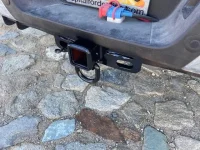
Here's a link to a video that shows the Anderson Charging wire near the beginning of the video, and a picture of the plug on my Tremor. A added this to my Xplore X22, but it is also standard equipment on Black Series trailers


Attachments

  • 1-1 copy 2.webp
    1-1 copy 2.webp
    99.4 KB · Views: 69
I've been researching adding a dc to dc charger/battery box combo in my bed. If anyone has some advice/other things to consider I'd appreciate it!

I'm looking at this prefabbed battery box


with the dc to dc charger and adding a LiFePo4 battery. Maybe not at this point but adding an inverter to it as well.

Main questions are:
- is there any reason to not run the cable from upfitter switch 5 or 6 to the dc/dc charger? I've read a lot about straight off the battery with fuse and relay but it would seem easier off the upfitter (plus I need to use at least one of them to feel cool)
- is the redarc 40 amp dc/dc too much for the 40 amp upfitter?
- what gauge wire would be recommended if I'm wanting to run the wire to the back of the bed?
- any recommending paths for wiring with ease of actually getting power in the bed and not looking hack? (Bonus points if I don't have to put any holes in the truck)

I'm open to suggestions and it's definitely a want not a need at this point. Would like to run an iceco portable dual zone off this system as well as general boondocking use.

Also not trying to hijack this thread at all - but it's recent with a lot of input from you guys that have done similar things so I figured I'd give it a try!

Thanks in advance!
-Randy
I prefer to run the charging wires straight from the battery. You can have a larger draw than from the up fitter system and you don't need a switch on the Anderson plug to run the dc-dc charger.

A 40 amp charger on a 40 amp circuit is not a good idea. My 30 amp dc-dc charger recommended a 60 amp breaker. The rating on the charger is output, not input and its efficiency tops out around 90%. It can also handle surge loads, I think, but not sure how much. The breaker must be large enough to handle the maximum load.

For a 40 amp charger, you could run #6 wires, but #4 marine romex is the absolute best. And the #4 would handle a larger load if you wanted to run a small winch or large 12V compressor. Also, the 40 amp upfitter system will not handle larger loads. Use the upfitter system for other things than the Anderson. You can look up wire ampacity easily and find a chart. The length of the wire on a Tremor will be about 30' times 2 for two conductors.

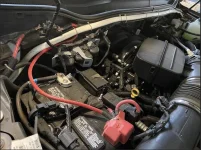
I connected to the primary battery on the passenger side of the truck. Then ran the wire across just under the hood at the top of the firewall, then down and along the frame, tied to another wiring loom from Ford. Then over the spare tire and out onto the bumper near the license plate. See my other post for a pic.
 
Nice video, love nerding out on campers. For off road I like the pop up truck campers more so (welding up an aluminum frame right now... slowly haha) cause anywhere the truck goes it can go basically and you can turn around on a road, etc. But I know the value of a trailer for unhitching and having some more space. I have a trailer as well for family stuff but needs to be a little longer with bunks for the kids, I still drag it up forest roads but can't nearly get the places yours can. So fun to mod them!
 
Not to change the subject but... @Frazior how'd you mount that breaker? The Dirt Church ARB compressor mount uses a similar breaker but they call for it to be taped to the top of the battery.
Here is a picture of my breaker on my Anderson system. It is mounted with screws to a flat spot on the firewall and a short jumper runs to it from the plus terminal on the battery. "Taped to the top of the battery"? NO WAY. Don't "tape" the breaker on, as a mounting system! Heat and vibration are not friends of tape. Electrical connections must be secure to be safe and reliable. Sheesh.
 

Attachments

  • Anderson breaker.webp
    Anderson breaker.webp
    180.5 KB · Views: 131
The AC system? Your alternators are DC unless you meant something else with AC? The DC-DC chargers are used like an isolator more or less but just boost the voltage to deal with line losses is all and/or provide proper stage charging for your battery.
The alternator. Which produces alternating current which is the converted to dc.
 
The alternator. Which produces alternating current which is the converted to dc.
But it does that internally so its all DC on the user side of things. Or am I missing what you were suggesting?
 
Here is a picture of my breaker on my Anderson system. It is mounted with screws to a flat spot on the firewall and a short jumper runs to it from the plus terminal on the battery. "Taped to the top of the battery"? NO WAY. Don't "tape" the breaker on, as a mounting system! Heat and vibration are not friends of tape. Electrical connections must be secure to be safe and reliable. Sheesh.
Thanks! And yeah, I wasn't keen on taping it to anything, especially the top of a battery that gets replaced every so often.
 
Last edited:
The alternator output is DC. It has internal diodes that convert AC into DC. The Anderson wires are not connected to the alternator, they are connected to the truck battery. The battery only sees regulated DC current, and that current is programmed to act as a smart charging program.

The dc-dc charger is a battery charger that can take lower voltage, if needed, caused by line losses, and convert it to higher voltage, as needed, for charging batteries. It also is a multi-step charger that properly manages battery charging. It can also be programmed to charge lithium or lead acid. And in the case of the Victron brand, can also be a battery disconnect to protect the truck batteries, without running a separate wire or installing a relay. This is done by it measuring the voltage to determine if the engine is running or not. A charging program is especially important for lithium batteries and is not the same as for lead acid batteries. Lithiums must have a voltage of no higher than 14.6 volts, and they do not need a float charge once charged, so they are not perfectly compatible with lead acid charging programs as in our Tremor charging systems. Use the dc-dc charger with lithium batteries. The dc-dc charger should be placed in the trailer near the batteries.

If charging lead acid batteries, no dc-dc charger is needed, except to act as a disconnect when the truck is not running. In this case, #4 wire size is best and the trailer batteries will charge properly from the truck's charging system. But you can use the dc-dc charger if you want to. Just plug in the Anderson plug every time you hook up, and all the time while towing. Either unplug at camp, or install a relay controlled by the "key" circuit to act as a disconnect. With mine, I never unplugged the Anderson on my trips unless we were staying for more than one night. I had no automatic disconnect. Then I went to lithiums and installed a dc-dc charger.
 
But it does that internally so its all DC on the user side of things. Or am I missing what you were suggesting?

At a base level, I'm just suggesting why spend hundreds on a dc/dc charger when you could spend a hundred or less on a switchable isolator and accomplish the same thing with equipment already on the truck.

Without looking it up, I would be willing to be the alternator(s) on the truck will charge any battery at a higher amperage level than a dc/dc as well.

Not trying to be a snot, as I said, I'm far from a guru, so somebody educate me if I need it.
As I said some before and rapsy said: provides a disconnect that can make up for line losses and stage charging depending on battery type. DC - DC charges don't have to be hundreds but you get what you pay for including isolators, so of those also get expensive. At the end of the day multiple ways to skin the cat. :)
 
At a base level, I'm just suggesting why spend hundreds on a dc/dc charger when you could spend a hundred or less on a switchable isolator and accomplish the same thing with equipment already on the truck.

Without looking it up, I would be willing to be the alternator(s) on the truck will charge any battery at a higher amperage level than a dc/dc as well.

Not trying to be a snot, as I said, I'm far from a guru, so somebody educate me if I need it.
On older trucks and using lead acid batteries, you can do this. It's very old school.
But you have to be careful not to 'reconnect' a mostly dead battery to a charged battery.
That will cause high current flow and can damage things.

Current truck are more advanced, we have smart alternators that output variable voltage.
And they aren't designed to charge LiFePO4 batteries directly. Which are a better choice for rv/tt/camper.
You need a DC-DC charger to do that. It limits current and adjusts voltage.
$200 is cheap for all the problems it handles and solves.
 
At a base level, I'm just suggesting why spend hundreds on a dc/dc charger when you could spend a hundred or less on a switchable isolator and accomplish the same thing with equipment already on the truck.

Without looking it up, I would be willing to be the alternator(s) on the truck will charge any battery at a higher amperage level than a dc/dc as well.

Not trying to be a snot, as I said, I'm far from a guru, so somebody educate me if I need it.
Please read my earlier post. The dc-dc charger is not needed for lead acid, but it is needed for lithium because lithium batteries need a different charging program than the truck has.

The truck alternator is being controlled as a smart charger for lead acid starting batteies and the alternator will not charge "any battery" properly. Lithium is different and modern trucks don't use simple voltage regulators as they used to.
 
Does anyone know the max amps the stock Ford wiring in the 7-pin puts out? With 190watts of solar and driving, the DC fridge still slowly drains the RV batteries. I'm likely going to run a dedicated charging cable like you guys have done here.
 
Does anyone know the max amps the stock Ford wiring in the 7-pin puts out? With 190watts of solar and driving, the DC fridge still slowly drains the RV batteries. I'm likely going to run a dedicated charging cable like you guys have done here.
The charging wire in the seven pin will never be very satisfactory. I don't know its actual rating, but the wire is small and likely not more than 15 amps. If you instal an Anderson plug with #4 or # 6 wire from the battery directly, through a marine 60 amp breaker, you can install a 30 Amp Victron dc-dc charger in the RV and get a charge tuned for either lithium or lead acid batteries with a bulk rate of 30 amps. The Victron is voltage sensing, so you don't need a switched wire to turn it on and off. Or, if you are using flooded lead acid batts or AGM batts, you can connect the Anderson system directly to you batteries without the dc-dc charger, charge directly from the truck system, and plan to unplug it if you are camping for more than just overnight. I ran mine this way for a couple of years and it worked great. Very simple and worked very well. Then I went to lithium and added the dc-dc charger to manage them and again, it works flawlessly. On the trailer side, the Anderson plug that plugs into the Anderson plug on the back bumper of the truck, has a set of #4 or #6 wires that go directly to the house battery in the trailer. The best style of wire to do this with is Marine, fine stranded and tinned, two conductor romex. On a Tremor, it takes about 32' of wire for the truck, and then however much for the trailer. You can get lengths of this wire, the plugs, and the marine style breakers on Amazom. It is an excellent upgrade to the truck and trailer, and the plug on the rear bumper can also be used for an electric jack, air compressor or other accessories.
 
At a base level, I'm just suggesting why spend hundreds on a dc/dc charger when you could spend a hundred or less on a switchable isolator and accomplish the same thing with equipment already on the truck.

Without looking it up, I would be willing to be the alternator(s) on the truck will charge any battery at a higher amperage level than a dc/dc as well.

Not trying to be a snot, as I said, I'm far from a guru, so somebody educate me if I need it.
100% agree with this, believe you could charge a lithium battery with the alternators direct and they be okay. When the voltage gets too high the internal BMS will shut them off not the best but would work in a pinch. This was my idea too as my Lithium’s are mainly solar, but I wanted the ability to run a set of jumper cables to charge them if it wasn’t sunny for 10 days.


The issue I was told however from the friends that did it are the lithium batteries low internal resistance. This means that 400Ah of batteries would draw at 1C placing 400A of current on the alternator overheating it in 30 min at cruise speed even quicker at idle. The reduced draw of the DC-DC inverters saves your alternators by killing your wallet. Was bummed to hear alternator could overheat at capacity.
 
At a base level, I'm just suggesting why spend hundreds on a dc/dc charger when you could spend a hundred or less on a switchable isolator and accomplish the same thing with equipment already on the truck.

Without looking it up, I would be willing to be the alternator(s) on the truck will charge any battery at a higher amperage level than a dc/dc as well.

Not trying to be a snot, as I said, I'm far from a guru, so somebody educate me if I need it.
You can charge AGM or flooded batteries directly, but Lithiums have a different charging profile than the truck charging system. With lead acid, you don't even need an isolator because you can simply unplug the Anderson plug to disconnect. The charge rate if hooked up directly, with #4 wire will be somewhere around 30 amps. I've measured 24 doing it this way.
 
Back
Top Bottom