Anderson connectors

Thanks for this, yeah, I did notice the nomenclature said "two terminal" but the part number shows the three terminal. Appreciate the clarification.
I noticed the website was not the friendliest.

If I have to call to place an order; I am looking elsewhere.
Read this from Mouser, on the same page.

L2dcnFZ.png


For the inverter, it's what the manufacturer calls for, specifying 2/0 for up to a certain length, and my length from the battery to the backseat far exceeds that, so I went up one size.
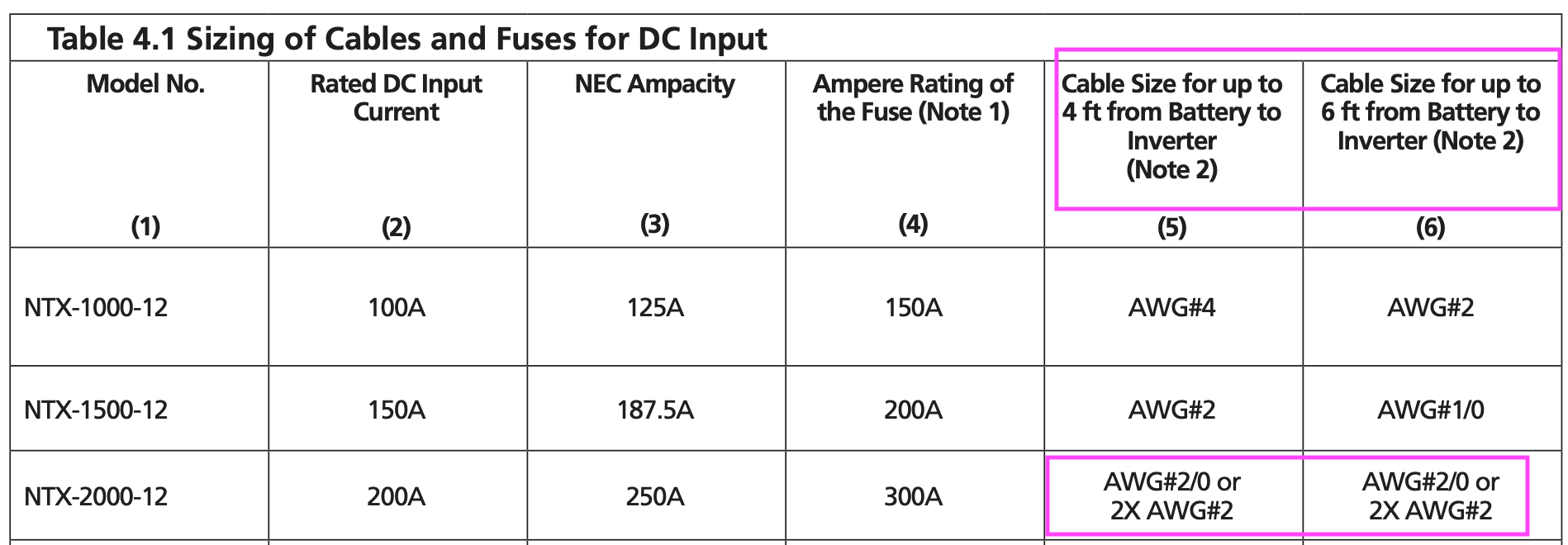
bv32TcM.png
So according to this, I'd need 4/0?

Here I thought 0 awg was more than plenty.
 
I noticed the website was not the friendliest.

If I have to call to place an order; I am looking elsewhere.

So according to this, I'd need 4/0?

Here I thought 0 awg was more than plenty.

It depends. Amps vs gauge is not a fix thing.

1. Higher wire count is better. The same gauge wire could have a wire count of 700 or 1200 or anything in between. More wires count will carry more current.
2. The insulator is critical. They come in like 75c, 90c, 120c temp rating. The 120c rated wire will carry a lot more current safely.
3. Pure copper is far better than CCA (copper clad aluminum). Pure copper will carry more current than CCA.
4. Intermittent vs continuous. You can get away with smaller wire with intermittent use vs continuous. This gets back to item 2 (temp).
5. Wire length. You need larger wire for longer runs. 20 ft is a lot different from 4 ft.

My opinion is to get GOOD wire for things like this. It is going to be expensive. But it's worth it, it just works better and it's safer. And sometimes it will allow you to use a smaller gauge and working with large cables can suck.

My winch on the front of my truck is wired with good 1/0 wire, but it's only 4 ft long.
If I was running wire to the back of my truck 20 ft, I'd be using 3/0.
Your experience will vary greatly.
There is so much to know and so little time on earth - ha!


This is what I went: absolute 0ga (.37 ) DCCA Copper Wire rated at 900 AMPS

The primary run turned out to be about 24'+/-

It won't be used on a daily basis but when it is used, it can be for a good 2-3 hours of continous use.

What worries me the greatest is use when it's 110F+ outside, which in this desert, we've had 2 months of it non-stop.

I did measure the wattage draw of the jack hammer pictured above, it was about 1,400+/- watts during impact.

I should have check in with you guys before I tackled this last weekend - darn.

DCCA is copper clad aluminum. CCA is only about 63% capacity of pure copper.
And I hate to say it, but there is no way that will carry 900 amps at 30 ft. That's just pure marketing BS.

How much will it carry, hard to say. If it's under 200 amps, you'd probably be fine.
Will it work for your jack hammer, probably.
1400 watts / 12 volts * 85% efficiency, so about 140 amps.

Personally, I'd fine some pure copper wire in 1/0 and you'd be good to about 280 amps.
Last time I looked a 25 ft set of red/black 1/0 copper wire was about $220. That was just the plain wire.
It's a bit of getting what you pay for.
 
Last edited:
DCCA is copper clad aluminum. CCA is only about 63% capacity of pure copper.
And I hate to say it, but there is no way that will carry 900 amps at 30 ft. That's just pure marketing BS.

How much will it carry, hard to say. If it's under 200 amps, you'd probably be fine.
Will it work for your jack hammer, probably.
1400 watts / 12 volts * 85% efficiency, so about 140 amps.

Personally, I'd fine some pure copper wire in 1/0 and you'd be good to about 280 amps.
Last time I looked a 25 ft set of red/black 1/0 copper wire was about $220. That was just the plain wire.
It's a bit of getting what you pay for.
You've given some excellent advice here and previous. One more thing to watch, connections. Make sure you have solid connections and keep the terminal the same size as the stud for maximum contact. Avoid stacking connectors if you have the option. I've seen many failures due to a connection, not necessarily the wire size.
 
I ordered them from Amazon.


You can slide the cable from the driver side battery, through the inside of the front fender well, then follow an exisiting harness that follows the the chasis.

Picture is below the front driver seat looking to the front of the vehicle.

View attachment 165546


Along the frame rail looking to the back of the vehicle:

View attachment 165549


Once you get the rear fender well, go over it (through the inside of the body) and it should come out as pictured in the first post, third picture.

This was the easiest part of the entire wiring process.
Well done!
 
At this point in the game, what do you all think I should do? Pull the cable to run new cable, run a new line, or keep it and just use it with caution?

Time is more of an issue than money.
 
At this point in the game, what do you all think I should do? Pull the cable to run new cable, run a new line, or keep it and just use it with caution?

Time is more of an issue than money.
It all comes down to how you are going to use it right now. With what you have, you could probably run most tools without issue. The suggestions are merely to help you make the decisions necessary for maximum efficiency and remove as many potential issues as possible. It sounds like you already have it working and you were just trying to get a second opinion. I like what you did, only changes you may consider is wire size but that would be a major time sync to re-do.

I'm of the opinion to use what you have with caution, watch the wires and especially connection points for heat. If anything gets "warm", the cable or the connector is not sufficient for the job. You could also get an inexpensive current probe and measure the current you are drawing. That will give you a good idea if you need to upgrade.

This is sound advice (be careful, meter your amps, etc) but i would add ONE thing to it... do some rough calcs and see what the 'max' amps you can run on your existing wires based on the calcs. Then... add a fuse thats the same amount or maybe just above it. Then go about your day. Make sure to have plenty of fuses.

If you blow that fuse then you know you're pulling more amps. You could keep going up in fuses as you blow them (yes a MAJOR inconvenience when you just need to get crap done) but the whole purpose here is to NOT let the smoke outta the wires.
Letting the smoke outta 0gauge might put on more of a show than you want to watch.

***i am just smart enough to know that there is a LOT that i dont know about electricity. One of the things I have learned is that when you do your calcs... some calculators assume the 'length' you tell them is ONE WAY... some assume its Total run. This makes a massive difference in the correct results. Please make sure to pay attention to this.
 
@AZsurveyor if you do look at buying additional wire... i am a big fan of Ancor marine grade wire (they are owned/own BlueSea). You can get it on Amazon (check the prices though, i've found that certain colors will be cheaper than others)
It might be overkill but wiring is one thing I want to do once. Therefore, it needs to be done right the first time.

Its 100% copper wire so you get the full send capabilities plus the corrosion resistance from it being tinned.
 
This is sound advice (be careful, meter your amps, etc) but i would add ONE thing to it... do some rough calcs and see what the 'max' amps you can run on your existing wires based on the calcs. Then... add a fuse thats the same amount or maybe just above it. Then go about your day. Make sure to have plenty of fuses.

If you blow that fuse then you know you're pulling more amps. You could keep going up in fuses as you blow them (yes a MAJOR inconvenience when you just need to get crap done) but the whole purpose here is to NOT let the smoke outta the wires.
Letting the smoke outta 0gauge might put on more of a show than you want to watch.

***i am just smart enough to know that there is a LOT that i dont know about electricity. One of the things I have learned is that when you do your calcs... some calculators assume the 'length' you tell them is ONE WAY... some assume its Total run. This makes a massive difference in the correct results. Please make sure to pay attention to this.

Very good advice from @Canyon Trekker & @OmahaBravo too.
At a minimum I'd fuse each run coming off the busbar.
Also wouldn't be a bad idea to add a disconnect between the battery and the bus bar to turn off everything, just in case.

I did that with a solenoid controlled from an upfitter switch. That way I can either flip the switch or shut the truck off and everything goes dead.
But you could go as simple as a manual disconnect. Cheap and effective.
 
@AZsurveyor if you do look at buying additional wire... i am a big fan of Ancor marine grade wire (they are owned/own BlueSea). You can get it on Amazon (check the prices though, i've found that certain colors will be cheaper than others)
It might be overkill but wiring is one thing I want to do once. Therefore, it needs to be done right the first time.

Its 100% copper wire so you get the full send capabilities plus the corrosion resistance from it being tinned.
Battery Cables USA is also a great source of good quality cable. Used exclusively in my 5th wheel battery bank and Victron setup.
 
Very good advice from @Canyon Trekker & @OmahaBravo too.
At a minimum I'd fuse each run coming off the busbar.
Also wouldn't be a bad idea to add a disconnect between the battery and the bus bar to turn off everything, just in case.

I did that with a solenoid controlled from an upfitter switch. That way I can either flip the switch or shut the truck off and everything goes dead.
But you could go as simple as a manual disconnect. Cheap and effective.
I dig the switch.

its got me thinking... if a guy adds an LVD (low voltage disconnect) in series with this switch idea of yours... he could get the benefits of the LVD and still maintain manual control of the whole circuit. #winning
 
Well after everything I have read and understood, I am going to punt until I decide how to finish this set up considering all suggestions given here.

First, I need to do some testing, as you all have kindly suggested and certainly some experimenting before I start to tear anything off.

I will add that regardless of the case, the set up won't be used on a daily basis and use can vary greatly. Obviously, it is used for when its needed to ease the labor intensive part of breaking apart asphalt, concrete, etc. This use can be of a few minutes or a few hours at a time in extreme cold or extreme heat. Typically before each job, I already have an idea of how much use it can get, if any.

Short of me going all out - the ideal set up would be simply to go with a generator but again, because it is something not used every day, it's not worth the hassle (then I have to carry a gas jug, oil, the generator itself, more room, etc) and I wanted to stick with central power of the rig.

Needless to say and as you guys have pointed out, the biggest factors here are length and continous use.

I'm bummed that we spent so much time doing this wiring but doing it again wouldn't be hard, like I said its all about time and we're at a good stopping point should I decide to rewire before moving further along.

The obvious answer is to go 4/0 and be on the safe side.

Can I get get away with 2/0? Perhaps.

The difference in price isn't much and certainly not worried about the price - more worried on cable flexibility and being able to snake it through and at that point, can the ports or connectors handle it? How about the engine batteries?

There's a lot of think about still.

I still have yet to use my rear portable winch - I would think this winch in continous use would draw more than the hammer itself.

Appreciate each and every one of your guy's knowledge, feedback, and criticism.
 
Last edited:
Well after everything I have read and understood, I am going to punt until I decide how to finish this set up consedering all suggestions given here.

First, I need to do some testing, as you all have kindly suggested and certainly some experimenting before I start to tear anything off.

I will add that regardless of the case, the set up won't be used on a daily basis and use can vary greatly. Obviously, it is used for when its needed to ease the labor intensive part of breaking apart asphalt, concrete, etc. This use can be of a few minutes or a few hours at a time in extreme cold or extreme heat. Typically before each job, I already have an idea of how much use it can get, if any.

Short of me going all out - the ideal set up would be simply to go with a generator but again, because it is something not used every day, it's not worth the hassle (then I have to carry a gas jug, oil, the generator itself, more room, etc) and I wanted to stick with central power of the rig.

Needless to say and as you guys have pointed out, the biggest factors here are length and continous use.

I'm bummed that we spent so much time doing this wiring but doing it again wouldn't be hard, like I said its all about time and we're at a good stopping point should I decide to rewire before moving further along.

The obvious answer is to go 4/0 and be on the safe side.

Can I get get away with 2/0? Perhaps.

The difference in price isn't much and certainly not worried about the price - more worried on cable flexibility and being able to snake it through and at that point, can the ports or connectors handle it? How about the engine batteries?

There's a lot of think about still.

I still have yet to use my rear portable winch - I would think this winch in continous use would draw more than the hammer itself.

Appreciate each and every one of your guy's knowledge, feedback, and criticism.
take a look at the Ecoflow or similar devices. You could use the existing wiring you have to wire in a charger to keep the ecoflow topped off and then run your tools directly from this device. It would take up bed space but you could use it for personal stuff when not at work (e.g. power outages, etc).

Just another option for you weigh.
 
This is sound advice (be careful, meter your amps, etc) but i would add ONE thing to it... do some rough calcs and see what the 'max' amps you can run on your existing wires based on the calcs. Then... add a fuse thats the same amount or maybe just above it. Then go about your day. Make sure to have plenty of fuses.

If you blow that fuse then you know you're pulling more amps. You could keep going up in fuses as you blow them (yes a MAJOR inconvenience when you just need to get crap done) but the whole purpose here is to NOT let the smoke outta the wires.
Letting the smoke outta 0gauge might put on more of a show than you want to watch.

***i am just smart enough to know that there is a LOT that i dont know about electricity. One of the things I have learned is that when you do your calcs... some calculators assume the 'length' you tell them is ONE WAY... some assume its Total run. This makes a massive difference in the correct results. Please make sure to pay attention to this.
Good advice, however fuse size needs to be 1.5-2 times larger than the demand to compensate for surge current. Example: A 10A load should be fused no less than 15A, maximum 20A depending on the device. (Motors require a heavy surge as does most transformer fed devices.)
 
take a look at the Ecoflow or similar devices. You could use the existing wiring you have to wire in a charger to keep the ecoflow topped off and then run your tools directly from this device. It would take up bed space but you could use it for personal stuff when not at work (e.g. power outages, etc).

Just another option for you weigh.
Very good option! I just looked this up.
Here's a link to a beast:
 
take a look at the Ecoflow or similar devices. You could use the existing wiring you have to wire in a charger to keep the ecoflow topped off and then run your tools directly from this device. It would take up bed space but you could use it for personal stuff when not at work (e.g. power outages, etc).

Just another option for you weigh.
I have a small one (500W) that powers my laptop (and other small devices) since the OEM inverter flickers when I plug in my MSI.

Here's another thing to consider (which just came to mind and in talking with my team):

I will also be doing the "Bronco inverter" (Samlex 2Kw) sometime soon (the idea was to jump on it after this project). :cry:

That inverter will then allow me to run 120v into the bed and since now I know what cable to appropriately run; I can use this to my advantage as this will be done correctly and almost in place of this mess.

Again, after some testing and trails, I may not even need to rewire this mess and simply stick with the 2Kw.

After all, Bronco has field tested the 2Kw and has gotten good feeback.

I currently carry three inverters in the rig, a 4Kw (as pictured), 1Kw, 500w all pure sine wave and if I can elimate all them by using simply the 2Kw onboard with outlets throughout the rig then we're in busines.

Just typing this out, I'm liking this idea a whole lot more!
It's much simpler to run 120V wiring than 12V wiring. ๐Ÿ‘
 
Back
Top Bottom