mrmag00
Tremor Aficionado
Founding Member 📜
Trail Captain 🧭
Meetup Organizer 🚧
Nice setup you got there
Follow along with the video below to see how to install our site as a web app on your home screen.
Note: This feature may not be available in some browsers.
So, I bought that stuff on a roll for rigging a "fishing kayak crate" and I think I will have to try this with the chains nowYou would have thought by now someone could produce a cheap bungee cord that weaves inside the links to keep the chains higher. I get the whole "cradle to catch the hitch" idea, but if the receiver hitch can't support the wide variety of hooks....there's part the problem. Then you need to hook back to the chain to keep them short.......well the hooks can't fit inside the links.....another problem.![]()
![]()
![]()
![]()
![]()
![]()
![]()
![]()
So we use hammerlocks, add a little twist...done.
![]()
Several YT videos explain. But basically if something hit them it’d be more likely to unhook if you attached from the top. Everything I attach on my TT is with openings towards the rear- cotter pins, etc. Just in case debris of some sort hits it, it is more likely to get more attached than less.Years ago I found out that the CHP wants those towing in CA to hang trailer safety chains this way. At first it messed w/ my then-OCD (oh, it's gotten worser n worser lmao) until I saw some later safety vid explaining why, and for the life of me it's too early in the mornin' to try to get whatever that was onto this keyboard.
Plus, I'm here to grab a bite and lookit the forum before I go hook up to my old toyhauler and move it 1 mile to storage here in Utah so's I can put my new No Bo 19.6 on my lot and hook 'er up.
G'mornin to me mates, here! *coffee*
SameOh drain plug… I thought it was something else and wondering how you were going to displace the gas blowback pew pew
Oh drain plug… I thought it was something else and wondering how you were going to displace the gas blowback pew pew
“Sounds” like a good quality piece of gear.I have no clue what you’re talking about. I hear nothing![]()
Several YT videos explain. But basically if something hit them it’d be more likely to unhook if you attached from the top. Everything I attach on my TT is with openings towards the rear- cotter pins, etc. Just in case debris of some sort hits it, it is more likely to get more attached than less.
That's it. If some road debris were to hit the tow hooks (and before tow hooks had safety latch tongues). Thank you.
Moved two trailers today and setup with parking perfection --->||<--- cuz that's how I was taught and that's how I am, even if. Hee.
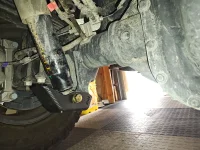
Did you happen to notice the grip length on your supplied bolts? I haven't installed my Foutz because I didn't like the threaded shank being threaded so deep onto the shank. Only half of the unthreaded shank would've been within the i.d. of the lower shock mount bushing itself.
It might not matter but I keep forgetting to ask a machinist or anyone else expert in fasteners.
That’s @Apples go-to move.View attachment 267794
Here are the stock bolts. If I understand what you are saying correctly, I feel you are way overthinking this![]()
Trust me (or not) it’s fine.Did you happen to notice the grip length on your supplied bolts? I haven't installed my Foutz because I didn't like the threaded shank being threaded so deep onto the shank. Only half of the unthreaded shank would've been within the i.d. of the lower shock mount bushing itself.
It might not matter but I keep forgetting to ask a machinist or anyone else expert in fasteners.
Forgive my ignorance, would a higher grade bolt, say a 10.9 or 12.9 resolve this issue, or is it one where it doesn't matter the strength of the bolt?Trust me (or not) it’s fine.
If you are talking shock bolts, the front and rear lower bolts are not spec’d for shear strength. It’s tensile strength. The clamping force of 110ish lb-ft is what keeps the shock in place. Not the shear strength of the diameter (threaded or unthreaded) of the bolt.
No forgiveness necessary, man. Maybe I’m missing the issue at hand.Forgive my ignorance, would a higher grade bolt, say a 10.9 or 12.9 resolve this issue, or is it one where it doesn't matter the strength of the bolt?
I think the application for the shock mount guards are to help prevent the lower shock mount from getting caught on a rock or something else, acting as a slider. I don't think it would be responsible to expect them to offer any more protection than that, as you mentioned, there are other failure points that the guard could not protect against.No forgiveness necessary, man. Maybe I’m missing the issue at hand.
While I don’t know off the top of my head what the rating is for OEM bolts, 100lb-ft for their diameter isn’t a lot. Even a low grade isn’t near the yield strength at that torque.
While it wouldn’t hurt (in our applications) to go one grade higher, you can run into “the next weakest link” when choosing higher strength fasteners. Going too much higher can be the wrong application. 12.9 bolts do not fare well in open air unless properly coated (geomet, black oxide) but once the coating is compromised it’s downhill. 12.9 also doesn’t do well with sub zero temperatures.
Sorry for the non answer answer, but fastener choice isn’t cut n dry. In short, I wouldn’t hesitate to use stock shock bolts. The upper mounts that are only supported on one side (stud mount) will probably fail well before the lower bolts.
Edit- if one really wanted the shoulder all the way through, the better bet is to order longer bolts with the appropriate length shoulder and cut the threads down. I’ve done this, but it can be tough because the lower mounts will deflect some as clamping force (torque on the nut) increases. You don’t want to torque the nut to the shoulder. It’s torque to clamp the mount.
100%I think the application for the shock mount guards are to help prevent the lower shock mount from getting caught on a rock or something else, acting as a slider. I don't think it would be responsible to expect them to offer any more protection than that, as you mentioned, there are other failure points that the guard could not protect against.
Trust me (or not) it’s fine.
If you are talking shock bolts, the front and rear lower bolts are not spec’d for shear strength. It’s tensile strength. The clamping force of 110ish lb-ft is what keeps the shock in place. Not the shear strength of the diameter (threaded or unthreaded) of the bolt.