Twin ARB with air tank install

I’m not an expert for sure and am just learning this stuff myself. I also assumed it would take closer to 20 feet when routing around and through the frame and things to get to the bed. That put my numbers in at least the 40’ circuit range. I also was using critical because I figured voltage drop of 10% would not be ideal for something with 2 motors. (Perhaps I’m totally wrong here) I saw on another thread someone say the ARB runs much stronger when the truck engine is on which tells me it’s fairly sensitive to voltage fluctuation.
My buddy ran dual 8 gauge and I ran dual 6 gauge, and when the trucks are on we do not see any noticeable difference. His thinner gauge would run more hot being a thinner gauge but at the short durations these are run, it should be a non-issue. We have not done a true test to see if mine fills any quicker.
 
The twin is rated at 68.6A total (34.3A each individual compressor) at maximum load as seen below from their spec sheet.

View attachment 45744

There are two power wires to two 40A fuses as the ARB twin is essentially two compressors. It would still be best to continue to run off individual power cables to minimize the risk of damage to both compressors. The cable between the battery and fuses can be combined into a single cable or connector though. Also, the best practice is to have both fuses near the battery.

At 14V (although actually probably 14.5+) when the truck is running, a 10% drop leaves you to 12.5V (13.05V after 3% drop) which is still within spec of the 12V compressors.

Following the chart with a 10% voltage drop, 8 gauge is plenty up to 30' for each of the two power cables. Following 3% voltage drop on the chart, you would need two 4 gauge power cables at 30 feet.

View attachment 45745
One thing worth mentioning is that the chart lengths are circuit lengths. So if it takes 20 ft of wire to run from your battery to your compressor then that would be a 40 ft circuit on the chart. I also agree that a slightly smaller wire is acceptable if you run 2 of them and connect each compressor independently rather than running one big power wire to the back and connecting both compressor power wires into a single spot.
 
My buddy ran dual 8 gauge and I ran dual 6 gauge, and when the trucks are on we do not see any noticeable difference. His thinner gauge would run more hot being a thinner gauge but at the short durations these are run, it should be a non-issue. We have not done a true test to see if mine fills any quicker.
Were these both mounted in/under the bed?
 
If you run power from the battery you can use switch 1, 2, 3, or 4. The switch is for turning it on and that is it.
That's correct, assuming you are ok with only using the compressor with the ignition on. He installed on 6 so that he can run with ignition off if he wanted. And only 5 and 6 have this ability.
 
The upfitter switches in 5/6 may be rated at 40 amps but only for very short lengths of wire. Based on my research a single power wire from the engine bay to the bed of the truck should be at minimum 4 AWG. I think it would be much safer electrically to connect the compressor directly to the battery using appropriately sized and fused wires for the amperage and length needed for the install location.

I have mine thru the relay so I "wasted" the 40 amp switch but that is ok because its now "hot" with engine off.
 
Why is there a concern about the amp rating of the upfitter switch? All the juice goes through the main cable and that switch is like, or is, a relay isn't it? Obviously I haven't wired mine in yet. I have a 4 ga running to my back seat and I'll be running it off that.
 
Why is there a concern about the amp rating of the upfitter switch? All the juice goes through the main cable and that switch is like, or is, a relay isn't it? Obviously I haven't wired mine in yet. I have a 4 ga running to my back seat and I'll be running it off that.
I think the concern is when people use the upfitter wire to “power” their compressor rather than using it as an on/off switch to the relay on the compressor. I agree the size of the upfitter wire and its amp rating are rather negligible when used to just switch the ARB relay (purple wire).
 
Last edited:
I think the concern is when people use the upfitter wire to “power” their compressor rather than using it as an on/off switch to the relay on the compressor. I agree the size of the upfitter wire and its amp rating are rather negligible when used to just switch the ARB relay (purple wire).
Beat me to it , most heavy draw items would require a relay switch so you don't need many amps. I would be ok with some LED lights on the switch directly.

Ford should have made the option to make all the up fitters hot.
not just 5 & 6 . But in a way its good cause I have LED lights on the switches 1 & 2 . I still have the ARB switch ( rocker ) in use by the compressor. So you must turn on the up-fiitter #6 and the rocker switch to run the compressor. That way if my back flip cover is open and my cab is locked nobody can turn the compressor on.
 
I also agree that a slightly smaller wire is acceptable if you run 2 of them and connect each compressor independently rather than running one big power wire to the back and connecting both compressor power wires into a single spot.
I guess I thought you had to run individual wires. Were you talking about doing a single 4 gauge wire to the compressor?
 
I guess I thought you had to run individual wires. Were you talking about doing a single 4 gauge wire to the compressor?
Ah yes. I was thinking about running a 4 gauge from the battery to the bed into a distribution block. Then I could connect the compressor to the block as well as backup lights to the block. Perhaps 4 is not a large enough wire for this purpose…
 
Ah yes. I was thinking about running a 4 gauge from the battery to the bed into a distribution block. Then I could connect the compressor to the block as well as backup lights to the block. Perhaps 4 is not a large enough wire for this purpose…
In that case though, what are the odds of running both the compressor and the lights? And if so the lines might just dim a touch and compressor run a little slower.
 
I was thinking about running a 4 gauge from the battery to the bed into a distribution block
I am most likely not going to do anything with my compressor until spring or summer. Well, except think of how I will mount it along with other stuff in the bed, etc. I have thought alot about running power to the bed and then using that for the ARB and other stuff. The idea being that I would not need things like a portable winch or a dc-dc charger and the ARB running at the same time so running multiple power feeds wouldn't be necessary... I would use an upfitter to switch a relay for the rear power feed and then separate switches for the accessories as needed. The ARB would be hardwired, others would be connected as needed using Anderson connectors or something equivalent. I'm sure I will evolve or simplify my plan before I actually decide on what will be executed, though...
 
In that case though, what are the odds of running both the compressor and the lights? And if so the lines might just dim a touch and compressor run a little slower.
I doubt I would ever need to run them together. But in the spirit of building headroom into the system I’m wondering about running a 1/0 cable from the battery to the bed into this block.

EE4F4E23-1022-4170-AAC7-83CF9F9E20CD.webp


My other option seems to be to run 2 of the 4 gauge cables from the battery to the bed using this option.

25D6D398-AB12-4AF3-B8E7-A46D8E641FB0.webp


I haven’t figured out if there is any reason to go one way or the other at this point.
 
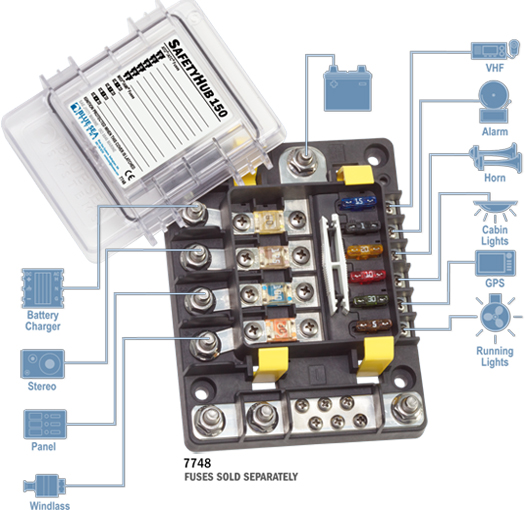
Have you considered running a larger gauge cable to a rear installed BlueSea SafetyHub 150. You could run the compressor and other items in the bed. This is my plan but I have just started planning out. Engineer by trade so my install will be overpriced and overbuilt.

BlueSea Safety Hub 150

SH150lg.jpg
That does look like a great option. Do you prefer those high amp bolt down fuses over the MAXI fuses on the stinger?
 
That does look like a great option. Do you prefer those high amp bolt down fuses over the MAXI fuses on the stinger?
I have used these AMG fuses on rewriting my 12v travel trailer with no issues. I don’t really have a preference other than I like Bluesea stuff.
 
Back
Top Bottom