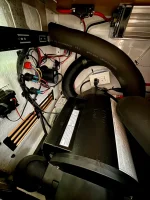
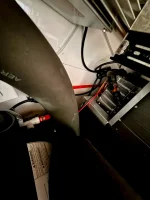
Pull the drawer.
View attachment 216274
All the way back
View attachment 216275
View attachment 216276
That’s the one I have. Appears to be 60A

Yep! 60amp! I may have incorrectly remembered 40amp or they changed the spec at some point. Happy to see the 60amp.
Super inefficient, but I keep thinking that those of us with Ford's ProPower Onboard could utilize a big AC converter charger as we drive (along with our DC charger if need be). That would easily handle 60 to 100amps (840 to 1400 watts) of charging. It is NOT efficient converting/inverting from 24v DC to 120v AC to 12v DC...but hey, it's already there and the dedicated 24v Pro Power Inverter never gets used except when using Pro Power Onboard. One could either relocate the Supertramp AC charger plug from the current location to a plug down near the in-bed pro power outlets, or just Y the input plug to have two plugs (though that would be a little dangerous as energizing one plug would energize the blades on the other plug. Zap if you touch them).
Or, more efficiently, one could tap into the 24v Pro Power Onboard circuit under the rear seat at the series-wired batteries by the 24v Pro Power inverter. Then run 24v back to the camper and utilize one of the new Victron XS 1400 to charge from 24v to 12v. It only charges at 700watts (50 amps) set up like that, which is the same as the Victron XS 50, but would utilize the 24v circuit and alternator where it otherwise sits dormant. There are some idiosyncrasies associated with energizing Pro Power Onboard, though. You have to go to the menu and turn it on. If on, it gives all kinds of messages like "make sure you are not idling your truck in enclosed space" and, if you go to drive, it pops messages to let you know something is plugged into the 120v outlets and to ensure you mean to do that and that everything in the bed is secure, etc.
I've not dug up any forum articles where someone has tapped into the Ford 24v circuit to see if the computer will let you, or if it does anything odd. I would hope the computer would not know the difference between the inverter drawing 24v current or some other 24v load drawing current, but if they have some type of sensor in the alternator, to know load is being drawn, and then something in the inverter or 120v outlet, knowing what is being drawn, it may try to compare the two and shut down the system if the two don't match.
Anyone know of someone that has tapped into the 24v circuit and written about results? It's normally not good to draw load directly from an alternator without a battery inline to buffer, but I wonder if one could avoid cables coming out of the cab (running off the in-series 12v batteries under the seat), by wiring directly to the 24v alternator posts since the other set of conductors does flow to the batteries so the batteries are on the same circuit, just not inline. I'll have to research that. Not sure if they would fulfill the buffering need in that configuration. But if they did, one could avoid having to run your 24v circuit out of the cab and could instead simply run conductors directly from the 24v alternator. You'd still have to turn on the alternator by turning on the pro power onboard, I imagine, but maybe the 24v alternator is smart enough to turn on when load is applied and the turning on Pro Power is simply to energize the inverter. One could then have a 24v conductor running direct from the alternator back into a connector and then into the camper to a Victron XS 1400 (50 amps in this configuration). You could still have a 12v DC circuit, as usual, running into camper and a Victron XS 50 (or second XS 1400 for consistency, though both get the same 50 amp throughput and the XS 50 is cheaper). Then you'd have 100amp of DC charging from two completely separate 50 amp sources. Good redundancy.
I'm starting to be a fan of 24v house battery systems in campers. While it's now worth retrofitting, I've been going through the mental exercise anyway. Pretty straight forward especially now that the XS 1400 has come out for DC charging to 24v. There are some good Victron 24v/120v inverter/chargers which are somewhat bulky, but less so than running separate inverter and AC chargers. Fridges can already run directly off 24v (and more efficiently). Some A/C can run off 12v or 24v (or are at least available in 24v versions). 24v to 120v inverter would run all your 120v loads (like induction cooktop, electric teapot/coffee makers, etc.). So you would only need a 24v to 12v converter sized for the remaining 12v draws like fans, waterpump, roof actuators, Truma Combi, etc. Some lights can run off of 12v or 24v. Same with USB plugs that convert from 12v/24v down to 5v. Not sure about actuators, fans, etc. Water pumps are typically designed for either 12v or 24v. 24v system would mean much smaller (and so cheaper and easier to run) conductors for all the 24v circuits, too.