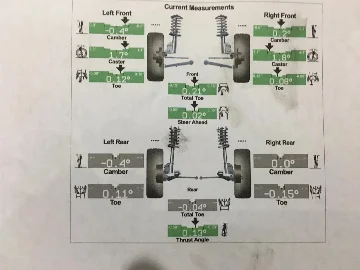
good question - also @DigiMan are you running at max cold pressure on your trailer tires to start?@DigiManTX : What was the tire PSI setting for the front and rears?
Navigation
Install the app
How to install the app on iOS
Follow along with the video below to see how to install our site as a web app on your home screen.
Note: This feature may not be available in some browsers.
More options
Style variation
You are using an out of date browser. It may not display this or other websites correctly.
You should upgrade or use an alternative browser.
You should upgrade or use an alternative browser.
Scared Sh!tless
- OP 🔹 DigiManTX
- Start date


Just pulled our 32’, 7k lb TT on its first trip with the Tremor 6.7L (1200 mi round trip) with +/- 6 % grades. Truck downshifted once to 8th gear on the way up. Otherwise stayed in 10th the whole way. No sway whatsoever. Ran the truck tires at the door recommended psi & the TT tires at 63 psi cold. Transferred our Equalizer WDH to the Tremor with a tongue weight of about 5-600 lbs. and couldn’t even tell the TT was behind the truck. No sway, no what I call big rig blow-by when we passed. Had an absolute blast towing with the truck.
Completely different towing experience than with my wife’s 2017 Yukon.
Completely different towing experience than with my wife’s 2017 Yukon.
Last edited:



Maybe the title should be "Scared hitchless!?"

I agree with others that if you are getting sway empty something is off on the truck and should be looked at by the dealership or a good alignment shop.
The solid front axle in the Superduty is not going to feel as responsive in steering as the IFS GM you came from but should not be getting pushed around much on the road especially empty.
With my 2020 I have found if tongue/pin weight gets too light you are in for a rodeo when towing. Had a few times where moving odd things for friends where had to stop and move weight forward on the trailer to get towing back to rock solid stable. The Tremor seems to handles and ride best with more tongue weight than my old 2500 Suburban liked to run at.

Duratracs sway alot when there new . I agree 100% with Leogeo.. Check the pressure tooMy bet is the Duratrac tires are not broke in yet. Took about 3000 miles on mine. Meanwhile, they were all over the road. No trailers involved, but I could see that the problem would cause just what you are seeing.

Is the front of your trailer sitting at the same height as it was with the previous truck? If the tremor is sitting higher and you didn’t further drop the tongue to accommodate the extra height then you are not getting the same benefit of the weight distribution you used before.
My '23 Tremor towing my Fussion 26. It weighs a little over 10k and has 1600lbs tongue weight. I use an old Ox brand WD hitch. Tow's great. I do tow like an old woman though at 60-65 mph.
Chas
Chas

My bet is the Duratrac tires are not broke in yet. Took about 3000 miles on mine. Meanwhile, they were all over the road. No trailers involved, but I could see that the problem would cause just what you are seeing.
Going through that now with 2500 miles. It's all over the place unloaded. Its almost like its windy but no wind

This would be the same with any vehicle. You must have tongue weight to tow without swaying. Remember the trailer has caster built in to spindle design, make sure you have enough tongue weight to give the trailer a little rake and lower in the front.I agree with others that if you are getting sway empty something is off on the truck and should be looked at by the dealership or a good alignment shop.
The solid front axle in the Superduty is not going to feel as responsive in steering as the IFS GM you came from but should not be getting pushed around much on the road especially empty.
With my 2020 I have found if tongue/pin weight gets too light you are in for a rodeo when towing. Had a few times where moving odd things for friends where had to stop and move weight forward on the trailer to get towing back to rock solid stable. The Tremor seems to handles and ride best with more tongue weight than my old 2500 Suburban liked to run at.
There is no such thing as caster in a non steering axle like a trailer axle. Caster is the inclination of the steering axis, and since there is no steering axis, the concept does not exist. There is come positive camber when unloaded built into solid trailer axles so that when fully loaded they bend to near zero camber. I don't think that this has much to do with sway.Remember the trailer has caster built in to spindle design,
A agree with you that tongue weight is the most important factor. Unfortunately the OP has not told us what his tongue weight actually is. I do not agree that one should adjust the tongue weight to rake the trailer lower in front. One should adjust the tongue weight to be 12 to 15% of the trailer weight then adjust the drop or rise of the hitch to make the trailer approximately level.

I’m thinking the new truck is higher and he is still using same hitch height so new tongue weight is way low.


- Feb 8, 2023
- 1,401
- 2,555
- 2024 F350 SRW Lariat 4x4 6.7L 3.55
- 2022 F350 SRW Lariat 4x4 7.3L 4.30 (RIP)
The hitch height does not change tongue weight, it only changes the angle of the trailer. @shermanator2 is right that the tongue weight should be verified and adjusted first, then the hitch height should be adjusted. The only way to really do this correctly is using a CAT scale because you need to know all three weights (front axle, rear axle, trailer axles), which change based on how the trailer is loaded as well as the settings of the WDH.I’m thinking the new truck is higher and he is still using same hitch height so new tongue weight is way low.
Mis spoke on the built in but the trailer needs to be a bit lower in the front front tounge weight to alleviate wandering. High in front will definitely cause excessive wandering. This is worse with single axle trailers.There is no such thing as caster in a non steering axle like a trailer axle. Caster is the inclination of the steering axis, and since there is no steering axis, the concept does not exist. There is come positive camber when unloaded built into solid trailer axles so that when fully loaded they bend to near zero camber. I don't think that this has much to do with sway.
A agree with you that tongue weight is the most important factor. Unfortunately the OP has not told us what his tongue weight actually is. I do not agree that one should adjust the tongue weight to rake the trailer lower in front. One should adjust the tongue weight to be 12 to 15% of the trailer weight then adjust the drop or rise of the hitch to make the trailer approximately level.

maybe if you post a picture of the setup could help point out the issue.
Agree trailer level - but would suggest 20%-25% pin weight for a 5th wheel or goose neck - which is what the OP posted about. As you noted 12% - 15% would be good for a bumper pull trailer.A agree with you that tongue weight is the most important factor. Unfortunately the OP has not told us what his tongue weight actually is. I do not agree that one should adjust the tongue weight to rake the trailer lower in front. One should adjust the tongue weight to be 12 to 15% of the trailer weight then adjust the drop or rise of the hitch to make the trailer approximately level.
I tow a 32' toy hauler, 2,000# tongue weight with my '22 F-250 Tremor and my Weigh Safe True Tow WD hitch. I've towed in about every condition of wind, grade and traffic; it moves a little passing trucks or being passed, especially in a hard wind, but I don't find it much of a problem. Maybe I could benefit from a rear sway bar but it would compromise off road performance a little. I love the truck and the hitch. I'm very experienced towing with all kinds of vehicles in all conditions.

- Jan 9, 2023
- 316
- 412
- 2024 F350 King Ranch Tremor HO Diesel
- 2001 Ford Excursion Ltd 7.3L
Can anyone explain what happens when the stock Duratrac tires “break in” that makes them more effective on sway reduction?
I can’t specifically explain the duratracs but as tires wear in they just become more stable. I once had a brand new set of KO2s put on a day before I left on a 1000 mile road trip with my 5’er and was all over the road at the beginning of the trip. Coming home was a lot less of an issue and the following trip with approx 3000 miles on the tires I was stable.
Watch NASCAR or F1 and as soon as they put tires on what do they do…..they spin the crap out of the tires driving out of the pit onto the track
Watch NASCAR or F1 and as soon as they put tires on what do they do…..they spin the crap out of the tires driving out of the pit onto the track
Deep tread aggressive tires are prone to tread squirm, especially the 2-ply sidewall Duratrac's. This tread squirm will amplify any suspension irregularities or defective parts. These effects will dissipate commensurate with tread wear. Adjusting tire pressure can help in the interim.
- Staff 🛡️
- #40

- Jun 25, 2021
- 10,997
- 20,648
- 22MY F250 Star White Lariat Tremor
- 22MY Winnebago Voyage 2831RB
That is to get them up to temp as quickly as possible for adhesion. Very important for the use case but a bit different phenomenon than the Duratrac break in situation.Watch NASCAR or F1 and as soon as they put tires on what do they do…..they spin the crap out of the tires driving out of the pit onto the track