Group Discount — 10% off the AGM Scissor Jack HD (July 15–Aug 14)

what's the diff between a hammer drill and a regular drill ? is it necessary to have both ? will they both achieve the same goal ?
A regular drill just spins to get the job done. A hammer drill spins while violently thrusting in and out—basically the difference between making love and that one guy who thinks he needs to jackhammer through the mattress to prove a point.
What @Optimus🤖 described is a rotary hammer, not a hammer drill 😂

Hammer drills are great for drilling small holes (under 3/8") into masonry, and most can also be used as a regular drill with the "hammer" function switched off. They’re handy, but once you’re drilling much larger than 1/4 inch, especially into concrete, you’re going to want a proper rotary hammer.

Basically a rotary hammer is a spinning hammer. A hammer drill is a drill that buzzes a little.
 
Is it reasonable to use this with the hand crank only? I am thinking of getting this to keep in the trailer instead of the bottle jack but would not usually have a M18 drill with me. How many turns per inch of lift?
 
How many turns per inch of lift?


+/- 5 or 6 iirc and the handle is about one foot too short for comfort (to use the crank effectively I had to lay under the rear bumper) to run the jack from the rear bumper to the rear axle. Up front it may be ok for length.

Harbor Freight a battery drill motor, then, but see that it has at least 1000 in/lb torque capacity.
 
Something is not quite adding up with the numbers here. AGM recommends 1500 in lb torque in the drill. Is there such a thing in a cordless drill? The one @Apples got is only 1400 in lb. and is pretty damn big. Even if there is such a thing, I do not think that most of us could hang on to the drill while it was applying that much torque. With say a 10" radius to the end of the battery or side handle, It would take 150 lbs of force applied by hands. I don't think most of us could do that while laying under the truck.
 
AGM recommends 1500 in lb torque in the drill.

Ah.

I got my recommended 1000 in/lb from an "official" AGM video. Lemme go find it. Remember, too, I mentioned yesterday that it only took 1/2 trigger squeeze depth, so I doubt it was the full 1400.

and 1000 in/lb is somewhere around 86 ft/lb, but using the hand crank is not difficult, only slow.
 

"you wanna have at least 1000 in/lb of torque" - @1:50
 
I don't think most of us could do that while laying under the truck.


I did it yesterday, 1/2 trigger squeeze, 1st of 2 drill motor speeds, and since I'm old I did find it easier to rest my support hand on the battery against the direction of rotation.
 
I saw that, but here are the specs from their page. Even 86 ft lb will be hard to hang on to. Thanks for testing and showing that for a normal lift, that much is not necessary.


AGM Jack Specs.webp
 
I saw that, but here are the specs from their page


Well then those fellers best get their factoids synchronized! :ROFLMAO: Betcha they toned down the requirements after a few test lifts.

It is a beefy unit. For the price, it should be. An 18V drill motor makes it that much easier, is all.

I'll have a chance to run it again and to also lift each front corner of the truck where the weight is when I do a tire/wheel swap. Hopefully, that'll be some time in the next 48 hours... just waiting on the delivery.
 
Hey everyone,

I’ve been looking into using a high-torque cordless drill for trail repairs and tire changes on our trucks, and wanted to share some math and drill requirements for anyone considering a similar setup.

Many high-capacity jacks list a spec like "1,500 in-lbs of torque," but that’s usually the maximum structural rating of the screw—not the actual torque required to lift a corner of our trucks.

1. The Actual Weight Being Lifted​

Even with an 8,000 lb diesel curb weight, jacking up a single wheel doesn't mean lifting 8,000 lbs. The truck stays supported by the other three tires while the suspension droops.

  • Front Corner Load: ~2,500 – 3,200 lbs (due to engine weight)
  • Rear Corner Load: ~1,800 – 2,500 lbs

2. Breakdown of Torque Requirements​

Acme lead screws on scissor jacks suffer from high friction, but mechanical leverage changes dramatically as the jack rises:

  • Flat/Fully Collapsed: Mechanical advantage is at its worst. Starting from a dead flat position under an axle requires an initial breakaway force of around 800 to 1,000+ in-lbs.
  • Pre-Lifted 2–3 Inches: If you spin the jack up by hand until it makes contact, avoiding the flat geometry, the required torque drops closer to 500 to 700 in-lbs.
Bottom line: A drill rated for 800+ in-lbs of torque will have plenty of power to raise a Super Duty corner smoothly, provided you don't start with the jack completely flat.

3. Drills That Fit the Spec (Non-Impact)​

Standard impact drivers can't have their impact feature disengaged, so sticking to a high-torque drill/driver is the way to go. Here are solid options across the big three platforms:

  • DeWalt 20V MAX XR (DCD800B): ~900 in-lbs (Solid mid-tier choice that easily clears the spec)
  • Makita 18V LXT Brushless (XFD14Z): 1,250 in-lbs
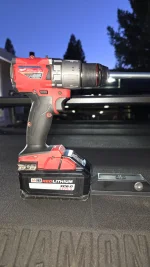
  • Milwaukee M18 FUEL (2903-20 or 2904-20): 1,400 in-lbs
  • DeWalt 20V MAX XR (DCD1007): 2,100 in-lbs (Absolute powerhouse if you want overkill headroom)

4. Tips for Keeping It Safe & Easy​

  1. Use the Side Handle: An 800+ in-lb drill under a continuous load will kick hard if the jack binds. Always run the auxiliary side handle so you don't twist a wrist.
  2. Grease the Screw: Applying heavy-duty grease or anti-seize to the jack's lead screw and thrust bearings reduces friction significantly, keeping the drill motor cooler.
  3. Use Impact-Rated Adapters: Don't use standard chrome 1/2" socket adapters in the drill chuck—they can shear under sustained high torque. Use an impact-rated 1/2" drive socket adapter.
 
Thanks @DtxTremor. I was just about to reply that I realized what you said in #2. A scissor jack has a tremendously variable ratio. It takes a lot of torque when collapsed and nearly zero at the top. This is unlike a bottle jack that is a constant ratio of pumps to height. @Apples test was with it pretty high so it makes sense that it did not take a lot of torque. AGM is specing the drill for the jack shorter and with a higher load.

Now we just need to find out from @Optimus🤖 what the best lube for the screw is.
 
Lubrication will be key to the longevity of the scissoring portion of this
 
IMHO, for the price they’re asking, it should be perfect. The manual handle extension should be at least a foot longer, the gear reduction assembly should be set at a ratio where the manual handle can lift the load easily as not everybody will be carrying power tools with them in the field.
 
IMHO, for the price they’re asking, it should be perfect. The manual handle extension should be at least a foot longer, the gear reduction assembly should be set at a ratio where the manual handle can lift the load easily as not everybody will be carrying power tools with them in the field.


Yes, the crank handle assembly (2 pcs) should be at least 1' longer, but the effort required to manually lift the truck doesn't seem excessive to me, and I'm old.

😝

Having a battery drill motor of sufficient torque is a bonus. That's all.
 
Thanks @DtxTremor. I was just about to reply that I realized what you said in #2. A scissor jack has a tremendously variable ratio. It takes a lot of torque when collapsed and nearly zero at the top. This is unlike a bottle jack that is a constant ratio of pumps to height. @Apples test was with it pretty high so it makes sense that it did not take a lot of torque. AGM is specing the drill for the jack shorter and with a higher load.

Now we just need to find out from @Optimus🤖 what the best lube for the screw is.
KY Jelly. It prevents chafing when you're cranking away for 20 minutes straight just trying to get it up.

If you’re trying to lift a heavy load, you’re gonna want something thick. Astroglide if you’re gentle, but if you're just gonna crank on it without asking how its day was, stick to the industrial stuff.

I believe this is what Optimus🤖 is referring to
 

Attachments

  • 51rn8WASryL._AC_UF1000,1000_QL80_.webp
    51rn8WASryL._AC_UF1000,1000_QL80_.webp
    27 KB · Views: 8
^ ^ ^ the "industrial stuff"? :ROFLMAO:


Fortunately, these AGM SuperScissors arrive w/ plenty of blue grease applied. So much so, in fact, I was compelled to wipe away a portion of the excess.

I plan on having to use this way out there in the sand, see... I'm even considering cleaning the screw threads and applying either ATF or graphite dry lube for such dirty, filthy and arid environs.

😱
 
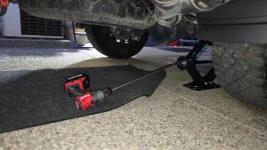
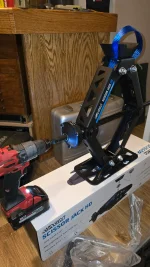
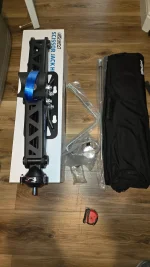
Received the jack today, tried it out and it works with the older Milwaukee drill that I've had for a couple years. (Model 2804-20) Torque specs on this are ambiguous; I found 740 in-lbs. and 1200 -lbs. listed in various spots. However, it didn't seem to labor at all. I ran it on the low-speed setting and lifted the rear tire in just a few seconds once positioned correctly. The acme main shaft is already lubed, the lube is a "sticky" type, likely a low friction lubricant. This will likely be a dust magnet, keeping it in the bag is probably a good idea. The jack is solid and doesn't have any flex to it when lifted.

A couple notes:
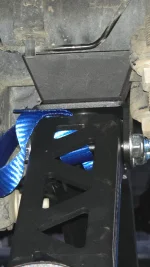
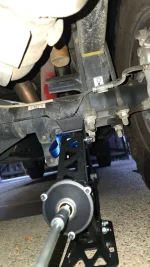
The axle puck fits the axle housing perfect in the spot shown; radius is perfect. But take note that it doesn't hit the brake line when positioning it. (see pics)
My drill was able to turn the jack using the long smooth hand driver bit that came with the jack, no slipping of the drill jaws on the smooth 1/2-inch shaft. The shaft comes with a swivel head run of the mill 1/2-inch socket attached to it. It's thin wall, nothing special. An impact socket is not necessary if you decide to run this with a drill with extensions. (Which is my plan) The shaft only allows about 22" by itself, another foot or so would be ideal to reach the back of the truck without crawling under the bumper to jack it up. I may use two 24" extenders, still under evaluation.
You can't really angle the jack towards the back tire and jack it up, because there is a bolt on the frame that won't allow the jack in any position but straight back as shown.

20260723_205742.webp
20260723_203923.webp


20260723_203808.webp
 

Attachments

  • 20260723_205109.webp
    20260723_205109.webp
    159.4 KB · Views: 10
  • 20260723_204251.webp
    20260723_204251.webp
    174.9 KB · Views: 9
  • 20260723_203603 (1).webp
    20260723_203603 (1).webp
    258.8 KB · Views: 11
  • 20260723_203527.webp
    20260723_203527.webp
    196.4 KB · Views: 10
  • 20260723_122217.webp
    20260723_122217.webp
    184 KB · Views: 10
  • 20260723_121639.webp
    20260723_121639.webp
    190.7 KB · Views: 11
Last edited:
AGM, you sneaky bastiges... you ain't th' only ones sellin' these things!

Here's another, identical jack labeld by another entity. The host of this video Short goes on to present this jack as one he wanted for his INEOS Grenadier.

"how fahn-cy" :ROFLMAO:

 
Back
Top Bottom