Furnace Help

What are the leds doing when it fires up?

Rheem failure codes​


FLAME LED
The FLAME LED is an indication of the presence of flame.
OFF – No flame is detected.
Rapid Blink – Unexpected Flame
Slow Blink – Marginal Flame Sense
Steady ON – Normal Flame Detected
STATUS LED
The STATUS LED is an indication of a fault present.
Steady ON – Normal Fault detected.
1 Blink – Ignition failure – 1 HR lockout
2 Blinks – Pressure switch stuck open switch will not close when inducer is on.
3 Blinks – Limit switch open main limit or roll-out control.
4 Blinks – Pressure switch stuck closed. Switch will not open.
5 Blinks – Not applicable.
6 Blinks – Line and Neutral reversed.
POWER LED
The POWER LED is an indication of 24ac power to the board.
OFF – No power (24VAC) to control board.
ON – Control is powered.
CFM LED
The CFM LED is an indication of target airflow. This is a reasonably close approximation of the airflow pushed by the blower motor through the furnace.
Because of manufacturing and measurement tolerances, air density, humidity, ambient air temperature and other things, the CFM actually measured may vary significantly from this target value.
One Blink represents 100 CFM of target
airflow. A half blink represents approx. 50 CFM. When the blink sequence is complete, there will be a noticeable pause of approximately one second before the sequence repeats. For example, if eleven and one half blinks are counted followed by a one second pause and then eleven and one half blinks are counted again, the target airflow is approximtely 1150 CFM.
 
What are the leds doing when it fires up?
They’re doing what you would expect:
1. Power and OK LEDs turn on solid when power is provided to the furnace and remain solid until lockout.
2. Flame LED mirrors the presence of the flame. On when there’s flame, off when there isn’t. It will flicker with the flame if the flame sputters.
3. Once the system goes into lockout, the OK LED blinks once every 2 seconds. The power LED remains solid, and the flame LED is out.

I do not appear to have a CFM LED.
 
So some further things I did:
1. Checked the exhaust flue for blockages. Searching around someone had an issue where pressure dropped once the burners ignited, and a flue blockage was the cause. No hard blockages, but there was a significant amount of dust built up. Vacuumed that dust out, did not resolve the issue.

2. Tried to test the pressure switch and it seemed to drop voltage momentarily when the gas shut off? I don’t know if that’s the cause of the switch or the source of the voltage, though.

I need to call it for the night. @Himni and @BroncoHooves thank you so much for the time and help. Not at a solution yet, but at the very least this is making me feel better about calling a tech since it’s far less likely I missed something obvious!
 
That may be a fan limit switch. Basically, if it gets too hot, it will shut the gas off (for the scenario of the blower not working and moving air)

Worth checking that as well!
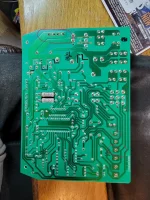
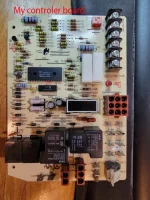
I had this exact problem a few years ago on my house heater. It would cycle on and off several times before actually start and run. I had a service company fix it and they replaced all of the boards with an updated model. However, I asked if I could keep the old boards. They gave them to me to research, and what I found was a cracked solder joint on one of the relay boards. There were two boards, one that looked identical to yours, the controller, (it was fine) and another board that had similar edge connectors, with a Molex connector. The Molex connector pins were all cracked around the edges on the boards solder side.

Unfortunately, I didn't keep the old defective board to show you where it was broken but did keep the control board. I'll show a picture here to show what the solder connectors looked like, though the defective board did not have "good" traces on the back like the control board. If I remember correctly, the board was just a white fiber board for the fan control.
 

Attachments

  • 20240320_223619a.webp
    20240320_223619a.webp
    150.7 KB · Views: 26
  • 20240320_223222a.webp
    20240320_223222a.webp
    152.1 KB · Views: 25
It sounds like the gas valve solenoid is bad. Check to see if you still have 24 volts at the gas valve when the flame goes out. If you do, then the gas valve is bad. Flame sensor normally does not make a clicking sound.
 
  • Like
Reactions: ccw
I had this exact problem a few years ago on my house heater. It would cycle on and off several times before actually start and run. I had a service company fix it and they replaced all of the boards with an updated model. However, I asked if I could keep the old boards. They gave them to me to research, and what I found was a cracked solder joint on one of the relay boards. There were two boards, one that looked identical to yours, the controller, (it was fine) and another board that had similar edge connectors, with a Molex connector. The Molex connector pins were all cracked around the edges on the boards solder side.

Unfortunately, I didn't keep the old defective board to show you where it was broken but did keep the control board. I'll show a picture here to show what the solder connectors looked like, though the defective board did not have "good" traces on the back like the control board. If I remember correctly, the board was just a white fiber board for the fan control.
Those white fiber boards are notorious for developing cracked solder joints. Also lead-free solder sucks.
 
It’s also crossed my mind that I try a new board. Can get one for $250 on Amazon and doesn’t seem terribly difficult to switch everything over.
I had a similar situation in my last house. Finally called someone out and he said basically the furnace had to be replaced. Next guy said it was the board. $300 later it was golden... After chatting him up a bit it seems that is the result for most of the error codes as there is little to no serviceable parts.
 
I had this exact problem a few years ago on my house heater. It would cycle on and off several times before actually start and run. I had a service company fix it and they replaced all of the boards with an updated model. However, I asked if I could keep the old boards. They gave them to me to research, and what I found was a cracked solder joint on one of the relay boards. There were two boards, one that looked identical to yours, the controller, (it was fine) and another board that had similar edge connectors, with a Molex connector. The Molex connector pins were all cracked around the edges on the boards solder side.

Unfortunately, I didn't keep the old defective board to show you where it was broken but did keep the control board. I'll show a picture here to show what the solder connectors looked like, though the defective board did not have "good" traces on the back like the control board. If I remember correctly, the board was just a white fiber board for the fan control.
Those white fiber boards are notorious for developing cracked solder joints. Also lead-free solder sucks.
I had a similar situation in my last house. Finally called someone out and he said basically the furnace had to be replaced. Next guy said it was the board. $300 later it was golden... After chatting him up a bit it seems that is the result for most of the error codes as there is little to no serviceable parts.
Grabbing that new board off Amazon is really tempting. As best I can tell it has a 30 day return policy, too, so I think I could just return it if it doesn’t fix the issue? I’m lucky to have time to diagnose this.

@Canyon Trekker thankfully my furnace is old enough and cheap enough that it seems to have only one circuit board as best I can tell. If it has more than one then I have no idea where they’re hiding it lol.

It sounds like the gas valve solenoid is bad. Check to see if you still have 24 volts at the gas valve when the flame goes out. If you do, then the gas valve is bad. Flame sensor normally does not make a clicking sound.
Logic behind replacing the flame sensor was that it could have been dropping current once it heated up, thus signaling the gas valve to close.

Agreed on needing to test the gas solenoid, though. That’s a good call. Will try that later today.
 
I own my own plumbing and heating business.
I diagnose furnaces all the time. Sounds like gas valve relay on the board has gone bad. I would bet dollars to doughnuts a new board would solve your problems. Of course this diagnosis is without me being on site to do my physical checks.
 
I own my own plumbing and heating business.
I diagnose furnaces all the time. Sounds like gas valve relay on the board has gone bad. I would bet dollars to doughnuts a new board would solve your problems. Of course this diagnosis is without me being on site to do my physical checks.
Thank you! Appreciate it.

Well, I’m able to get 30 minutes of a tech’s diagnostics time on site for $160 so I’m going forward with that. At least see if they can confirm what’s wrong.

What I do after that is highly dependent on their findings, though I’m kind of hoping they confirm your thought of the relay.

I’m happy to replace pretty much anything short of the actual gas valve (I won’t mess with gas) myself once I know what’s wrong.
 
Grabbing that new board off Amazon is really tempting. As best I can tell it has a 30 day return policy, too, so I think I could just return it if it doesn’t fix the issue? I’m lucky to have time to diagnose this.

@Canyon Trekker thankfully my furnace is old enough and cheap enough that it seems to have only one circuit board as best I can tell. If it has more than one then I have no idea where they’re hiding it lol.


Logic behind replacing the flame sensor was that it could have been dropping current once it heated up, thus signaling the gas valve to close.

Agreed on needing to test the gas solenoid, though. That’s a good call. Will try that later today.
If you only have one board, wouldn't be a bad idea to check the solder joints. A cracked joint can also cause the chatter as it's trying to make contact and vibrating from the fan. Just a thought...
 
Those white fiber boards are notorious for developing cracked solder joints. Also lead-free solder sucks.
I used to repair boards with lead free solder on occasion, it can take 850 degrees F to melt that stuff and usually destroys the board in the process. Takes a very special skill to work with that stuff. We had a dedicated ROHS solder station and operator to do the repairs on boards. (Some of those boards were worth 10s of thousands of dollars or obsolete and no longer available so forced to attempt repair.)
 
  • Like
Reactions: ccw
What's that they say about paying not for time, but for knowledge?

Tech showed up and before I had the symptoms out of my mouth he said "pressure switch". I let him know I replaced it just a couple of years ago, though I'm open to it having failed quickly.

He pulls the pressure switch hose off the port on the inducer. That port was clogged with ash. He stuck a paper clip in to clean it out...and fixed. Literally just needed a paper clip in the right hole. 🤦‍♂️

The port was flowing just enough vacuum to allow the system to start, but when it warmed up would close up enough to cause the pressure switch to open and cut off the gas. The flakiness would have been from the vacuum fluctuating slightly.

Tech called out that my furnace make/model basically doesn't provide error codes. For the pressure switch it will only give an error code if it's open after the inducer starts, but before ignition. If the pressure switch opens after ignition? Nothing. (He proved this by pulling the hose to the pressure switch after the furnace was running.)

Added to my yearly maintenance: sticking a paper clip in that port.

Of course this diagnosis is without me being on site to do my physical checks.
You were bang on with this caveat! I'm sure you would have found it immediately as well if you were in person.
 
What's that they say about paying not for time, but for knowledge?

Tech showed up and before I had the symptoms out of my mouth he said "pressure switch". I let him know I replaced it just a couple of years ago, though I'm open to it having failed quickly.

He pulls the pressure switch hose off the port on the inducer. That port was clogged with ash. He stuck a paper clip in to clean it out...and fixed. Literally just needed a paper clip in the right hole. 🤦‍♂️

The port was flowing just enough vacuum to allow the system to start, but when it warmed up would close up enough to cause the pressure switch to open and cut off the gas. The flakiness would have been from the vacuum fluctuating slightly.

Tech called out that my furnace make/model basically doesn't provide error codes. For the pressure switch it will only give an error code if it's open after the inducer starts, but before ignition. If the pressure switch opens after ignition? Nothing. (He proved this by pulling the hose to the pressure switch after the furnace was running.)

Added to my yearly maintenance: sticking a paper clip in that port.


You were bang on with this caveat! I'm sure you would have found it immediately as well if you were in person.
Great news and glad it was a cheap (techs time) repair for you!
 
  • Like
Reactions: ccw
Back
Top Bottom