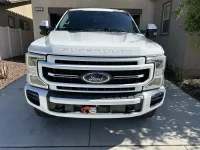
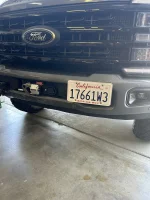
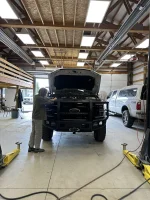
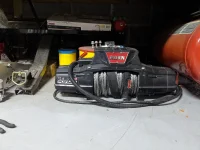
I guess that's one advantage of having to use a front license plate.UV is blocked by the flip license plate. Water submersions will affect either equally from capillary action of a braided rope.
Not us here in AZ
Follow along with the video below to see how to install our site as a web app on your home screen.
Note: This feature may not be available in some browsers.
I guess that's one advantage of having to use a front license plate.UV is blocked by the flip license plate. Water submersions will affect either equally from capillary action of a braided rope.

Jealous of that!I guess that's one advantage of having to use a front license plate.
Not us here in AZ

Me too. But I’m running without. Not trying to jinx myself - but 2 years in. lolJealous of that!
It sure is nice not have to worry about not needing one up there for those of us who have a winch. I imagine that is a PITA (I've seen the post on this).Jealous of that!


I am seriously considering swapping the hook that came with the factory Warn winch with the Factor 55 Ultrahook. Even with the AEV Winch Hook Isolator, I'm not crazy with how the stock hook sits. That plus it's weathering to a dull flat finish takes away from the front of the truck. I know it's mostly a cosmetic thing but I do like the look of the blue Ford Performance one - it should go well with the AntiMatter blue truck.
Does anyone who has one have any pros/cons on this hook (except the price) and pics of it installed?


Not compatible with the factory winch, but I like a spliced end and no hardware with the Yankum Hawse. Someone/Yankum really should make a similar adaptation for the factory winch.

If you do a ton of winching, it seems that the better application is the snatch block pulley.I ended up adding two 75' extensions to my recovery kit rather than a single longer extension line. Figured it would give me more options. And with loops on both ends, one can loop them together and they will slide right over or through when using a Recovery Ring. Many slick recovery rings out there, each with their own traits (like the Factor55 "Rope Retention Pulley" recovery ring with fingers to help keep line from falling out if there is slack), but I chose the Yankum "Offset Winch Snatch Ring XL" recovery rings so the winch line glides over the outer diameter of the ring rather than the ring turning and heating up a single spot on the soft shackle. Liking it so far, but haven't done any heavy recoveries yet (knock on wood).
Very well put together but if you've never been in the desert to experience ambient temperature that not only is up to 10-15 degrees hotter than actual thermometer readings, you've also never experienced UV rays in the desert. While I don't disagree that at higher altitudes, UV are a lot stronger, they're also not as "warm" as they are here in the desert plus they seem to radiate or shine off of everything since we are in a desert afterall. There isn't a lot of vegetation here to keep us from UVs, whether its direct or shinning off the ground, buildings, pavement, etc.Agreed that different environs have different wear factors to consider. I have no data regarding how temps effect synthetic road as it's not as much of a factor here in MT and so I've never even thought to research it. (though we did have record consecutive days over 90, and many triple digits record days this summer). I would think any "human survivable" air temperature wouldn't have much impact on synthetic lines, but really I have no idea. Thinking about temps, I would assume the air temp would be similarly high for all the line behind the bumper. UV is a degrading factor I'm more familiar with and that is not necessary tied to temperature (example: high elevation, mountain top UV intensity can be more severe than low elevation hot desert UV intensity). In either case, the UV resistance of good quality synthetic rope is rather good so probably more about "hours of exposure" thing than anything. I park in my shop or a garage so my vehicles see very little UV and weather exposure compared to those that park outside day and night. My daily exposure being so low relates to my comment about "in 10 years, I'll cut a foot off the end of my winch line and form a new loop". Ha.
Also agreed that professional recovery teams, or those that do frequent and heavy recovery work, still tend to employ snatch blocks rather than snatch rings. Part of that may be familiarity, part that weight and bulk are not as much of a factor as overlanders, and part more heavy duty and more frequent uses, etc. My pickup recoveries would be considered medium duty and infrequent and so recovery rings being lighter and more compact than snatch blocks is valuable for my needs. That snatch rings are slightly less efficient than snatch blocks isn't a big factor for the occasional overlanding recovery and a high percentage of winch pulls will be straight line vs compound pulls anyway. And snatch blocks have a bit of a chance to damage synthetic line, too, though the risk is low if you are methodical. The same care is needed for recovery rings to ensure rope doesn't slip off the ring as you tension and cut your soft shackle. "Check, tension, check again, then pull" reduces both risks.
Fun stuff! In the end, both get the job done so good to have choices so everyone can find what fits their needs or is simply the equipment they are more comfortable or experienced using.

 Build'