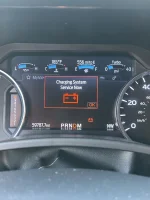
Charging System Service Now

Two different instances. My tech didn't observe 0 voltage with his badass scanner, he got strange alternator signals. Something about the generators sending crazy hertz or something. I can't exactly recall, but I'll see if he can send me his report. It was before this when i was left stranded that i used my $50 load tester to read the battery at 0% charge, it wouldn't load test. I threw it on a trickle charger to get everything up and running and to the dealership to replace the alternator.

After the dealership confirmed his alternator concerns, i had it replaced. Following this, i used my $50 load tester when the light came on to check both batteries. Driver was at 100% and pass was like 30-40% lower to my recollection. Enough charge to test, but lower than the driver.

1) to test the battery health/charge, my load tester provides a percentage - I didn't look at volt because I'm stupid, but i can do that tonight. Removed terminals from the batteries to load test one at a time.
2) Negative, dealership gave me nothing about what they did, only that they couldn't find the issue while incorrectly telling me the batteries are not wired in parallel.
3) I'll try to get this.

This is very interesting. I wonder if i should try OEM batteries first? I hate to remove $800 batteries, but, if they're potentially the issue, it's a no brainer. I run these same batteries in my 2003 Ram 2500 and they've been amazing for 7 years now - still load test good and read 100% health as of last week.
There are many success stories upgrading the OEM Flooded Lead Acid to AGM, the only advantage of an FLA is price. Both versions are the exact same chemistry. It's the construction that makes a difference. (Vented vs. non vented and the absorbed glass mat instead of flooded.) And neither will be intermittent hooked up correctly. And frankly, the stock setup will work with the AGM just fine without making any changes in Forscan. An AGM battery is superior in every aspect and Odyssey is one of the best. I replaced my flooded batteries with the Batteries Plus brand, X2 AGM which has a 4-year warranty. I have 1.5 years so far and no indication whatsoever that they have deteriorated. But I do hook up a maintainer if the truck is going to sit for any length of time to keep them charged. I too have the 22 YM and have not adjusted any Forscan settings because they are already sufficient for the AGM upgrade. (I wrote another long story on this in another thread.)

@HelmPilot asks some very good questions pertinent to troubleshooting but I think we need to keep in mind that you are chasing an intermittent issue, which would be more suited to connections or alternator function rather than the type of battery.

Your load tester is fine for testing the capacity of the batteries if you test them independently and unhooked from the truck. The only thing it may not do is show the voltage. But the algorithm in the testers brain will figure that out. It's odd that one battery was discharged though, still sounds like a connection issue. Have you checked to see if both battery plus terminals are securely connected to the starter? UPDATE: Your tester does show the voltage.

My reason for testing voltage is primarily for the alternators, if one is bad, it may not put out enough current to keep the system charged. But the second alternator possibly will. The expected indication would be one alternator is significantly lower than the other if tested independently and may have different results after a warmup. The undertaking to do this is somewhat involved; probably the easiest way is to disconnect one from the buss bar and see if the voltage remains at 14.X volts while running.

"Super out of whack readings" may be an appropriate statement, it would be nice to see a report on that.
 
I'm no expert, but figuring out why your truck left you stranded in the first place could be the key here. It seems like this is the root of your ongoing issues.

I've been stranded twice—once with FLA and once with AGM—and both times I managed to self recover fairly easily with no ill effects after the fact.

I'm also running X2 AGMs and never had to adjust any settings.

One more interesting tip: if your vehicle is completely dead, make sure to recharge or jump-start using the passenger-side battery. It's closer to the alternator, thereby using the juice out of the battery that is closest to.
 
And we’re back… 🤦‍♂️ thanks to you guys, I have a lot more info now than I had when I started this thread; thanks for all the info!
Ill keep this updated as I progress.
IMG_4824.webp
 
Got my buyback offer from Ford; can't say I'm stoked buy weighing my options. Pulled the DTC tonight; here's what it's showing:

TCM
Code: P163B - Generator B Field Terminal Circuit
Code: P163D - Generator B Field Terminal Circuit High
Code: P163C - Generator B Field Terminal Circuit Low

Just plugged all this into Grok and AI is pretty darn confident i need to replace Alternator B (Passenger side) now that I've replaced the driver, stating it's not uncommon to fail in pairs.

Here's the Grok breakdown:
Yes — **these DTCs are extremely helpful** and **directly explain why the "Charging System Service Now" error persists** even after replacing the **driver’s side alternator (Generator A)**.

| **P163B** | Generator B Field Terminal Circuit | General fault in the field control circuit of **Generator B** (passenger-side alternator) |
| **P163C** | Generator B Field Terminal Circuit Low | Voltage or signal too **low** on the field control wire |
| **P163D** | Generator B Field Terminal Circuit High | Voltage or signal too **high** on the same wire |

> **"Generator B" = Passenger-side alternator**
> **"Generator A" = Driver-side alternator** (the one you already replaced)

### What This Means
The **passenger-side alternator (Gen B)** is **not being properly controlled** by the PCM. The field terminal is the wire that tells the alternator how much to charge (via PWM signal from the PCM). These codes mean:

- The PCM is **not seeing correct feedback** from Gen B.
- The alternator may be **under-charging**, **over-charging**, or **not charging at all**.
- Even though you replaced **Gen A**, the system sees **Gen B as failed or disconnected**, so it throws the **charging system warning**.

This is **very common** on 6.7L Super Duty dual-alternator trucks — one alternator fails, but the system flags both due to load-sharing logic.

Root Causes (Most Likely → Least)
| Cause | Likelihood | How to Confirm |
| **Bad passenger-side alternator (Gen B)** | 85% | Test output with multimeter at alternator stud: should be 13.5–14.8V at idle |
| **Broken, chafed, or corroded field control wire (Gen B)** | 10% | Inspect small 2-pin connector at alternator; check for green crust, melted pins, or wire damage near exhaust/turbo |
| **Faulty PCM (rare)** | <5% | Only if both alternators test good and wiring is perfect |

### Immediate Next Steps

#### 1. **Test Gen B Output (Passenger Side)**
- Start engine.
- Use multimeter:
- Probe **positive at Gen B output stud** (large cable).
- Negative to chassis ground.
- **Expected**: 13.5–14.8V at idle, even with lights/AC on.
- **If <13V or 0V** → **Gen B is bad or unplugged**.

#### 2. **Inspect Gen B Field Connector**
- Locate the **2-pin connector** on the back of the passenger-side alternator.
- Unplug and inspect:
- Burn marks?
- Green corrosion?
- Bent pins?
- Wire chafed near turbo or exhaust manifold?
- Clean with contact cleaner if dirty. Reconnect firmly.

#### 3. **Clear Codes & Retest**
- Use FORScan → **Clear DTCs** in **PCM**.
- Start engine → recheck live data:
- Look for **"Generator B Voltage"** or **"Genmon B"** in **PCM live data**.
- Should rise to 13.5–14.8V within 30 seconds.

#### 4. **If Gen B is Dead → Replace It**
- **Part**: Motorcraft GL-9872 (or equivalent) — ~$600–$800 + labor.
- **Tip**: Replace **both alternators at the same time** if one failed — they share load and often fail close together.

---

### Why the Error Didn’t Clear After Gen A Replacement
- The system **requires both alternators to report properly**.
- Gen B was already failing or got damaged during the Gen A repair (common if wiring was tugged).
- The **BCM/BMS sees imbalance** → triggers **"Service Charging System Now"**.

---

### Pro Tip: Use FORScan Live Data to Confirm
In **PCM Live Data**, look for:
- `GENMON A` → Should be ~14.0–14.8V (your new alternator)
- `GENMON B` → Should match A. If stuck at 12.6V or 0V → **Gen B not charging**

---

### Summary: Action Plan
| Step | Action |
|------|-------|
| 1 | Test **Gen B output** with multimeter → <13V = bad |
| 2 | Inspect **Gen B 2-pin field connector** for damage |
| 3 | Clear codes in **PCM** via FORScan |
| 4 | If Gen B dead → **replace passenger-side alternator** |
| 5 | Drive 20–30 min → error should **permanently clear** |

---

**You’re 95% there** — the driver’s side was fixed, now just finish with the passenger side. These codes are **diagnostic gold** and point **directly** to the fix.

Let me know what Gen B voltage reads, and I’ll tell you exactly what to do next!
 
Last edited:
^ ^ ^ Holy smokes! That's some pertinent info, there.

My 7.3 Gaszilla is wearing double alts, so your post is a keeper. Thanks for your efforts in sharing this with us!

Here's looking forward to your fixing this issue and then keeping your truck!

🏁
 
^ ^ ^ Holy smokes! That's some pertinent info, there.

My 7.3 Gaszilla is wearing double alts, so your post is a keeper. Thanks for your efforts in sharing this with us!

Here's looking forward to your fixing this issue and then keeping your truck!

🏁
They offered me a modest settlement to keep it; would certainly cover the repair of the 1st and 2nd alternator and maybe a DCR pump and lighter exhaust lol.

I don’t want to get rid of it, so I’m definitely leaning toward doing Alternator B to see if it fixes it! Otherwise, I’ll only have Rams to drive and no one wants to be left in THAT situation. 😂
Keep it, it's a classic and that alone is worth more than their offering.

We'll catch the gremlin sooner or later.
 
Got my buyback offer from Ford; can't say I'm stoked buy weighing my options. Pulled the DTC tonight; here's what it's showing:

TCM
Code: P163B - Generator B Field Terminal Circuit
Code: P163D - Generator B Field Terminal Circuit High
Code: P163C - Generator B Field Terminal Circuit Low

Just plugged all this into Grok and AI is pretty darn confident i need to replace Alternator B (Passenger side) now that I've replaced the driver, stating it's not uncommon to fail in pairs.

Here's the Grok breakdown:
Yes — **these DTCs are extremely helpful** and **directly explain why the "Charging System Service Now" error persists** even after replacing the **driver’s side alternator (Generator A)**.

| **P163B** | Generator B Field Terminal Circuit | General fault in the field control circuit of **Generator B** (passenger-side alternator) |
| **P163C** | Generator B Field Terminal Circuit Low | Voltage or signal too **low** on the field control wire |
| **P163D** | Generator B Field Terminal Circuit High | Voltage or signal too **high** on the same wire |

> **"Generator B" = Passenger-side alternator**
> **"Generator A" = Driver-side alternator** (the one you already replaced)

### What This Means
The **passenger-side alternator (Gen B)** is **not being properly controlled** by the PCM. The field terminal is the wire that tells the alternator how much to charge (via PWM signal from the PCM). These codes mean:

- The PCM is **not seeing correct feedback** from Gen B.
- The alternator may be **under-charging**, **over-charging**, or **not charging at all**.
- Even though you replaced **Gen A**, the system sees **Gen B as failed or disconnected**, so it throws the **charging system warning**.

This is **very common** on 6.7L Super Duty dual-alternator trucks — one alternator fails, but the system flags both due to load-sharing logic.

Root Causes (Most Likely → Least)
| Cause | Likelihood | How to Confirm |
| **Bad passenger-side alternator (Gen B)** | 85% | Test output with multimeter at alternator stud: should be 13.5–14.8V at idle |
| **Broken, chafed, or corroded field control wire (Gen B)** | 10% | Inspect small 2-pin connector at alternator; check for green crust, melted pins, or wire damage near exhaust/turbo |
| **Faulty PCM (rare)** | <5% | Only if both alternators test good and wiring is perfect |

### Immediate Next Steps

#### 1. **Test Gen B Output (Passenger Side)**
- Start engine.
- Use multimeter:
- Probe **positive at Gen B output stud** (large cable).
- Negative to chassis ground.
- **Expected**: 13.5–14.8V at idle, even with lights/AC on.
- **If <13V or 0V** → **Gen B is bad or unplugged**.

#### 2. **Inspect Gen B Field Connector**
- Locate the **2-pin connector** on the back of the passenger-side alternator.
- Unplug and inspect:
- Burn marks?
- Green corrosion?
- Bent pins?
- Wire chafed near turbo or exhaust manifold?
- Clean with contact cleaner if dirty. Reconnect firmly.

#### 3. **Clear Codes & Retest**
- Use FORScan → **Clear DTCs** in **PCM**.
- Start engine → recheck live data:
- Look for **"Generator B Voltage"** or **"Genmon B"** in **PCM live data**.
- Should rise to 13.5–14.8V within 30 seconds.

#### 4. **If Gen B is Dead → Replace It**
- **Part**: Motorcraft GL-9872 (or equivalent) — ~$600–$800 + labor.
- **Tip**: Replace **both alternators at the same time** if one failed — they share load and often fail close together.

---

### Why the Error Didn’t Clear After Gen A Replacement
- The system **requires both alternators to report properly**.
- Gen B was already failing or got damaged during the Gen A repair (common if wiring was tugged).
- The **BCM/BMS sees imbalance** → triggers **"Service Charging System Now"**.

---

### Pro Tip: Use FORScan Live Data to Confirm
In **PCM Live Data**, look for:
- `GENMON A` → Should be ~14.0–14.8V (your new alternator)
- `GENMON B` → Should match A. If stuck at 12.6V or 0V → **Gen B not charging**

---

### Summary: Action Plan
| Step | Action |
|------|-------|
| 1 | Test **Gen B output** with multimeter → <13V = bad |
| 2 | Inspect **Gen B 2-pin field connector** for damage |
| 3 | Clear codes in **PCM** via FORScan |
| 4 | If Gen B dead → **replace passenger-side alternator** |
| 5 | Drive 20–30 min → error should **permanently clear** |

---

**You’re 95% there** — the driver’s side was fixed, now just finish with the passenger side. These codes are **diagnostic gold** and point **directly** to the fix.

Let me know what Gen B voltage reads, and I’ll tell you exactly what to do next!
Great report and makes perfect sense. I wouldn't be surprised that the B alternator was the culprit all along; changing the "A" side only masked the issue. If this was me, I'd be asking for both alternators (no rebuilt) and the batteries to be load tested to insure they were not damaged. Of course, ask nicely, it's not the dealer's fault for a computer to make a mistake in diagnosis. (That's why knowledgeable testing is so important when the computer fails to get the right answer.)
 
TDLR: probably not the new stuff, check the old stuff first.

Occam’s Razor. I do a ridiculous amount of troubleshooting in my work life with electrical and data systems I have a general but not specific knowledge of.
I always start at the first point of issue and go least invasive to full brain surgery.

In this case there’s been a lot said about the alternators, batteries, connections which quite honestly I am really into from the geek side of me. But let’s back up and get a little redneck.

The problem didn’t start after the new batteries, the new connectors, or the new alternator. The problem started with one dead battery. You just didn’t get a code for whatever reason.

I think the clue might be with your statement that you have a lot invested in this truck. What all have you done? How much was done with a beer in tow or not having “exactly “ right connector to do a crimp on a light. I don’t know, maybe you don’t drink and are a perfectionist, maybe it was all done professionally, but I would start by looking at anything aftermarket that has been done on the truck and check each wire. Make sure the connections to the the negative (frame, body panel, bolt etc) are solid. Make sure no wires run in haste have gotten rubbed on something and show bare copper.

Sorry for the novel, but I’ll end with two recent electrical issues. First, my son (18) is a novice shade tree mechanic learning all the mistakes we all did. He immediately put lights, airhorn, stereo, speakers, a lift etc as soon as the money hit his pocket. Then one day he started having battery charging problems, then he would hit a bump and lose power steering, sometimes his lights would dim. But it was intermittent.
We checked all the things. Voltage, battery, alternator, connectors etc… then I said “remember that connection you had a hard time with on your airhorn?” Sure enough, bad connection shorting on the frame root of all problems. The damn airhorn.

This is too long already, but just fixed a similar problem on one of our trailers, side marker light wire rubbed through on an unprotected frame joint, shorting was coming and going.

Anyway, just food for thought. All that cool battery, alternator, fancy battery connector shit you put on, probably not the problem. Likely a bad wire somewhere. It’s whatever caused the first battery to die to begin with.

Usually it’s something we did to ourselves, frankly like most problems in life! Sorry to ramble I just can’t keep it short I guess.
 
They offered me a modest settlement to keep it; would certainly cover the repair of the 1st and 2nd alternator and maybe a DCR pump and lighter exhaust lol.

I don’t want to get rid of it, so I’m definitely leaning toward doing Alternator B to see if it fixes it! Otherwise, I’ll only have Rams to drive and no one wants to be left in THAT situation. 😂
Keep it, not worth the hassle of swapping out all your parts. I will say, if you go with the buy back, it will go to a dealer who will repair it. It will then get inspected by ford and sold at auction to only a ford dealer. This dealer will sell it on their lot for a mark up and ford will put a 12 month bumper to bumper warranty on it. California has one of the easiest lemon law buy backs in the country. There is a large ford dealer near me with a lot full of ford buy back vehicles from California. They sell fast here in the rust belt, as they are usually clean. Along time ago my wife bought a buy back vehicle. It had 6 k on it, she drove it until 100k without a single problem. So, these lemon vehicles are repairable.
 
Well, pulled my bill for the previous repair to find it was Alternator B that had the issue last time. Same error code as reported the first time when the dealer replaced the alternator. Here i thought I had a good plan... This in mind, in alignment with most in this thread, it has to be a wiring/connector issue.
1762364028904.webp
 
TDLR: probably not the new stuff, check the old stuff first.

Occam’s Razor. I do a ridiculous amount of troubleshooting in my work life with electrical and data systems I have a general but not specific knowledge of.
I always start at the first point of issue and go least invasive to full brain surgery.

In this case there’s been a lot said about the alternators, batteries, connections which quite honestly I am really into from the geek side of me. But let’s back up and get a little redneck.

The problem didn’t start after the new batteries, the new connectors, or the new alternator. The problem started with one dead battery. You just didn’t get a code for whatever reason.

I think the clue might be with your statement that you have a lot invested in this truck. What all have you done? How much was done with a beer in tow or not having “exactly “ right connector to do a crimp on a light. I don’t know, maybe you don’t drink and are a perfectionist, maybe it was all done professionally, but I would start by looking at anything aftermarket that has been done on the truck and check each wire. Make sure the connections to the the negative (frame, body panel, bolt etc) are solid. Make sure no wires run in haste have gotten rubbed on something and show bare copper.

Sorry for the novel, but I’ll end with two recent electrical issues. First, my son (18) is a novice shade tree mechanic learning all the mistakes we all did. He immediately put lights, airhorn, stereo, speakers, a lift etc as soon as the money hit his pocket. Then one day he started having battery charging problems, then he would hit a bump and lose power steering, sometimes his lights would dim. But it was intermittent.
We checked all the things. Voltage, battery, alternator, connectors etc… then I said “remember that connection you had a hard time with on your airhorn?” Sure enough, bad connection shorting on the frame root of all problems. The damn airhorn.

This is too long already, but just fixed a similar problem on one of our trailers, side marker light wire rubbed through on an unprotected frame joint, shorting was coming and going.

Anyway, just food for thought. All that cool battery, alternator, fancy battery connector shit you put on, probably not the problem. Likely a bad wire somewhere. It’s whatever caused the first battery to die to begin with.

Usually it’s something we did to ourselves, frankly like most problems in life! Sorry to ramble I just can’t keep it short I guess.
The Truck has a Stereo (ZEN unit, JL 5-Channel Amp, 2(10" Subs) and C3-650 components, then an ICOM Race radio. The stereo was professionally installed by a guy I've been using for years who is meticulous. Not to say it's NOT coming from his work, but it's unlikely. I installed the ICOM radio. All wiring was 12awg, loomed and heat-shrinked; connected to the driver's side battery. There are a bunch of Baja Designs lights on the truck - (5) LP6 on the front light bar, Squadron Pro and DOT in the fog pocket, Rock lights in wheel wells, Dust lights and (6) Squadron on my GFC. All are connected to my Upfitter harness aside from the "DOT" factory fog kit. That's been installed for years, though.

I appreciate your insights and it's in line with everyone else's recommendation. I have changed so much on this truck, it's hard to blame Ford for what's likely a "Custom Truck = Custom Problems" situation.
 
Great report and makes perfect sense. I wouldn't be surprised that the B alternator was the culprit all along; changing the "A" side only masked the issue. If this was me, I'd be asking for both alternators (no rebuilt) and the batteries to be load tested to insure they were not damaged. Of course, ask nicely, it's not the dealer's fault for a computer to make a mistake in diagnosis. (That's why knowledgeable testing is so important when the computer fails to get the right answer.)
My misunderstanding - ALT B has been the issue all along; it's the same error code I got initially that caused the dealership to recommend replacement.
 
^ ^ ^ Holy smokes! That's some pertinent info, there.

My 7.3 Gaszilla is wearing double alts, so your post is a keeper. Thanks for your efforts in sharing this with us!

Here's looking forward to your fixing this issue and then keeping your truck!

🏁
It's funny, I have not seen the issue anywhere - it's honestly why i created this thread. Eventually, I'll find the solution and the next guy can find this and use it as a resource so the diagnostic process only costs me my hair.
 
My misunderstanding - ALT B has been the issue all along; it's the same error code I got initially that caused the dealership to recommend replacement.
I appreciate all the detailed analysis you've provided. My guess is still a connection issue with the alternator fields which could be at the alternator itself, or even in the harness where it interfaces with the computer. The computer communicates through a bus, but the information is "read" somewhere in the physical path. Since it comes and goes, it is likely not the computer itself, (they don't generally fail that way) but it could be the connection to the computer or power supplies, possibly through the fuse panel. Any chance this could be a "water in the fuse box" issue? I would ask them to inspect that since we've seen that on several 22 models.

Technically, this is a very simple problem with only a few components in play. It's frustrating that they don't have someone to actually make measurements and locate the issue. :confused: Hang in there.
 
Canyon Trekker raises another intriguing point—the fuse box.

If you haven’t updated it, I would highly consider this.

Honestly, it wouldn’t surprise me if Ford didn’t this deep.

The new fuse box should be gray, while the original one was black.
 
I have a black fuse box... is there a recall on this? I've not heard of any moisture issues in 2022 fuse boxes - sounds like i need to look into this.
 
I appreciate all the detailed analysis you've provided. My guess is still a connection issue with the alternator fields which could be at the alternator itself, or even in the harness where it interfaces with the computer. The computer communicates through a bus, but the information is "read" somewhere in the physical path. Since it comes and goes, it is likely not the computer itself, (they don't generally fail that way) but it could be the connection to the computer or power supplies, possibly through the fuse panel. Any chance this could be a "water in the fuse box" issue? I would ask them to inspect that since we've seen that on several 22 models.

Technically, this is a very simple problem with only a few components in play. It's frustrating that they don't have someone to actually make measurements and locate the issue. :confused: Hang in there.
I have not heard of this! Need to look into it as my fuse box is original to the truck... Maybe i need to find another ford dealer to send this to. I like the idea of finding a competent dealer and bringing them my receipt for the first alternator outlining everything you guys discuss here. I wonder if the new fuse box would be a warranty or recall thing as my bumper to bumper has bee up for a while.
 
It's TSB 22-2044

This article supersedes TSB 22-2313 to update the Parts List, Service Procedure, and vehicle production fix dates. Some 2020-2022 F-Super Duty vehicles may exhibit a condition where the engine will not turn off and/or have various electrical symptoms including a dead battery, horn stays on and no crank/no start. The vehicle may also have an illuminated anti-lock braking system (ABS) indicator with diagnostic trouble codes (DTCs) C0020 and U3003 in the ABS module. This may be a result of water/moisture intrusion into the battery junction box (BJB). The BJB is located under the hood of the vehicle. This water/moisture intrusion may be related to the BJB cover not installed completely or broken cover tabs/locking fingers allowing water/moisture into the BJB. To correct the condition, follow the Service Procedure to inspect for water/moisture intrusion into the BJB and replace the BJB and cover if water/moisture intrusion is found.


98% sure this is your problem.
Read up on the TSB, looks like it was superseded by TSB 22-2313 which isn't discernibly different. None of the DTC's or symptoms match up. I'll need to get under the hood tonight when i get home to check if there's evidence of water intrusion in the fuse box.

I think my next course of action is to take the truck, receipt for alternator (showing both what i spent and that there's an unperformed PCM update), and this TSB to a different dealership. I'll ask them to load test the batteries and alternators and go from there.

Thanks for the help!
 
Back
Top Bottom