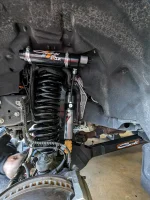
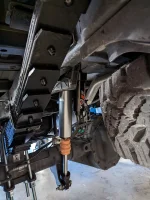
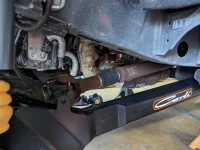
The guy on the phone with CJC Offroad literally said it to me yesterday. He said its all about the bed payload being affected and not the trailer towing capacity. I asked him about it because I was curious what affect the Trophy Hitch was going to have on trailer towing abilities.
@Vecman its super encouraging to hear your enthusiasm! Yea, I figured that not only for myself...but also the eventual resale of the vehicle...most people buy a Tremor for a few different reasons...and most of those people would pay extra for that 37" spare ability.
In truth - I never have a payload in the back and the ride quality in the rear seat (from factory) is abysmal... two babies in car seats get their heads rocked the whole ride!
Payload and Trailer tow capacity aren't mutually exclusive, nor are they directly related. Trailer capacity refers to how much a truck can legally tow behind it as rated by the Manufacturer of the vehicle and DOT. This is a legal rating not altered by any suspension modification. NOW, how that truck handles the load will depend on suspension modifications and configuration of the trailer/payload.
In the end, the weight doesn't matter, if it's within the limit of the door-sticker, but it's distribution will determine how much it relies on the rear suspension to haul it.
If you have 2,700lbs of gravel in the bed, it will directly load the leaf springs. You can use your airbags to combat this preloading of the rear spring.
If you have a 17,000lb. 5th wheel Travel trailer that runs 3,400lbs of tongue weight, you're within the legal limit of what you can tow but it's maxing the bed-load in most configurations and sitting super-heavy on the leaf springs - airbags would definitely be required here.
If you have a 17,000lb. Goose-Neck that loaded with heavy-equipment loaded over the axles only runing 1,200lbs of tongue weight, you're within the legal limit of what you can tow but it's not nearly as reliant on the leaf springs so it won't dip nearly as much and may not require airbags.
the answer is a resounding... it depends!
interesting. carli made it sound differently, but payload would be more than tongue weight should be at max tow capacity, so makes sense i guess. will eliminate the squat tho. i don't tow heavy so also not planning on bags. that trophy hitch has gotta be heavy as hell tho, may add weight in the ass as well.
Tophy hitch only adds 100lbs or so, negligible on these trucks. The additional weight of the full size wheel/tire is another 60-70lbs. Only if you're maxing the factory payload would this be a consideration.
@rayw72 Thanks! I actually had planned to install the airbags however CJC Offroad mentioned that while they would counteract the payload loss, it would detract from the ride quality. In other words, they recommended to forgo the airbags install unless I see my routine usage case change. The Progressive Springs package essentially takes off 15% payload capacity from what the vehicle ships with from the factory (from what I was told).
Since at most I'm going to be towing a 20' Zodiac on a trailer which is probably pushing 10k lbs, I'm not really concerned. Our fam does have a larger boat but really have no intent to trailer it (much less own a trailer for it).
100% correct, airbags are a necessary evil. Forego them unless you absolutely need them!
From what I understand, adding airbags would not increase the weight that the axle, rims, tires, etc... are rated for so would not increase payload. I think CJC is making a point that it will enable you to maintain your original payload numbers as by mitigating the greater squat that would come from comparable loads due to the softer leaves.
@ccw - Is the above correct? Appreciate any clarification/correction

Airbags do not modify payload, they mitigate the sag under load, especially with lighter rate leaf springs.
Correct. The only way to increase the payload capacity listed on the door sticker is reducing the weight of your vehicle.
(Or a GVWR increase done by the manufacturer, but I’ve never heard of that happening in North America.)
In this case an aftermarket parts manufacturer is saying that their part reduces your payload capacity relative to factory. Then they say that air bags restore your payload back to factory. Not over factory.
I will also note that it’s quite possible this is true. On a stock truck we can’t say that air bags increase the payload capacity of the truck because we don’t know if the springs are the weak link in the overall system. And air bags are just that, springs.
In this case we have an aftermarket part where the manufacturer is stating their springs are definitely the weak link. Adding air bags to support the springs therefore makes sense to restore that payload.
100% correct. Airbags should be marketed as restoring your
loaded height as they have zero affect on payload. To your point, it's rarely the leaf springs that are the limiting factor in capacity - rather the axles, tires, etc. The problem is, you need to speak in terms most laymen will understand - consumer education would be a nightmare in more technical terms.
I have the airbags on mine, left at 5 psi per recommended, and I don’t notice any ride quality issue at all. You’re dropping a lot of money on the system, it’s a drop in the bucket really to add these, even if not needed now. You never know what the future holds. I’ve had several experienced SD guys drive my truck around, and they all are in shock at how smooth and comfortable the ride is. So I’d say still go for it, even if you don’t think you’ll need it now. Way easier (and possibly cheaper) to do it during the initial suspension upgrades than doing it later.
You'll notice it on bigger hits. The problem is 2-fold. First, the airbags and brackets outmeasure the bump stops they're replacing so you're giving up some travel on the up-stroke. Secondly, 5 psi ramps up QUICK as the suspension compresses. Running at speed throuhg a big culvert would likely net you a bottoming event in the rear where it wouldn't be the case on a truck with no airbags. We normally recommend bags with internal bumps as they can be run at 0psi unloaded to further mitigate their adverse effect.