Applying the parking brake: what's your preferred method?

My 2020 has always auto- engaged on inclines, slight or severe
 
The "auto-apply" parking brake may be instead Ford's Hill Start Assist feature that "may" also use all four brakes via the ABS system.

Either way, there's some good discussion in this thread about best practice to setting the Parking Brake (a separately-operated, electric-only rear brake caliper activation), not to be corn-fused w/ Hill Start Assist.

/imho - "often wrong, but never in doubt" 🥴
 
I like to flick to the right, then jam the wheel to the left at 45mph, and pull it to begin breaking traction...

That's the only way to hang the ass end all the way out there before you punch it and powerslide through the corner, Applying counterster and throttle modulation as necessary.
 
This process mentioned earlier seems convoluted and pointless.

1. Stop the vehicle
2. Press the parking brake
3. Shift into neutral
4. Release the brake pedal
5. Press the brake pedal again
6. Then shift into park

The same is achieved by stopping the vehicle, holding the brake, shifting to P, engaging the parking brake, releasing the brake.

This will place zero tension on the transmission with no unnecessary steps.

You should always is your parking brake.
 
First , always in neutral on the 12 speed automatic. 😆
 

Attachments

  • PXL_20260104_172752275.webp
    PXL_20260104_172752275.webp
    265.6 KB · Views: 12
The same is achieved by stopping the vehicle, holding the brake, shifting to P, engaging the parking brake, releasing the brake.

This will place zero tension on the transmission with no unnecessary steps.
In my experience, that's not always the case. My F-350 moves a little after putting it in park and letting off the brake, whether or not the parking brake is engaged and even does it on flat ground. Every once in a while, it'll move enough that I can hear the tension on the pawl release when I shift out of park. You have to pass neutral to get to park anyway so I don't really view it as an extra or unnecessary step and releasing the brake in neutral practically guarantees there is no stress on the pawl. No need to press the brake again before shifting from neutral to park on many vehicles.

Realistically, it probably doesn't really matter unless you're on a steep incline or any incline with a load. My borderline OCD brain just makes me do shit like this because why not 🤷‍♂️😂

It's always so interesting the different experiences people have.

I've never had a vehicle move after applying the parking brake or had any kind of clunk or rocking after putting it in park when using the parking brake. As long as you hold the brake the entire time during the process and completely apply the parking brake this just doesn't compute.

Not to say that isn't what happens with you/your truck. I just don't understand it. Which means basically nothing, haha.
I haven't actually seen the pawl mechanism on these trucks, but I've always figured it was mostly from driveline lash/windup and compliance settling into the pawl. 7" of lift and 38s probably make it more pronounced 😂
 
^ ^ ^ There's always a bit of spring wrap happening when 8000 lbs leans one direction or the other onto the rear axle that I've noticed over the years.

And I notice, too, that there's a distinct electric motor screw noise when the electric parking brake engages/disengages, unlike the Hill Start Assist which when it's called upon is somewhat instantaneous in operation.

*headscratch*
 
I only ever used the parking brake when I had a really steep driveway and sometimes couldn’t get it out of park. In that case I absolutely used it properly by putting the parking brake on and then putting it in park.

Now I only use it to activate my high idle switch but I only press it until the light comes on.
 
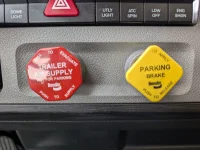
Ew. An automatic and a freightliner
Buttonjammer?

My left foot gets bored now.

It doesn’t even have a parking brake pedal or a high beam clicker to play with, much less a clutch. . :(
 
My left foot gets bored now.

It doesn’t even have a parking brake pedal or a high beam clicker to play with, much less a clutch. . :(


Much less a good dead pedal like the late model F150s have had for the last 10 years.

Come on, Ferd!


As to the getting used to, I remember when cars had an L- or T-handle rig we had to pull straight out from under the dash! heehaw.
 
My wife and I knew a couple from beer league softball post college who had gotten a new manual ford fusion when it came out. Well 2 months later during a trip to local target they (she) didn’t set parking break when parked. When they came out their new car had rolled 20yds forward and jumped the curb went down the little hill and submerged into the retention pond out front of target. Imagine their surprise when they came out from shopping 😂

Frustratingly, a coworker that I've known for many years did this (forgot to engage parking brake on manual transmission car) a couple weeks ago and his car rolled backwards across a couple parking lot rows and rolled into the rear bumper of my truck. Scuffed up about a foot of the driver's side rear bumper and one backup sensor both of which are painted-to-match. It's situations like this that I think about the robust chrome bumper of my previous pickup. Backup sensor currently seems to still be working correctly. He felt bad and has offered to pay for anything. I still haven't attempted to see how much buffs out. I've been too frustrated to mess with it. The insult to injury was that he said he'd done forgot to engage parking brake and had the car roll several times in the last 4 or 5 years since he bought this manual transmission car.

I typically don't engage my parking brake but this is an example of why I should. My parking pawl took the full impact of his car rolling into my truck rather than most/all of the forces being taken by the parking break. It didn't happen in this case, but the worst case scenario in this situation could result in a damaged parking pawl and/or it releasing and your pickup rolling and potentially adding to the damage by rolling into something else. Was a good reminder to engage parking break every time.

I've not parked on such an incline that my parking brake has ever automatically engaged on my '24, but on inclines, like boat ramp, I engage the parking brake before putting it in park, so maybe it just doesn't have the chance to do it automatically or perhaps incline isn't steep enough.

The parking brake does automatically engage if I'm backing up to a trailer and zoom in with the hitch camera. It's smart enough to know I'm doing that when looking to align the ball to hitch and it engages when I throw it in park to keep it from rolling. Interestingly, it then continues to automatically engage it every time I put it in park after that, in the yard, until I shut it off via the screen. Have not left that on to see if it stays on indefinitely. Next time I'll leave it on and see if it continues to do it indefinitely or perhaps just until the next time the engine is shut off.

I also noticed, accidentally, that my electric parking brake automatically disengages if I shift into drive, take my foot off the brake and push on the accelerator pedal. Beats driving away with parking brake engaged and heating it up like the "good ol' days". Ha. But even with that "feature", I normally disengage the parking brake via the switch before taking it out of park and driving away.
 
I remember when cars had an L- or T-handle rig we had to pull straight out from under the dash!
Got pretty good at breaking the back end loose at speed in my old Toyota Pickup on 35s using the twist-and-pull t-handle! 🤙🏼

Sometimes I wonder how I’m still alive - the mirrors on that truck practically touched the ground around corners 😂😂
 
Much less a good dead pedal like the late model F150s have had for the last 10 years.

Come on, Ferd!


As to the getting used to, I remember when cars had an L- or T-handle rig we had to pull straight out from under the dash! heehaw.
My mom's Dodge Dart had that. I used to be fascinated by it as a small child.

Her Gremlin had the folding style I believe. like an old school bus.

The school buses my mom drove usually had a 460 and 5 speed in them... Or some sort of Internatinal V8 gasser with 5 speeds.

Dad drove the big trucks thrift the 70s and 80s anong other things.

Both my parents had class A licenses. Before CDLs even were a thing.
 
Hill Start Assist is usually with the vehicle in gear. Essentially you move to a full stop, vehicle remains in Drive, vehicle is facing uphill, you can remove your foot from the brake to see the truck doesn't roll backwards. It does help to an extent when parking the truck on a hill, but it's not related to the Parking Brake operation.

WHAT IS HILL START ASSIST
Hill Start Assist makes it easier for you to
pull away when your vehicle is on a slope
without using the parking brake.

HOW DOES HILL START
ASSIST WORK
When the system activates, your vehicle
remains stationary for a few seconds after
you release the brake pedal. This gives you
time to move your foot from the brake
pedal to the accelerator pedal. The brakes
release when the engine has developed
sufficient torque to prevent your vehicle
from rolling down the slope.
 
Ew. An automatic and a freightliner
Yeah, it's because now days, nobody can drive anything else. It's sad. When I did a road test here, 13 years ago.....there were NO automatics.....and if you curbed a tire on the road test.....you could re-apply in a year. Things have changed alot. More sad.
 
Last edited:
Back
Top Bottom