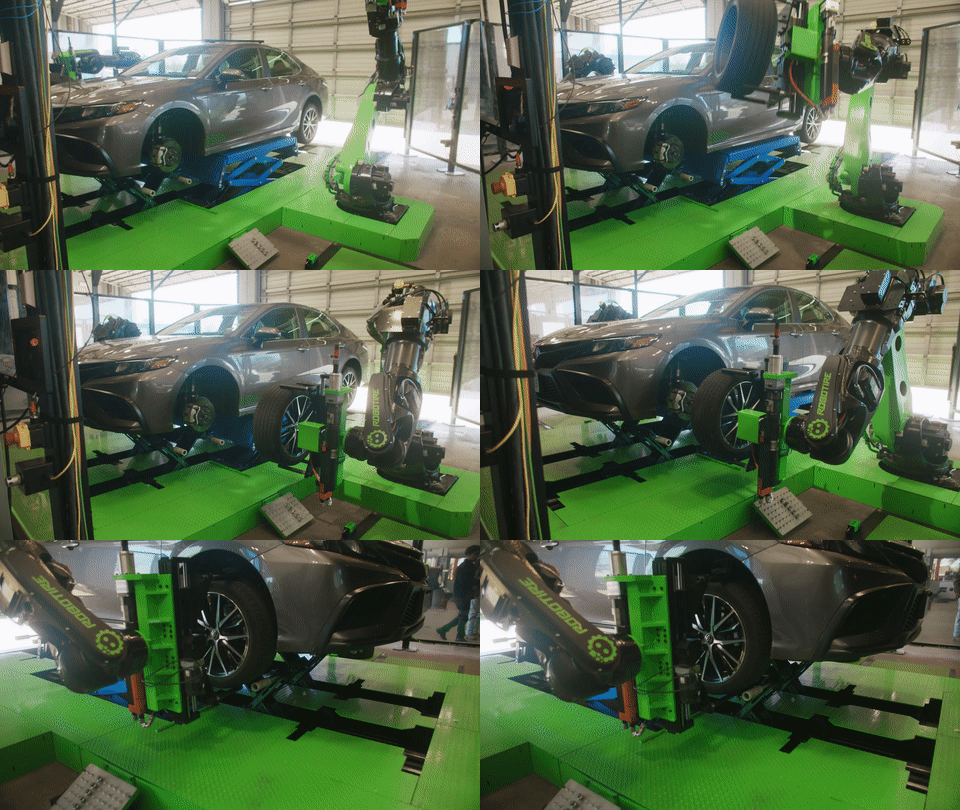
AI-powered RoboTire can change 4 tires twice as fast as a human

DTX2023Tremor

Bourbon & Tremor Enthusiast
Tremor of the Month 🏆
Founding Member 📜
Meetup Organizer 🚧
GB Coordinator 📢
Trail Captain 🧭
Joined
Jul 22, 2022
Messages
4,941
Reaction Points
16,140
Location
Dallas, Texas
Current Ride #1
2023 F350 Platinum Tremor 7.3L (built 9/25)

Discount Tire in Dallas has one of these. They say it will help minimize back injuries, but wonder if the robot produces same, better, or worse quality than a skilled tech.

On the plus side, it will likely torque the lugs to spec. I'd worry about damage to rims removing old/setting new tire. Not clear how it handles balancing before installation back on the vehicle.
 
Seeing how they already damage wheels and center caps and nearly strip lug nuts I can't imagine it'll be any worse lol. I wouldn't call the majority of 16-20 year olds they employ "skilled techs" haha.
Yep, and by question is…… who’s the “skilled tech” that sets up & configures the robot? That thing crashing into your truck would cause far more damage than scratched wheels. Would be a hard pass for me.
 
Yep, and by question is…… who’s the “skilled tech” that sets up & configures the robot? That thing crashing into your truck would cause far more damage than scratched wheels. Would be a hard pass for me.
One day, "AI" will be categorized as one of the most misused terms out there. The robots (or cobots) are timed, calibrated, and rely on sensors, targets, tool extraction panels, etc. to maintain consistency and repeatability. The "technician" is typically a code programmer under the direction of a group of engineers. The cobots are calibrated for each and every type of situation it may encounter. I would absolutely believe this will not work for every vehicle unless it was set up for that vehicle. (Ex: 2023 F250, stock wheel. or 8 lug patterns.) Incidentally, these robots have been used in the automotive industry for many years. Are they fail proof? No. But when operating correctly, they are precise and repeatable, much more than some humans on a Friday night. 🍻

I've worked with these collaborative robots in some prototype situations (not automotive) and saw what they can do, but only under precise coding in software. The "AI" portion is really nothing more than a physical target whereby the arm locates the device (tire/wheel) with respect to the memory of the tool set (which is previously calibrated and should be recalibrated periodically) and all the rest of the movement is programming with feedback sensors. Software directs the cobot to the precise position it needs to be and calibration and sensors to tell it what work needs to be done. (Locate lug nuts, turn direction, etc.)

Normally, these cobots are routinely checked for precision and consistency. They make far fewer mistakes than a human and have built in safety protocols to avoid such things as a crash. (Though, I have seen them crash as a result of re-programing with a glitch. :confused:) Once programmed, they virtually can't make a mistake unless something fails in the arm itself or the platform. (The reason for periodically re-calibrating)
 
One day, "AI" will be categorized as one of the most misused terms out there. The robots

Former CNC programmer, CMM programmer, BS in Mfg/Robotics, now an “IT guy”. Worked in automotive industry since ‘99 (Tier1 Supplier and manufacturer). I understand how they work. I also understand at some point a human involvement is needed. That person needs to understand what he’s doing vs a random “skilled tech” playing paint by numbers. That was my point.
 
One day, "AI" will be categorized as one of the most misused terms out there. The robots (or cobots) are timed, calibrated, and rely on sensors, targets, tool extraction panels, etc. to maintain consistency and repeatability. The "technician" is typically a code programmer under the direction of a group of engineers. The cobots are calibrated for each and every type of situation it may encounter. I would absolutely believe this will not work for every vehicle unless it was set up for that vehicle. (Ex: 2023 F250, stock wheel. or 8 lug patterns.) Incidentally, these robots have been used in the automotive industry for many years. Are they fail proof? No. But when operating correctly, they are precise and repeatable, much more than some humans on a Friday night. 🍻

I've worked with these collaborative robots in some prototype situations (not automotive) and saw what they can do, but only under precise coding in software. The "AI" portion is really nothing more than a physical target whereby the arm locates the device (tire/wheel) with respect to the memory of the tool set (which is previously calibrated and should be recalibrated periodically) and all the rest of the movement is programming with feedback sensors. Software directs the cobot to the precise position it needs to be and calibration and sensors to tell it what work needs to be done. (Locate lug nuts, turn direction, etc.)

Normally, these cobots are routinely checked for precision and consistency. They make far fewer mistakes than a human and have built in safety protocols to avoid such things as a crash. (Though, I have seen them crash as a result of re-programing with a glitch. :confused:) Once programmed, they virtually can't make a mistake unless something fails in the arm itself or the platform. (The reason for periodically re-calibrating)
Agree. I tend to use AI as a generic term rather than worry about using the proper term outside of specific circles. Most people I know don't know the difference between basic models (narrow and general intelligence) versus deep learning, machine learning, generative AI, etc...

To your point, what most of what people think of as AI isn't AI. This tire machine isn't running off of AI, just good ole regular software.
 
Former CNC programmer, CMM programmer, BS in Mfg/Robotics, now an “IT guy”. Worked in automotive industry since ‘99 (Tier1 Supplier and manufacturer). I understand how they work. I also understand at some point a human involvement is needed. That person needs to understand what he’s doing vs a random “skilled tech” playing paint by numbers. That was my point.
Point well taken. In my situation, we had three skilled technicians trained over a period of several months with hands on experience during the training, one of them was "conditioned" as the top guru to analyze any situation. He was skilled both electronically and mechanically who also knew code. A hard combination to find in one tech. These were the only people allowed to touch the controls. There was also another team of engineers that could remote access the controls for testing, troubleshooting and adding capabilities. However, they still had to have one of the "experts" there to physically reposition the robots during calibration or realignment. I was one of the local trainers/debuggers during inception of the systems.

My jest about the 17-year-old was just that. Those robots are extremely powerful and could cause great bodily harm or damage if not handled correctly.

I'm guessing you were one of those trainers or worked closely with the trainers and developers. I tried to talk my son into studying robotics 40 years ago as a possible career, he was gifted mechanically. He instead went into the repair side and runs his own shop now. I don't believe he uses robots yet. I have a whole line of machinist/metal workers on my family side including one that was into electric dragsters. And me in electronics all my life until I retired. (50+ years) Makes for some interesting get together "stories" and elevated conversations', all in fun of course.
 
Back
Top Bottom