Nice. And that is why every truck sold by every manufacturer has rake designed in. When used as designed it works.
Hey, I am relatively new here on the Ford Tremor Forum, but have a fair amount of both off-road and towing experience, so just want to add some possible useful information to your comment.
First, I have already read several threads, and I must say you seem to always have some great comments on a variety of topics. I have learned some new concepts, ideas, stuff and things and appreciate your input and thoughts as well as the perspectives from several other people on this forum.
In reference to the factory rake.....Two Points.
1. "When used as designed it works." I mostly agree with that, but there are some other criteria and variables for each Ford Super Duty Tremor owner to consider.
First, for each individual Ford Super Duty Tremor owner -----> What is the use of the truck? Second and a bit more specific, how much hauling (payload capacity) and towing (bumper pull, gooseneck or 5th wheel) use compared to off-road use? Maybe no hauling, towing or off-road use?
I would venture to say the Super Duty Tremor truck fits a niche between a F150 Raptor and a regular Super Duty. Moreover, with some modifications, the Super Duty Tremor could have the ability to either be more F150 Raptor like...or...more standard F250 / F350 Super Duty like. In addition, if Super Duty Tremor owners plan to use their truck more for hauling and towing, especially towing a bumper pull, then I would expect those owners to appreciate the factory rake and to keep the suspension stock OEM...or maybe add a front coil spring spacer and rear air bags...IF they also need a smidge more clearance for tires up front and at the same time do not want to sacrifice load capabilities.
On the other hand, if Super Duty Tremor owners plan to use their truck a fair amount off-road combined with some light hauling and occasional towing, especially gooseneck or 5th wheel towing, I can see these owners wanting a bit more clearance for tires up front for traversing across uneven terrain off-road, especially in mud and or snow. Factor in medium to more heavy towing, add some air bags to the rear suspension. Will adding air bags to the rear suspension negatively affect rear axle articulation off-road? Maybe....Maybe Not. Could the answer be on YouTube?
DON'T TEAR YOUR AIR BAGS OFF ROADING!!!
When I was a kid growing up on a farm / ranch in the Sow Me state, we had both livestock, stock combo and flatbed trailers. It did not take long for my Dad to realize all of the advantages of gooseneck trailers vs bumper pull trailers. The gooseneck is far superior to the bumper pull...in turning radius, towing stability, and hooking / unhooking. The bumper pulls are simply put, a PITA.
Most of my previous Super Duty trucks were Diesel F350 4WD SRW 172" WB and used to tow 4 Star gooseneck horse trailers to 18 states, mostly in the Rocky Mountain states, Southwest states, Great Plains states, and Midwest states.....to compete in Mounted Shooting. Even though after hooking up the 4 Star gooseneck, the suspension would squat the truck some, but it still set noticeably high in the rear end. As a result, I added an inexpensive Rancho level kit which included Rancho 9000 shocks and their radius arms, along with some air bags on the rear suspension.
I was now able to haul and tow considerably more weight and no longer had to drive the truck "nose to the ground butt in the air" when not loaded. Because the truck was used for hauling and towing, there was no need to spend more money on a superior suspension system like Carli or Kelderman. The truck still did everything it was designed to do...and at the same time was more enjoyable to drive, especially when it was unloaded.
The off-road experience started when I was a kid...growing up in Missouri. I was fortunate enough to see Bob Chandler's 1974 Ford F250 4WD truck a few places, namely Midwest 4WD Center in Hazelwood Missouri, the Jeep races in Lesterville Missouri...but most often at "Number 9 Hills" (aka, "The Nines") which was an 8,000 acre 4WD playground paradise near Farmington Missouri. I later purchased my first 4WD truck......and Bob...his 1974 Ford F250 4WD 360 V8 / NP 435 was later modified with a 460 V8 / C6 / 2 1/2 ton Rockwell military axles that people now know as the original BIG FOOT truck.
It is worth mentioning the standard F250 4WD SRW 172" WB trucks have noticeably less factory rake compared to the standard F350 version. The same was true with the 4WD SRW 156" WB trucks although less pronounced, compared to the longer bed versions. I have also had two of the newer 4WD SRW 160" WB trucks...one F250 and one F350.
Present day, my needs changed a few months ago when I moved OTG, to a remote area in the Cowboy state...Wyoming. I currently have a 2022 F350 Lariat 7.3L UP - BAP - Tremor with Warn winch on order. I wanted the 7.3L gas engine for numerous reasons, because the newer diesel engines are so messed up with the EPA and other government regulations, additional cost, maintenance, etc., but also because my towing needs are reduced while my off-road needs are now more prominent. If I had the need for a diesel engine truck, I would opt for a 2005 - 2007 Ford F350 4WD and have Geo Performance in Livingston Montana install a tow performance 5.9L Cummins from either Industrial Injection in Utah or CPP Diesel in Pennsylvania...but, that is entirely a different discussion.
Initially, I plan to leave the suspension OEM stock. However, there is a great possibility, actually way more likely than not I will swap out the OEM stock suspension for a Carli level suspension. Not certain if I will go with the Fox 2.0 reservoir shocks (Back country) or King 2.5 reservoir shocks (Pintop). If I do indeed decide to install a Carli suspension, I plan to also add air bags to the rear suspension. I think this can be done in a way without sacrificing off-road articulation of the rear axle.
2. "And that is why every truck sold by every manufacturer has rake designed in."
What about the factory rake or lack thereof on both F450 and F550 Super Duty trucks?
Sometimes I am "blind in one eye and cannot see out of the other eye", and I could be wrong, but it appears to me the F450 and F550 Super Duty trucks set fairly level. Why is that? More importantly, how is it even possible for a Class 4 and Class 5 truck to carry considerably more weight than Class 2 and Class 3 trucks, yet set fairly level...with virtually no factory rake?
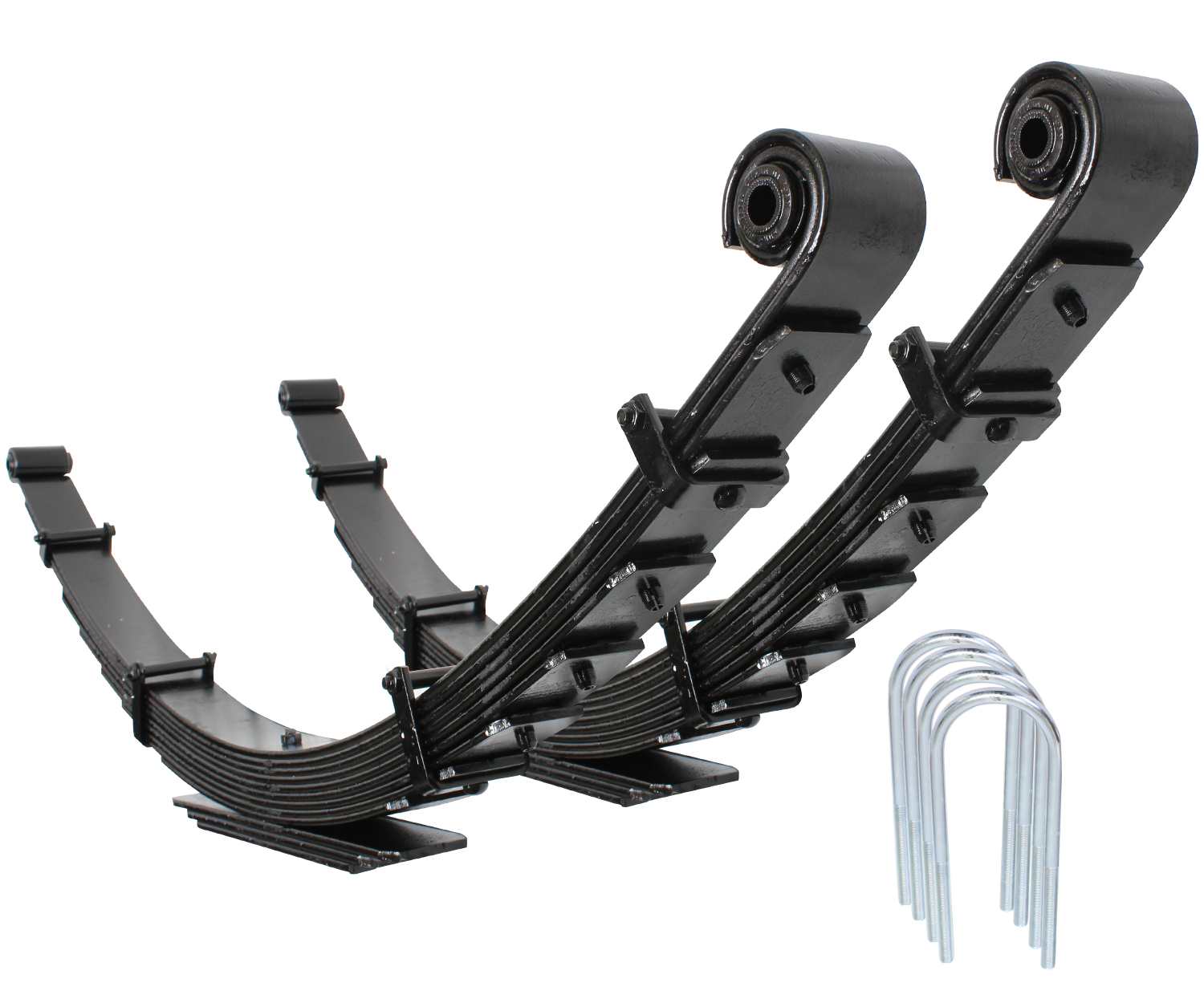
The obvious is the rear axle assembly...the axle shafts, housing, and differential case...much stronger...and the rear leaf spring packs...more springs, but each leaf also designed and engineered considerably different...to hold more weight, yet at the same time, yield no noticeable factory rake.
A couple of guys smarter than me stated that truck manufacturers could actually build Class 2 and Class 3 trucks with little to no factory rake, but the typical Class 2 and Class 3 truck buyers would not want such a stiff suspension. To say it another way, they said the truck manufacturers could design and engineer the rear leaf spring packs for Class 2 and Class 3 trucks to set with almost no factory rake, yet haul and tow Class 2 and Class 3 truck payloads, GVWR / GCWR ratings.
Hopefully, the above information is beneficial, helpful and informative to all who read it. I welcome any analysis, critique, ideas, opinions, or thoughts.