I don't see that anywhere at all. Not only that, the Tremor wheel/tire combo is one of many 18" combos. The Tremor's tires do not at all decrease its towing ability (unless you're comparing to a DRW obviously).
Navigation
Install the app
How to install the app on iOS
Follow along with the video below to see how to install our site as a web app on your home screen.
Note: This feature may not be available in some browsers.
More options
Style variation
You are using an out of date browser. It may not display this or other websites correctly.
You should upgrade or use an alternative browser.
What's needed to revert to "normal" F350 suspension?
- OP 🔹 toximus
- Start date


I am pretty sure that is not correct on the rear sway bar. Searching the order guide I only found the Rear Stabilizer Bar was included the camper package or heavy service package for box deletes in SRW trucks. When I was shopping for trucks I looked at quite a few non Tremor Superduties without one.The Tremor is the only package that does not have a rear sway bar. A tires rated load capacity is a tires rated load capacity. There is a separate towing capacity exception listed for 18's and Tremor, which means the 18's aren't the reason for the Tremor's reduced towing.

I think you missed a couple posts there partner.I am pretty sure that is not correct on the rear sway bar. Searching the order guide I only found the Rear Stabilizer Bar was included the camper package or heavy service package for box deletes in SRW trucks. When I was shopping for trucks I looked at quite a few non Tremor Superduties without one.
Sorry phone didn’t load newer posts I am in the process of getting through the others.I think you missed a couple posts there partner.
As for the tires they do have a great payload but don’t feel as good on lateral stability having run other tires as well as Duratrac’s on the non tremors Superduties. Changing them on a old work truck made a quick easy stability improvement for me. I think different shocks as well as smaller front sway bar coupled with tires may have something to do with different ratings. I am pretty sure there are some performance factors that go into the ratings as well.
Performance factors might definitely be a part of it actually - you can't get as low of gears in a Tremor as you can in a non-Tremor. Shorter gears usually = higher towing.As for the tires they do have a great payload but don’t feel as good on lateral stability having run other tires as well as Duratrac’s on the non tremors Superduties. Changing them on a old work truck made a quick easy stability improvement for me. I think different shocks as well as smaller front sway bar coupled with tires may have something to do with different ratings. I am pretty sure there are some performance factors that go into the ratings as well.

Agreed on all of that.Either way, with the combined capacity of over 8,000 pounds on the tires (at the rear), they aren't the weakest rated point. I'm sure we can all agree every component on these trucks that are used to calculate the truck's capacity are way underrated. I've seen a non-Tremor SRW F350 goosenecking a trailer that had to have had a ~10,000 pound hitch weight (two ~7,000 pound tractors, one completely in front of the trailer's axles) without failure. Obviously that is a stupid extreme. But my point is if you are within all of each individual components' rated capacities, you are definitely fine. What you can do legally, mechanically, and responsibly are all different, and are all based on different measures. If we all went by what we can do legally, half the weekend camping rigs you see going down the road would be gone. Mechanically, most of us are fine (actually following ratings or not). But some people are extremely irresponsible and shouldn't even be towing........
Aren’t the gears on the Tremor, 4.10’s, the lowest you can go without going for a dually (or maybe even a 450)?Performance factors might definitely be a part of it actually - you can't get as low of gears in a Tremor as you can in a non-Tremor. Shorter gears usually = higher towing.

Alright cleaned this up as best I could do quickly and updated the TREMOR Towing Table:
View attachment 39075
Visually showing the bottom line being that the maximum trailer weight of a Tremor is the GCWR limit Ford places on the VIN, or the CDL limit — if rules apply to you.
It's notable to me how different the math is on what configuration is best depending on what rules apply to you (or you choose to obey.)
(cc @ccw for quality control on this.)

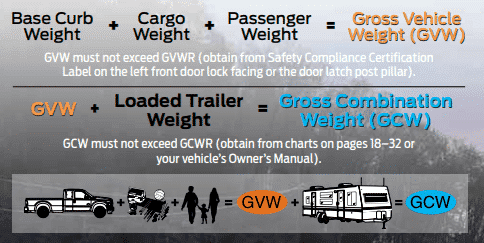
The max weight of the trailer for GCWR limit, second to bottom row would only be limited to these numbers if your truck was already at GVW before you even hooked up the trailer, ie. you were driving your F350 7.3 around at 11.3k with no trailer. You have not accounted for tongue/hitch weight. The GVW of the truck + the GVW of the trailer has to be less than GCVW. Depending on tongue weight you can tow up the truck's tow ratings and still be under GCWR in most situations - depends on your options / truck empty curb weight.
Also if you are not towing commercial you do not need a CDL (hence commercial DL) in almost all situations/states (exceptions include Hawaii and D.C.)
Even in CA:

License Classes and Requirements - California DMV
Noncommercial License Classes: License classes are based on the size of the vehicle you wish to drive or the weight of the trailer you wish to tow. No passenger vehicle, pickup truck, or RV may tow more than one other vehicle without a Commercial Class A license with the proper endorsement. You...
 www.dmv.ca.gov
Many of the references people use are coming straight from CDL laws, and they skipping over words like "commercial" and "for hire". A class A exempt is almost always what is needed, not a CDL.
Actually I'm sure there's a difference gas vs diesel. Diesel only available is 3.55Aren’t the gears on the Tremor, 4.10’s, the lowest you can go without going for a dually (or maybe even a 450)?

Either way, with the combined capacity of over 8,000 pounds on the tires (at the rear), they aren't the weakest rated point.
I'm sure we can all agree every component on these trucks that are used to calculate the truck's capacity are way underrated.
I've seen a non-Tremor SRW F350 goosenecking a trailer that had to have had a ~10,000 pound hitch weight (two ~7,000 pound tractors, one completely in front of the trailer's axles) without failure.
I don't fully agree, and not to argue or to prove you wrong, only to share a slightly dissimilar point of view:
I've, personally, had a consistently unenjoyable time towing at the 15k# capacity on the Tremor when at highway speeds. I've, similarly, had a consistently unenjoyable time in emergency stopping scenarios with the Tremor when loaded.
While my tires aren't even remotely at risk of *bursting* from the weight I carry/tow, I certainly feel as though I'm using the tires beyond their intended purpose when at capacity.
And this stands in contrast to my experience towing similar weight on A/T tires, where 15k# on a Super Duty feels imperceptible.
That said, we all perceive things differently.

i was thinking the same ..coming from a 17 F350 lariet dually.pulling a 42 foot Solitude 374 TH triple axle.. Tried it first with a 15 F250 but didnt care for the seat of the pants feeling nor over grossing the truck by a 1000 lbs.....lesson learnedNice trailer!
The Tremor isn’t technically “lifted” since it’s the same height as 17-19 Super Duty’s — which many people are towing big trailers with just fine.
If you don’t like the feel of the tow, start with the tires. These tires feel pretty loose when towing, and the Tremor is down rated relative to other Super Duty’s because of the tires.
FWIW, many people here are towing trailers of that size. The Tremor will handle it. If you want it to handle it better, why get a Tremor? Why not get a dually?
What exactly is it about the tires that you don't like for towing? I personally need an off road tire. So if a non-off road tire is just better (which I know is, regardless of the Duratrac's high capacity), I don't care, I can't use it. That being said, I won't use the off roadness of the tires to discredit the Tremor's towing ability. If you don't need off road tires and you tow, sure, don't use off road tires. But then again, also don't get a Tremor.I don't fully agree, and not to argue or to prove you wrong, only to share a slightly dissimilar point of view:
I've, personally, had a consistently unenjoyable time towing at the 15k# capacity on the Tremor when at highway speeds. I've, similarly, had a consistently unenjoyable time in emergency stopping scenarios with the Tremor when loaded.
While my tires aren't even remotely at risk of *bursting* from the weight I carry/tow, I certainly feel as though I'm using the tires beyond their intended purpose when at capacity.
And this stands in contrast to my experience towing similar weight on A/T tires, where 15k# on a Super Duty feels imperceptible.
That said, we all perceive things differently.
The max weight of the trailer for GCWR limit, second to bottom row would only be limited to these numbers if your truck was already at GVW before you even hooked up the trailer, ie. you were driving your F350 7.3 around at 11.3k with no trailer. You have not accounted for tongue/hitch weight. The GVW of the truck + the GVW of the trailer has to be less than GCVW. Depending on tongue weight you can tow up the truck's tow ratings and still be under GCWR in most situations - depends on your options / truck empty curb weight.
Also if you are not towing commercial you do not need a CDL (hence commercial DL) in almost all situations/states (exceptions include Hawaii and D.C.)
Even in CA:
License Classes and Requirements - California DMV
Noncommercial License Classes: License classes are based on the size of the vehicle you wish to drive or the weight of the trailer you wish to tow. No passenger vehicle, pickup truck, or RV may tow more than one other vehicle without a Commercial Class A license with the proper endorsement. You...
Many of the references people use are coming straight from CDL laws, and they skipping over words like "commercial" and "for hire". A class A exempt is almost always what is needed, not a CDL.
You make some interesting points. I'm not certain you're correct. But there's some conflation of GVW and GVWR here that's beyond my mental faculties at this point in time on a Friday.
I'll defer to you and @ccw to investigate this further.
What exactly is it about the tires that you don't like for towing?
They feel unstable and at their limit (like I'd expect a mud tire to feel) when at the Tremor's capacity ratings. To the extent that I imagine hanging 20k# (the non-Tremor capacity) off the bumper of the Tremor to be a harrowing experience.
I personally need an off road tire. So if a non-off road tire is just better (which I know is, regardless of the Duratrac's high capacity), I don't care, I can't use it. That being said, I won't use the off roadness of the tires to discredit the Tremor's towing ability. If you don't need off road tires and you tow, sure, don't use off road tires. But then again, also don't get a Tremor.
Agreed.

Last edited:
I'll also note again, just for posterity, that speed has a dramatic impact on the performance of the Duratrac's (as I perceive it.)
I regularly exceed the Tremor's tow ratings off-road and on back roads. (I know, I know…)
I just pucker up at capacity on high-speed roads. And wouldn't dare tow beyond capacity at or above ~65mph.
I'm pretty sure I agree with you. You're not saying the table is wrong, just that it's difficult to hit GCWR assuming you stay within GVWR, particularly once accounting for tongue weight?The max weight of the trailer for GCWR limit, second to bottom row would only be limited to these numbers if your truck was already at GVW before you even hooked up the trailer, ie. you were driving your F350 7.3 around at 11.3k with no trailer. You have not accounted for tongue/hitch weight. The GVW of the truck + the GVW of the trailer has to be less than GCVW. Depending on tongue weight you can tow up the truck's tow ratings and still be under GCWR in most situations - depends on your options / truck empty curb weight.
It's true that in some states you may require some special form of license when towing over 26,000 pounds, with your link showing that CA is one of those states. However, when it comes to trailers that do not fall under the traditional CDL exceptions (RVs and horse trailers for personal use), your link provides no mention of not requiring a CDL:Also if you are not towing commercial you do not need a CDL (hence commercial DL) in almost all situations/states (exceptions include Hawaii and D.C.)
Even in CA:
Many of the references people use are coming straight from CDL laws, and they skipping over words like "commercial" and "for hire". A class A exempt is almost always what is needed, not a CDL.License Classes and Requirements - California DMV
Noncommercial License Classes: License classes are based on the size of the vehicle you wish to drive or the weight of the trailer you wish to tow. No passenger vehicle, pickup truck, or RV may tow more than one other vehicle without a Commercial Class A license with the proper endorsement. You...
You'll note that it states you can only tow travel trailers (not for hire) and livestock trailers (if a farmer) over the specified weights with a non-commercial Class A. It makes no mention of other types of trailers or cargo, thus I wouldn't assume you're suddenly able to with that license class.
The challenge is defining "commercial" use. If you rent a skid steer and tow it home, you may not be towing it for hire but you are hauling it for a commercial purpose (rental). Similar for using a dump trailer to haul raw material that you purchased from somewhere, even if you just bring them home (purchase). Etc.
Definitely not a lawyer, but IMO the link you shared further exemplifies that a CDL would be required for other types of loads (assuming combined GVWR is over 26,000 pounds). It certainly doesn't prove one isn't needed just because you aren't driving for hire.
Another state I can confidently state requires a CDL for anything over 26,000 pounds combined GVWR, as long as it isn't a specific exception class, is WA. The site lays it out extremely clearly. Here's the flow chart for if a CDL is required:
And here's the exemptions to that flow chart:
Both of the examples I gave above (skid steer rental, dump trailer with raw material) don't fall under the exceptions and clearly would fall under the CDL requirements in the flow chart, assuming combined GVWR was over 26,000 pounds.
I'm all ears to seeing regulations that state otherwise, but until then I will recommend folks play it safe with the 26,000 pound limit unless they're clearly towing a CDL exempt trailer for personal use, e.g. an RV. I will also continue to state I'm not a lawyer, just a truck enthusiast.

On your WA example you are using the CDL requirements page, for commercial use. Not all commercial drivers need a CDL, only ones that fall into these categories. If you back up on your web page link you will read this:I'm pretty sure I agree with you. You're not saying the table is wrong, just that it's difficult to hit GCWR assuming you stay within GVWR, particularly once accounting for tongue weight?
It's true that in some states you may require some special form of license when towing over 26,000 pounds, with your link showing that CA is one of those states. However, when it comes to trailers that do not fall under the traditional CDL exceptions (RVs and horse trailers for personal use), your link provides no mention of not requiring a CDL:
View attachment 41664
You'll note that it states you can only tow travel trailers (not for hire) and livestock trailers (if a farmer) over the specified weights with a non-commercial Class A. It makes no mention of other types of trailers or cargo, thus I wouldn't assume you're suddenly able to with that license class.
The challenge is defining "commercial" use. If you rent a skid steer and tow it home, you may not be towing it for hire but you are hauling it for a commercial purpose (rental). Similar for using a dump trailer to haul raw material that you purchased from somewhere, even if you just bring them home (purchase). Etc.
Definitely not a lawyer, but IMO the link you shared further exemplifies that a CDL would be required for other types of loads (assuming combined GVWR is over 26,000 pounds). It certainly doesn't prove one isn't needed just because you aren't driving for hire.
Another state I can confidently state requires a CDL for anything over 26,000 pounds combined GVWR, as long as it isn't a specific exception class, is WA. The site lays it out extremely clearly. Here's the flow chart for if a CDL is required:
And here's the exemptions to that flow chart:
Both of the examples I gave above (skid steer rental, dump trailer with raw material) don't fall under the exceptions and clearly would fall under the CDL requirements in the flow chart, assuming combined GVWR was over 26,000 pounds.
I'm all ears to seeing regulations that state otherwise, but until then I will recommend folks play it safe with the 26,000 pound limit unless they're clearly towing a CDL exempt trailer for personal use, e.g. an RV. I will also continue to state I'm not a lawyer, just a truck enthusiast.
Do I need a CDL?
Find out if you need a CDL to drive your commercial vehicle.Emphasis mine.
Edit:
-Just saw your exempt link - I responded before I saw you posted it!.. But yes, RVS are exempt
CCW - I completely agree that everyone should play it safe and talk to their own states code enforcement for their specific situation. I am not familiar on various state law, and barely on TX! I am also not an expert on any of this and consider this all just a water cooler discussion of what's on the web. I'd say the 26k rule is a gray area and really hard to get a straight answer on. Most searches return results that are specifically in a commercial context, like truck drivers and the like. Even various DMV websites list info regarding 26k specifically under commercial rules, which I feel is misleading.
When you try to find the actual law there are often applicability rules that are not obvious on many websites, like federal law:
PART 383 - COMMERCIAL DRIVER'S LICENSE STANDARDS; REQUIREMENTS AND PENALTIES
§ 383.5 Definitions.
Commercial motor vehicle (CMV) means a motor vehicle or combination of motor vehicles used in commerce to transport passengers or property if the motor vehicle is a -
(1) Combination Vehicle (Group A) - having a gross combination weight rating or gross combination weight of 11,794 kilograms or more (26,001 pounds or more), whichever is greater, inclusive of a towed unit(s) with a gross vehicle weight rating or gross vehicle weight of more than 4,536 kilograms (10,000 pounds), whichever is greater; or
(2) Heavy Straight Vehicle (Group B) - having a gross vehicle weight rating or gross vehicle weight of 11,794 or more kilograms (26,001 pounds or more), whichever is greater; or
Reference:
It's easy to skip over words like "used in commerce." I still believe that if you are not a commercial vehicle there are very few situations/locations where you need an actual CDL. A class A exempt would be Texas's version of the requirement over 26k.
Disclaimer again: Not an expert Everyone should go out and get the appropriate license for their rig, whatever that might be.
When you try to find the actual law there are often applicability rules that are not obvious on many websites, like federal law:
PART 383 - COMMERCIAL DRIVER'S LICENSE STANDARDS; REQUIREMENTS AND PENALTIES
§ 383.3 Applicability.
(a) The rules in this part apply to every person who operates a commercial motor vehicle (CMV) in interstate, foreign, or intrastate commerce, to all employers of such persons, and to all States.§ 383.5 Definitions.
Commercial motor vehicle (CMV) means a motor vehicle or combination of motor vehicles used in commerce to transport passengers or property if the motor vehicle is a -
(1) Combination Vehicle (Group A) - having a gross combination weight rating or gross combination weight of 11,794 kilograms or more (26,001 pounds or more), whichever is greater, inclusive of a towed unit(s) with a gross vehicle weight rating or gross vehicle weight of more than 4,536 kilograms (10,000 pounds), whichever is greater; or
(2) Heavy Straight Vehicle (Group B) - having a gross vehicle weight rating or gross vehicle weight of 11,794 or more kilograms (26,001 pounds or more), whichever is greater; or
Reference:
It's easy to skip over words like "used in commerce." I still believe that if you are not a commercial vehicle there are very few situations/locations where you need an actual CDL. A class A exempt would be Texas's version of the requirement over 26k.
Disclaimer again: Not an expert Everyone should go out and get the appropriate license for their rig, whatever that might be.
Last edited: