- OP 🔹
- #21
Navigation
Install the app
How to install the app on iOS
Follow along with the video below to see how to install our site as a web app on your home screen.
Note: This feature may not be available in some browsers.
More options
Style variation
You are using an out of date browser. It may not display this or other websites correctly.
You should upgrade or use an alternative browser.
You should upgrade or use an alternative browser.
Little confused by carli installer in terms of caster
- OP 🔹 Cglenn
- Start date

Unfortunately like an idiot I've misplaced my post-alignment results sheet. But I remember my caster was set just north of 4 degrees... Truck drives great with that setup. That's with the 4-1/2" lift.
To answer the question on installing the caster shims. If doing the radius arm option, it's literally no extra work as the shims are installed before you run the pass through bolts that fasten the arms to the front axle. The shims that have the extra offset in the knuckle do take work but I don't consider it "extra" work as it really should be required work to be able to align the truck properly. Any installer tech with competency of doing alignments on lifted vehicles would understand the need for the proper available offsets with these shims. If the installer doesn't do alignments then they wouldn't really know this.
At our shop our techs also have years of experience doing alignments so it's just baked in knowledge that installing the shims with the right offsets is a must for ideal ride conditions.
If you're doing the front knuckle shims at the right time (usually after you've removed the front shocks and/or coils) you'll find that you have plenty of space to easily remove the cotter pin and castle nut holding the shim in place. Maybe an extra 10 mins per side tops. In my experience using a appropriately sized socket placed on the shim itself and banging it with an appropriately sized hammer a few times does the trick to pop the shim up and then it easily comes out. Installing it is the reverse. Carli even tells you the estimated orientation to install the new caster correcting shim in so that during alignment, you'll have minimal effort in dialing in the caster. But many techs don't read install instructions or even watch the "how to install" videos...
Installing all these kits are "big" jobs usually requiring multiple days and most guys frankly get lazy and fatigued as the install goes but you can't fall in to that trap with these big jobs as some of the most important stuff happens in the mid and late phases of the install... Especially when it comes time to torqueing everything properly. Otherwise you get all sorts of noises, binding or worse, fasteners straight coming undone when a customer is on their "big trip"....
Also make sure whoever is doing your alignment is a skilled and experienced technician. Often times you go to a place and it's a first year junior tech doing the work who doesn't know how to do anything that is outside traditional factory specs.
When dealing with aftermarket realities, doing things within OE spec is sometimes a no-no.
When dealing with aftermarket realities, doing things within OE spec is sometimes a no-no.



Absolutely the provided Carli caster shims should be used for best results in alignment... The factory Ford shims won't have enough offset in them to account for the lift provided by even a 2-1/2" kit.
You need the shims period.
To answer the question on installing the caster shims. If doing the radius arm option, it's literally no extra work as the shims are installed before you run the pass through bolts that fasten the arms to the front axle.
I’m somewhat confused now guys. This is what Carli website says and i checked with @BLACKCHERRY that shims were not required with Carli radius arms for my 3.5 system install. You seem to state otherwise.
“If running Carli Radius arms, it’s not necessary to run any additional caster correction as they increase caster 1°“
For the radius arm install specifically - A shim kit comes in the boxes with the radius arms (pic provided from Carli's website for reference) - shims are in the lower left under the arms.
 In the provided skim kit (at least what came with mine) you have 4 different shims to choose from in increasing caster offset (this is why the arms are referred to as "adjustable") but at least one shim has to be used per radius arms in order for the passthrough bolts to sit correctly. I'm speaking about the lower radius arm bolt that connects to the front axle. In the install instructions it tells you for your application (ride height) which shims to choose from. Lower height needs less offset, higher height needs more. But the goal again of having enough caster is to have a better geometry up front so that things like death wobble and steering "feel" are frankly a non-issue.
It's true that the radius will already have some caster offset built in but you will still need to choose matching shims to insert in to the arms during the install otherwise your lower bolt can not be properly installed. Even if that means using the lowest setting shim which possibly doesn't add any extra caster.
It's true that the radius will already have some caster offset built in but you will still need to choose matching shims to insert in to the arms during the install otherwise your lower bolt can not be properly installed. Even if that means using the lowest setting shim which possibly doesn't add any extra caster.
Last edited:
Btw... here are the install instructions for the various shims that go with the install. Judge for yourself if you "need" your install revised at this point.
Attachments
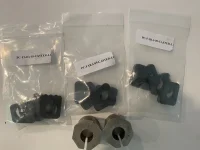
Thank you for explaining it to a novice like me. I was able to confirm that i have 2.0 shims installed by process of elimination, comparing to the 3 shims bags that i have left.Btw... here are the install instructions for the various shims that go with the install. Judge for yourself if you "need" your install revised at this point.
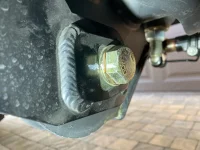
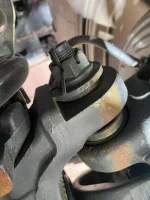
It’s the ball joint shims that i don’t have installed and those are the ones i wondered if need to be installed with Carli radius arms (they are in the attched photo, obviously not installed). My installer said they are not needed, so did Dan i believe.
So my question is, is this particular statement related to ball joint shims not being required with carli radius arms or am i still confusing something?
“If running Carli Radius arms, it’s not necessary to run any additional caster correction as they increase caster 1°“
Attachments
Last edited:
the ball joint caster sleeve shims are generally not needed IF the Carli adjustable radius arms are installed.Thank you for explaining it to a novice like me. I was able to confirm that i have 2.0 shims installed by process of elimination, comparing to the 3 shims bags that i have left.
It’s the ball joint shims that i don’t have installed and those are the ones i wondered if need to be installed with Carli radius arms (they are in the attched photo, obviously not installed). My installer said they are not needed, so did Dan i believe.
So my question is, is this particular statement related to ball joint shims not being required with carli radius arms or am i still confusing something?
“If running Carli Radius arms, it’s not necessary to run any additional caster correction as they increase caster 1°“
this is stated clearly in the radius install instructions.
This is going to create an issue for me when I install the Carli arms as I will most likely need to go back to stock shims, or 0.5* ones similar to stock (0.4*)
If STOCK radius arms are used, then the ball joint caster sleeve shims are required.
Thanks for confirming. I now beleive above statements by @Cybermig and @donmatteo apply to cases when stock radius arms are retained with carli levels - one needs to add ball joint caster sleeve shims. However, when mounting with Carli radius arms - ball joint caster sleeve shims are NOT required.the ball joint caster sleeve shims are generally not needed IF the Carli adjustable radius arms are installed.
this is stated clearly in the radius install instructions.
This is going to create an issue for me when I install the Carli arms as I will most likely need to go back to stock shims, or 0.5* ones similar to stock (0.4*)
If STOCK radius arms are used, then the ball joint caster sleeve shims are required.
For everyone’s knowledge, here’s my spec sheet on Carli 2.5 level with carli radius arms with 2.0 shims installed. I was shocked how little caster i had when the truck went on the alignment rack. The installer was shocked! We went to 4.0 shims and ended up with rougly +3 of positive caster. The installer said 3 was OK, but now after watching Carli vidoes. i wished we also put in the ball joints shims to get the caster to 5+ range.
Attachments
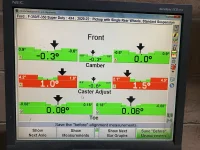
interesting that you posted this. i have had similar results and have just kept quiet about it. i was too expecting higher caster numbers. i was wondering if it could have been the machineFor everyone’s knowledge, here’s my spec sheet on Carli 2.5 level with carli radius arms with 2.0 shims installed. I was shocked how little caster i had when the truck went on the alignment rack. The installer was shocked! We went to 4.0 shims and ended up with rougly +3 of positive caster. The installer said 3 was OK, but now after watching Carli vidoes. i wished we also put in the ball joints shims to get the caster to 5+ range.

i installed the adjustable radius arms and was shocked how low the caster was after. i used the 3 notch shims and my readings were 2.3* driver and 2.9* passenger.
i have been battling a left pull, so i threw the 4 notch shim on the driver side to try and help it. i did not have the caster rechecked.
i have since figured out the reason for my pull and it has nothing to do with the alignment.
i have not done anything to address the caster, but i am considering either 1 or 2 degree shims at the knuckle
what was the cause of your pull? I notice exactly the same thing. Just curious of you found a fix that i can test.interesting that you posted this. i have had similar results and have just kept quiet about it. i was too expecting higher caster numbers. i was wondering if it could have been the machine
i installed the adjustable radius arms and was shocked how low the caster was after. i used the 3 notch shims and my readings were 2.3* driver and 2.9* passenger.
i have been battling a left pull, so i threw the 4 notch shim on the driver side to try and help it. i did not have the caster rechecked.
i have since figured out the reason for my pull and it has nothing to do with the alignment.
i have not done anything to address the caster, but i am considering either 1 or 2 degree shims at the knuckle
I think i’m just going to install the 2 deg ball joint shims and get my caster to about 5 deg. I’m a bit upset i didnt do it last weekend and get it over with while the truck was being adjusted. now it’ll cost me another couple of hundred to get this done. I learned a lot of new info i didn’t fully understand as of last weekend.

- Nov 2, 2020
- 565
- 1,545
- 2021 F250 Tremor 7.3 Lariat
- 2023 Xpore Roamer1, 2013 Jeep Rubicon 2dr
As most of us have experienced, these Tremors wander a lot when new. Many say the tires need to get broken in. Maybe, but I think it is mostly too little caster. I'm not going to lift mine, but I plan to do the caster shims anyway. I did the same thing on my Jeep and it went from terrible to OK as far as steering was concerned. I brought it up to about 5 degrees.
As far as which shims to order, I'm not sure. The Carli shims are expensive, but they might be made better than ones I can't get any data on.
The video in post 8 really shows how simple the procedure is.
Given all of that, I would seriously question anyone told me I could lift the truck and not add caster. It is already too low from the factory. As the control arm arcs around the axle center, as the truck is lifted, the axle rotates forward, which reduces caster. This makes the vehicle less stable at speed and less likely to return the steering wheel to center after a turn. It makes it harder to go straight on the highway. If the tires are out of balance, the truck is more vulnerable to a wobble, or shimmy.
Certainly get the shims if you lift the truck. I'll do it even though I'm not going to lift mine.
Ford uses an EPAS (electronic power assisted steering) on some vehicles. the EPAS automatically corrects the steering for road crown, angle, etc...what was the cause of your pull? I notice exactly the same thing. Just curious of you found a fix that i can test.
I think i’m just going to install the 2 deg ball joint shims and get my caster to about 5 deg. I’m a bit upset i didnt do it last weekend and get it over with while the truck was being adjusted. now it’ll cost me another couple of hundred to get this done. I learned a lot of new info i didn’t fully understand as of last weekend.
google it for more info
apparently some super duties get a version of this system. i'm not sure which trucks get it, but any truck that has the pro trailer system do. the trucks that have it have a big aluminum bracket just behind the driver shock mount. that bracket supports the motor which the steering shaft passes through.
my truck had a consistent left pull that seemed to start fairly recently, or i didn't really notice it until i put 37s on. but once i noticed it, it was very distinct. i thought it was the tires, but AT3s are not known to have a radial pull. i put the stock duratracs back on and the pull was the same. i checked every component on the front end, 2 alignments, caster changes, etc... to fix it. nothing was out of the ordinary and caster split wasn't horrible, but even correcting that did nothing to fix it. it seemed like something was "turning" the wheel left when i let go of the wheel. however, on some roads it drove perfectly straight.
then i found out about this EPAS system. after reading about it and symptoms when it failed, it sounded exactly like what my truck was doing.
I was posting on FTE and another member posted about having a bad steering wander on his '22. he pulled the power steering fuse (#9 i think) and all symptoms stopped. however, he did have lots of lights. so i figured i would do the same, but i took it a step further and pulled the bigger 40 amp fuse (#29 i think) that seemed to control more than the power steering. i got all kinds of light and warnings. i drove the truck. besides having heavier steering, the tracking and drive of the truck was instantly better. no pulling. i drove around my town on all the roads the truck would normally pull significantly on for about 20 minutes. no pull whatsoever.
so that proved to me there was and electrical issue causing my pull. it was something in that EPAS or one of the other electronic steering systems.
i reinstalled the fuse and fully expected the pull to be back, and i was trying to figure out how i could get the dealer to fix it. however, the pull did not come back! it has been well over a week and the pull has not returned. so something changed/reset when i pulled that fuse for 20 minutes.
i have not cleared any codes (i'm sure there are some stored) because i don't want anything to potentially reset and cause the issue to come back.
maybe you have something similar? good luck
Last edited:
Thank you for the insight. Respect for getting down to the bottom of the issue. Who would have thought that it was dialed in electronically by Ford to pull left.Ford uses an EPAS (electronic power assisted steering) on some vehicles. the EPAS automatically corrects the steering for road crown, angle, etc...
google it for more info
apparently some super duties get a version of this system. i'm not sure which trucks get it, but any truck that has the pro trailer system do. the trucks that have it have a big aluminum bracket just behind the driver shock mount. that bracket supports the motor which the steering shaft passes through.
my truck had a consistent left pull that seemed to start fairly recently, or i didn't really notice it until i put 37s on. but once i noticed it, it was very distinct. i thought it wa the tires, but at3s are not known to have a radial pull. i put the stock duratracs back on and the pull was the same. i checked every component on the front end, 2 alignments, caster changes, etc... to fix it. nothing was out of the ordinary and caster split wasn't horrible, but even correcting that did nothing to fix it. it seemed like something was "turning" the wheel left when i let go of the wheel. however, on some roads it drove perfectly straight.
then i found out about this EPAS system. after reading about it and it failing, it sounded exactly like what my truck was doing.
I was posting on FTE and another member posted about having a bad steering wander on his '22. he pulled the power steering fuse (#9 i think) and all symptoms stopped. however, he did have lots of lights. so i figured i would do the same, but i took it a step further and pulled the bigger 40 amp fuse (#29 i think) that seemed to control more than the power steering. i got all kinds of light and warnings. i drove the truck. besides having heavier steering, the tracking and drive of the truck was instantly better. no pulling. i drove around my town on all the roads the truck would normally pull significantly on for about 20 minutes. no pull whatsoever.
so that proved to me there was and electrical issue causing my pull. it was something in that EPAS or one of the other electronic steering systems.
i reinstalled the fuse and fully expected the pull to be back, and i was trying to figure out how i could get the dealer to fix it. however, the pull did not come back! it has been well over a week and the pull has not returned. so something changed/reset when i pulled that fuse for 20 minutes.
i have not cleared any codes (i'm sure there are some stored) because i don't want anything to potentially reset and cause the issue to come back.
maybe you have something similar? good luck
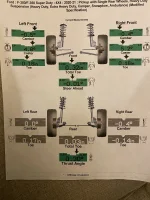
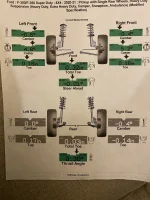
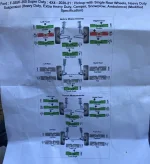
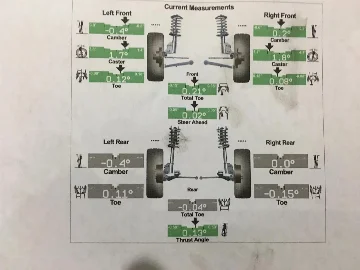
Here’s my alignment spec after maxing out radius arm shims at 4 degrees and adding the 2 degrees caster shims at the knuckle. I’m at 5 degrees of positive caster.
The truck drives different from where it was a week ago at 1 / 1.5 degree of caster. I can’t quite explain it yet how different and if i like it over where it was at approx 3 degrees maxing out radius arm shims at 4 degrees and factory shims at knuckle. It’ll take me sometime to understand.
Anyone looking at alignment spec see any issues outside of caster settings? I wonder if thrust angle of .3 is a bit much. I thought the closer it is to 0.0 the better.
Attachments
alignment looks good to my untrained eyes, except maybe toe. that should be closer to 0Thank you for the insight. Respect for getting down to the bottom of the issue. Who would have thought that it was dialed in electronically by Ford to pull left.
Here’s my alignment spec after maxing out radius arm shims at 4 degrees and adding the 2 degrees caster shims at the knuckle. I’m at 5 degrees of positive caster.
The truck drives different from where it was a week ago at 1 / 1.5 degree of caster. I can’t quite explain it yet how different and if i like it over where it was at approx 3 degrees maxing out radius arm shims at 4 degrees and factory shims at knuckle. It’ll take me sometime to understand.
Anyone looking at alignment spec see any issues outside of caster settings? I wonder if thrust angle of .3 is a bit much. I thought the closer it is to 0.0 the better.
positive thrust angle could cause a left pull.
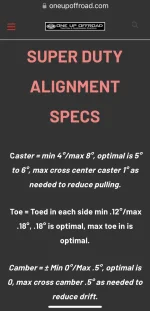
it is interesting that the target specs on the printout are much different than the ones on my printout. the chosen vehicle looks similar, maybe a touch different, but the range specs (caster) are much higher
If i had to describe my immediate feeling on increased caster is that it does feel like more steering effort is required where as before it required less.
“Increasing the amount of positive caster will increase steering effort and straight line tracking, as well as improve high speed stability and cornering effectiveness. Positive caster also increases tire lean when cornering (almost like having more negative camber) as the steering angle is increased. What's the downside to positive caster? If the vehicle doesn't have power steering, a noticeable increase in steering effort will be felt as positive caster is increased. Other than that, the effects of positive caster are pretty much "positive," especially increasing the lean of the tire when the vehicle is cornering while returning it to a more upright position when driving straight ahead.
And here is the guidance i found from a pretty reputable resource on SD suspensions.
“Increasing the amount of positive caster will increase steering effort and straight line tracking, as well as improve high speed stability and cornering effectiveness. Positive caster also increases tire lean when cornering (almost like having more negative camber) as the steering angle is increased. What's the downside to positive caster? If the vehicle doesn't have power steering, a noticeable increase in steering effort will be felt as positive caster is increased. Other than that, the effects of positive caster are pretty much "positive," especially increasing the lean of the tire when the vehicle is cornering while returning it to a more upright position when driving straight ahead.
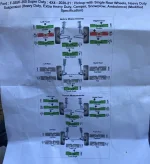
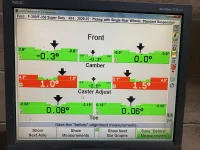
i noticed that they change every time you actually change the values. I dont know if these so called ranges can be trusted. Here are my 3 different readings over the last week or so.alignment looks good to my untrained eyes.
positive thrust angle could cause a left pull.
it is interesting that the target specs on the printout are much different than the ones on my printout. the chosen vehicle looks similar, maybe a touch different, but the range specs (caster) are much higher
And here is the guidance i found from a pretty reputable resource on SD suspensions.
Attachments

- Feb 12, 2022
- 206
- 425
- DoD
- '26 F250 Lariat Ultimate Tremor 6.7 HO
- ‘22 F250 Platinum Tremor 6.7, 1978 K10, 2019 718 GTS
In MY opinion…yes MY opinion, these trucks are very good right at around 3-3.5 degrees max caster (every vehicle is different). Toe should be IN at .04” - .09” per side. Any more toe IN than this and you will get premature tire wear and also unwanted wondering, especially where the roads are rutted bad. No toe OUT allowed at all.If i had to describe my immediate feeling on increased caster is that it does feel like more steering effort is required where as before it required less.
“Increasing the amount of positive caster will increase steering effort and straight line tracking, as well as improve high speed stability and cornering effectiveness. Positive caster also increases tire lean when cornering (almost like having more negative camber) as the steering angle is increased. What's the downside to positive caster? If the vehicle doesn't have power steering, a noticeable increase in steering effort will be felt as positive caster is increased. Other than that, the effects of positive caster are pretty much "positive," especially increasing the lean of the tire when the vehicle is cornering while returning it to a more upright position when driving straight ahead.
i noticed that they change every time you actually change the values. I dont know if these so called ranges can be trusted. Here are my 3 different readings over the last week or so.
And here is the guidance i found from a pretty reputable resource on SD suspensions.
As for caster, I believe you’re asking for more issues than not if you are in the 4.5-6 degree range with these newer coil sprung trucks. 4.5-6 degree caster is reserved for like older Jeeps, Toyotas, and SAS vehicles.
Now, before some of you get your panties in a bunch, the above info is by no means gospel, but it has worked great for others and myself for many many years.
my “before” measurements is what you’re describing as optimal. Maybe i should have left it there. I too now think that at 3.X of caster with everything else being close to factory spec felt the best for me. i can go back to oem ball joint shims where i was at 3 deg, it’s just going to cost me to go back there. All this experimentation is great but costs $In MY opinion…yes MY opinion, these trucks are very good right at around 3-3.5 degrees max caster (every vehicle is different). Toe should be IN at .04” - .09” per side. Any more toe IN than this and you will get premature tire wear and also unwanted wondering, especially where the roads are rutted bad. No toe OUT allowed at all.
As for caster, I believe you’re asking for more issues than not if you are in the 4.5-6 degree range with these newer coil sprung trucks. 4.5-6 degree caster is reserved for like older Jeeps, Toyotas, and SAS vehicles.
Now, before some of you get your panties in a bunch, the above info is by no means gospel, but it has worked great for others and myself for many many years.

Attachments



Tremor Forum Photos
Latest Discussions
-

-
 2024+ F-150 Tremor Standard Bumper Owners: 30" PRO Bar With an Amber DRL
- Latest: mandrautomotive
-
-

