Could this be the future for the people who tow heavy?

Sludgemonkey44

Cutting It Loose In My Silver Spruce
Tremor of the Month 🏆
Founding Member 📜
Joined
Jun 23, 2020
Messages
2,089
Reaction Points
8,565
Location
Butler, Pennsylvania
Current Ride #1
2020 6.7 F250 Super Duty Tremor Lariat Ultimate BAP
Current Ride #2
2022 KTM 500 EXC-F Six Days
I saw this article today and I thought it was interesting. I’m all for reducing emissions if it’s done in a practical way that actually makes sense. The current system with the amount of energy and resources needed to produce and transport the DEF and the DPF system as well as the amount of extra fuel wasted during regeneration do not seem like the best solution for emissions and pollution in perpetuity. Maybe some form of this will be the future.

 
Cummins is investing heavily in hydrogen fuel powered heavy duty engines. Several Midwest states are going to start hydrogen filling stations in certain areas. I’ve also read that cummins is working on a 6.7 gas for the nest gen ram hd trucks, which may turn into a hydrogen platform. I foresee a combination of hydrogen and electric for our future transportation. We need to get off fossil fuels and get transportation costs down and stable.
 
transport, storag are a larger impediment then production.
 
There’s been talk about hydrogen for years. The volatility issue, from what I can gather, is one of the main obstacles faced. If they can get that figured out, this would definitely be a deal breaker and move us beyond our nearly total dependency upon fossil fuels and the issues faced in the EV industry. Very interesting.
 
Hydrogen is expensive to make, transport, and store. I would be willing to bet that any new hydrogen plant will use natural gas in the generation process.
 
Solid state batteries will probably be the next "big thing" as they're supposed to be over double the capacity of lithium ion. Manufacturers started testing them about a year ago now. The EV market feels like it's going to be a perpetual mess for a while.
 
There’s been talk about hydrogen for years. The volatility issue, from what I can gather, is one of the main obstacles faced. If they can get that figured out, this would definitely be a deal breaker and move us beyond our nearly total dependency upon fossil fuels and the issues faced in the EV industry. Very interesting.
The real problem with Combustion engines in general is the efficiency of them. Most gas engines are only in the 30% efficiency range. In a nut shell if you use 1 gallon of gas, only 30% of the energy is converted into mechanical energy while the remaining energy is basically thermal energy. Some of the most efficient natural gas industrial Caterpillar generators get into the low 40% energy efficiency range but that's about it. In winter the efficiency actually goes up as you're utilizing some of the heat to warm the interior of the vehicle where in an electric vehicle you have to consume more energy to heat the cabin either through a heat pump setup or resistive heaters. Most Lithium battery technology today can store energy in the +95% efficiency range (DC charge high 90%, AC charge high 80% to low 90%) and most electric motors run in the 90% efficiency range. You can see there is a HUGE advantage in terms of efficency with electric motors.

1 gallon of gasoline has roughly 33.7 kilowatts of energy which means you're wasting over 20 Kw of energy. It's amazing to think that 3.5 gallons (21 pounds) of gas holds more chemical energy than literally TESLA's biggest car battery pack which is around 1300 lbs. This is why at the end of the day electricity will win once the storage to charge/discharge rates are increased. The only reason why internal combustion engines are used when they are so inefficient is because the amazing energy density of the fuel.

All the current lithium batttery technologies have pros and cons and unfortunately none of them are ideal yet. If or when solid state lithium batteries make it to market, it will be interesting to see how they perform.

Li-Ion (Varying chemistries here) - Decent charge and discharge rates, lifespand is lowest of the main lithium chemistries and low temperature charging is reduced and needs to be monitored to prevent cell damage in freezing conditions

LFP cell technology has good energy density, but lacks in the power department as it can't discharge and charge extremely fast. It's great for energy storage system for home consumption. Cell technology also has a good lifespan, but you cannot charge in freezing conditions or damage can occur.

LTO cell chemistry I like the best as it allows extremely fast charge and discharge cycles and low temperature operation -40F, but the downside is the energy storage density. Tesla's 4680 cells (not LTO) have literally 2.5x battery storage density but lose out on the safety factor of LTO cell chemistry and also fast charge and discharge ability. You could charge an entire battery pack in under 10 minutes as long as you have the power to do so. Some LTO cells have a 10C charge rate which means a 6 minute charge and discharge potential which is awesome especially when cells are water cooled.

Teslas battery packs from the model S to the model 3 have great battery managment systems along with proper cooling or warming of cells. Most manufacturers in the past have skimped in this area and I'm curious how future Ford and GM battery designs improve.

Until battery technology improves, I have no desire to switch from an internal combustion engine. The big concern for electric vehicles is if the battery pack or main motor inverter goes out, you could be out $20k easily for either of these issues. Where a simple engine or transmission issue may only set you back $5k. In electric vehicles there's no cheap repair of a battery pack or inverter board. In the future there probably will be 3rd party services for repairing defective battery module (there are for Teslas), and simple repairs of a motor inverter system where maybe mosfet or IGBT's are damaged or some simple couple dollar part on a PCB prevents the unit from working.

As far as Hydrogen goes, I like the idea but you still have conversion inefficiency. Electrolysis thats done efficiently maybe 75% efficient from the start. Then you have to compress the fuel to 3600+ PSi usually in a high pressure vessel which takes a decent bit of energy to compress the Hydrogen (ignoring the cost of Hydrogen compressor). Then you still have the inefficiency of a combustion engine which is really not that different from a normal combustion engine ran on liquid fuels. I'll be generous and say 50%.

Simple exercise here, lets say you have a nuclear plant that outputs 100 watts. At best you convert that to 75 watts of equivalent energy in Hydrogen gas. Then you compress that gas which I wont even factor the inefficiency here. Now that hydrogen gas combustion engine is at BEST 50% efficient, well that 75 watts is now reduced to only 38 watts of potential usable engine for motion. This is the major issue with combustion engines. I won't get into hydrogen fuel cells as that is a whole other issue which has its only problems and similarities with other fuels. I used 100 watts for an easy SI unit, obviously nuclear plants put out more power than an old incandescent light bulbs :)
 
Last edited:
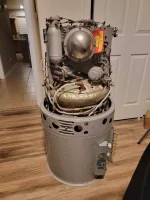
I have a nice Bacon type Hydrogen/Oxygen Fuel Cell used 60 years ago that put out 2.2 Kw of power on the Apollo CM spacecraft. Maybe we can retrofit 3 of them on an SD and give it a go :)
 

Attachments

  • 20230730_044143.webp
    20230730_044143.webp
    247.9 KB · Views: 53
I have a nice Bacon type Hydrogen/Oxygen Fuel Cell used 60 years ago that put out 2.2 Kw of power on the Apollo CM spacecraft. Maybe we can retrofit 3 of them on an SD and give it a go :)

Very Cool, where did you find that?
 
Surplused out of Pratt & Whitney (sub-prime contractor under North American Aviation/Rockwell during the Apollo lunar exploration program). Retain many items of technology associated with the U.S. Space program - mostly spacecraft and liquid rocket engine, spacesuit subassemblies. Most folks are not aware that Fuel Cell technology and in particular Hydrogen Fuel Cells were advanced and heavily leveraged during the early days of the space program to make power on orbit and transiting to/back from the moon (i.e. it is not novel). However in space there is the luxury of having a very cold environment to allow for high density cryogenic storage (though Cryo storage has its down sides as evidenced during Apollo 13).
 
The big concern for electric vehicles is if the battery pack or main motor inverter goes out, you could be out $20k easily for either of these issues.
Like when the CP4 goes in your 6.7 Tremor and you re out $15k and don't have your truck for 3 months waiting for parts.
 
Like when the CP4 goes in your 6.7 Tremor and you re out $15k and don't have your truck for 3 months waiting for parts.
While a bad CP4 can cause thousands in repairs there are ways to mitigate the risk signficantly. There are far more electrical components on an inverter board that can fail than actually engine mechanical parts. A simple 1 cent part whether a resistor, diode, capacitor failing has the potential to be catastrophic. Without PCB schematics, it would make it extremely difficult to repair and virtually no chance of repair by homeowner.

When I was younger, and had vehicle problems I fixed the issues myself because I didn't have the funds to pay someone to do the work. That meant I learned how to do brakes, struts, springs, intake manifold gaskets, valve cover, entire exhaust system, fuel pumps, injectors, ABS system, and eventually automatic transmissions. As I became more knowledgeable I then picked up a side hustle fixing cars by rebuilding tranmission or whatever was the issue. With all the electronics today it virtually makes it impossible to fix as the communication protocal of the CANBUS on especially electric vehicles require programming of modules. Not to mention if you say pull a battery from a Tesla that had a salvage title for no other reason than theft and you try to swap it in your Tesla, you can have a whole lot of issues with Tesla at corporate side not allowing the battery to Supercharge via DC charger because they decide the Vin either doesn't match or the vin number that battery pack belonged to was salvaged and they deem no longer safe. Simple stuff like this means less repair and more of a throw away society. The same thing has been going on with tractors and especially John Deere.

A brand new 7.3L Godzilla crate engine from Jegs is under $8k. There's a reason why I went the Godzilla route over the Powerstroke route. The Powerstroke literally adds nothing to the SRW towing capacity until you do DRW. You can make a point that the diesel towing experience is significantly nicer, but not worth it for my needs.

 
Back
Top Bottom