Carli Torsion Swaybar at stock ride height?

I had those disconnects on my Jeep with the cotter pin. Easy to take off. Putting back on after a long day on the trail wasn’t my favorite thing to do. Was jealous of the guys with electronic disconnects. It would be nice if the tremor package had that like the Power Wagon does.
I loved the sway bar disconnect on my Power Wagon on rough FS roads.

Right up until it re-engaged at 25mph. :cry:
 
I’m running the stock leafs right now with felling wedges between the lower overload and regular stack. Stock front springs with the Accutune 2.5 Fox DSCs front and back. The back feels good. It drove great with factory front sway once I put on the on the new shocks. I wanted to see how it did without the front sway and I removed it. Feels awesome off-road, but a little too loose on road. I also have a Supertramp camper and when fully loaded for trip, the front sway on highway is a little taxing to drive. That’s why I thought the Carli torsion would be a good middle ground. I also had a slight rub at full lock on with my 37s on the sway bar. Being able to fully turn without the rub is really nice. I’ll be installing Alcan custom leafs in the rear in September and will reassess once they go on.
Please report back with the Alcan custom leafs, they are literally 8 miles from my house and have been curious how they ride. Curious about ride without camper and with camper. I'll be getting a Four Wheel Camper likely by winter and want to account for that, but still ride equal or better than stock when empty. Likely adding the Carli Pathfinder shocks and front springs this winter as well.
 
Interesting. the guy who designed the shackles says there is no improvement when the carli shackles are used with stock leafs.
Weird, It was a enough of a difference on smaller bumps that multiple people who ride in my truck noticed.
 
Interesting. the guy who designed the shackles says there is no improvement when the carli shackles are used with stock leafs.

My 2022 F350 seems to have better rear suspension feel with the Carli shackles. I did a test ride before, then did the swap work, went on a drive over the same route, the differences were there. The rear suspension cycling, say over speed bumps, was showing there was a better feel.
I did make damn sure the Carli bushings were greased. I had to use a wire to clean the grease channels so the grease would purge out properly. There was just a little bit of the rubber (whatever) casting on the bushings that needed to be punched through so to speak.

😎 😎 🇺🇲 🇺🇲 🇺🇲 🇺🇲
 
My 2022 F350 seems to have better rear suspension feel with the Carli shackles. I did a test ride before, then did the swap work, went on a drive over the same route, the differences were there. The rear suspension cycling, say over speed bumps, was showing there was a better feel.
This makes sense since they should lower the minimum spring rate but have little effect on the maximum spring rate. The only issue I have with them is the increase in rear squat when towing (just like the Sulastics).
 
This makes sense since they should lower the minimum spring rate but have little effect on the maximum spring rate. The only issue I have with them is the increase in rear squat when towing (just like the Sulastics).


The Carli rear shackles ??? Ummm...I see it as the OEM rear shackle is designed to be fixed in place (vulcanized??) with the suspension action working against the holding force. Where the Carli shackles allow the bushing sleeve to rotate freely inside the bushings along the grease runners (so to speak). Rear squat is all due to how the shackle allows the bushing sleeve to move inside their greaseable bushings.
So the design difference of the OEM vulcanized versus the Carli greaseable is the factor many see with a load.
 
So the design difference of the OEM vulcanized versus the Carli greaseable is the factor many see with a load.
Yes but the reality is the OE bushing is physically fused whereas the Carli can rotate. This equates to more spring rate, but it is small compared to say the overload spring, so it is only noticeable when empty. However, this also means the suspension compresses more easily under light load, which equates to more initial squat until the Carli shackle is fully rotated.
 
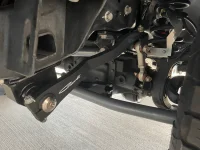
I'm running one on my truck. The first and main issue is that the Carli sway bar is clearly designed for a lifted truck. Its arms are longer and shaped differently than the factory sway bar. The factory bar is bent to clear the drag link, while the Carli bar is straight, much thicker, and can create clearance issues.

I initially installed it with the standard 2.5" Carli links, which did clear the factory drag link. However, because the links are longer, the arms ended up less than 1/2" from my factory hard brake lines—a little too close for my liking. The factory links, on the other hand, were too short to clear the drag link, but they did offer better brake line clearance. You may also need to rotate the drag link adjustment sleeve so the bolts clear the arm.

At the same time as the sway bar in stall, I was going to switch to a full Synergy steering setup (tie rod, drag link, and track bar). I had about ½” of clearance between the passenger-side arm and the Carli link (which isn’t adjustable in length) but still had the same issue with the closeness of the brake lines. At the time, I put back the factory sway bar until I found a solution.

As mentioned earlier, the bar is clearly intended for a suspension lift, where the axle is positioned lower and farther away from the frame. With a lift, the arms would sit more horizontally, allowing the Carli links to work within their proper range of motion. Without a lift, the arms point upward, and the inline ball joints on the Carli links are pushed close to their angular travel limit. BLACKCHERRY mentioned in the other thread that this could potentially cause a link to pop, and I believe him.

My solution was to pick up a set of Carli drop brackets (CS-FSBD-45-17) from eBay, which relocate the sway bar down and forward relative to the frame, paired with PMF end links. This repositioning provided much better clearance for my brake lines, and since the Carli arms narrow at the link ends, it also improved drag link clearance.

With the arms shifted downward and forward, you will need adjustable links that are longer than Carli’s and can pivot freely without binding. I went with the shortest rod-end style links PMF sells and added some silicone O-rings to quiet them down. I also notched the bracket that attaches to the sway bar for a better fit.

I’ve run this setup for about 4,000 miles with no clunking or signs of binding or interference.
 

Attachments

  • IMG_0790 - Copy.webp
    IMG_0790 - Copy.webp
    379.9 KB · Views: 49
Yes but the reality is the OE bushing is physically fused whereas the Carli can rotate. This equates to more spring rate, but it is small compared to say the overload spring, so it is only noticeable when empty. However, this also means the suspension compresses more easily under light load, which equates to more initial squat until the Carli shackle is fully rotated.
I might have used the wrong term but I used vulcanized to describe this aspect.

Spring rate is spring rate you can't change the rear spring rate.......now overall effective rate with all the considerations of parts combined...yea I can agree with that view point.
 
Back
Top Bottom