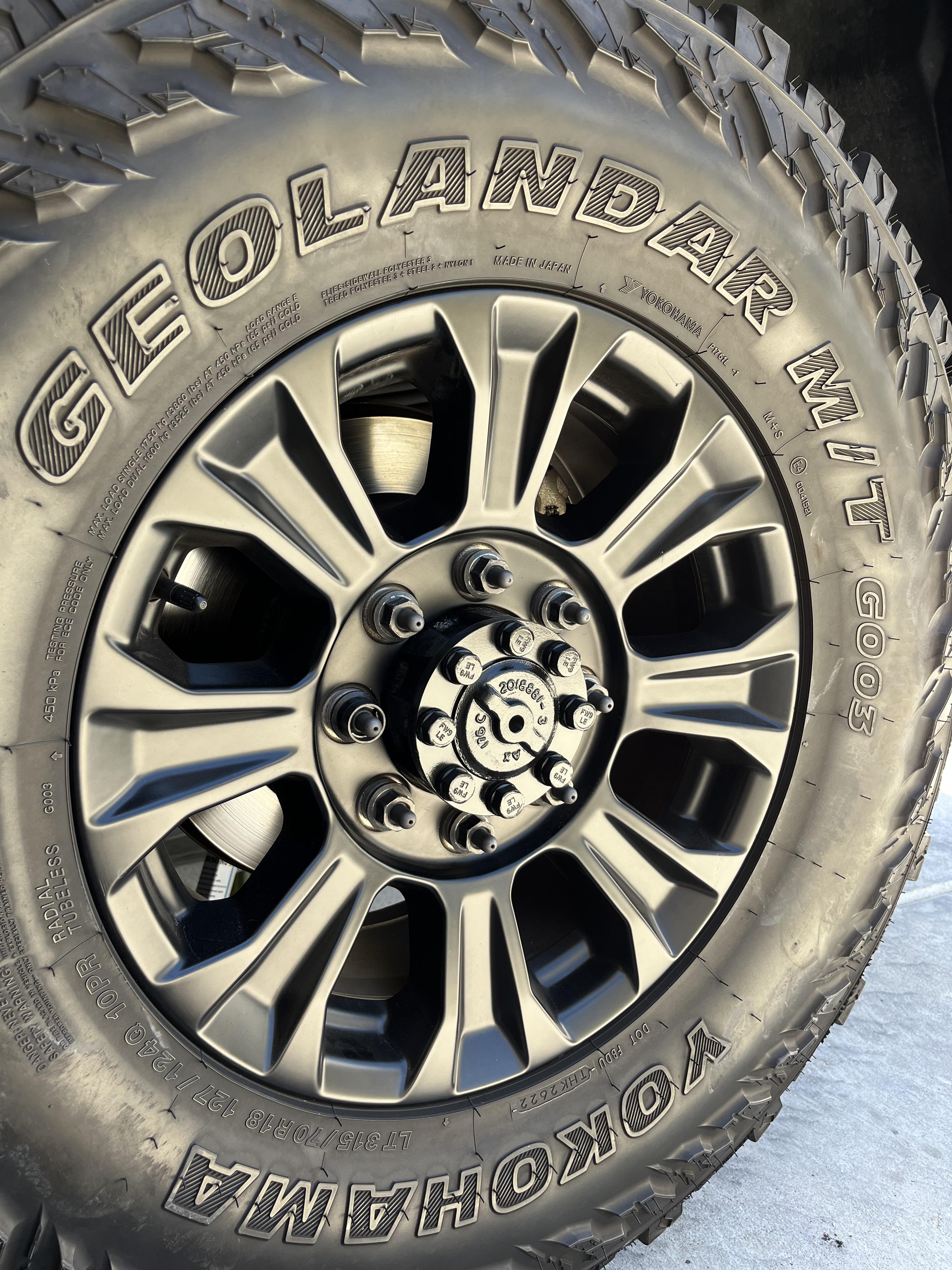
37x11.50r18 on stock wheels and ride height

View attachment 113453
View attachment 113454
I just installed the new Falken RT in 37x13.8r18. Yes it rubs at full lock with factory radius arms. I have a set of 0.5” spacers coming from Bora. This should remedy the rubbing. As for manufacturers suggestions….I get it but there’s a reason wide tires on skinny wheels is called “redneck beadlocks”. It works. Also note here in Texas there’s plenty guys in duallys with 6” wide stick wheels running 13.5’s. Never seen an issue.
Did the 0.5" Spacers alleviate the rubbing?
 
Did the 0.5" Spacers alleviate the rubbing?
Yes they did and still kept the tires far enough inside the fenders to not overly sling mud down the sides of the truck.
 
With Toyo AT3, you can go all the way to 37x12.50 no problem on the factory 8" rim. Sidewall looks cool as well on stock rim! I'm not a fan of most aftermarket rims, and will probably go this route when/if my truck arrives.


Why not go this route now, i figure with your 1/2 boras you’ll clear this combo (both radius arms and sway bar) no problem at all on stock truck.
 
Why not go this route now, i figure with your 1/2 boras you’ll clear this combo (both radius arms and sway bar) no problem at all on stock truck.
I need the spare to fit under the bed still. Trophy hitch is lower rated than factory and I don’t want that for insurance reasons.
 
You don't need to change the spare. The factory spare will still work just fine until you get the bigger one fixed - just turn off the Traction Control.
 
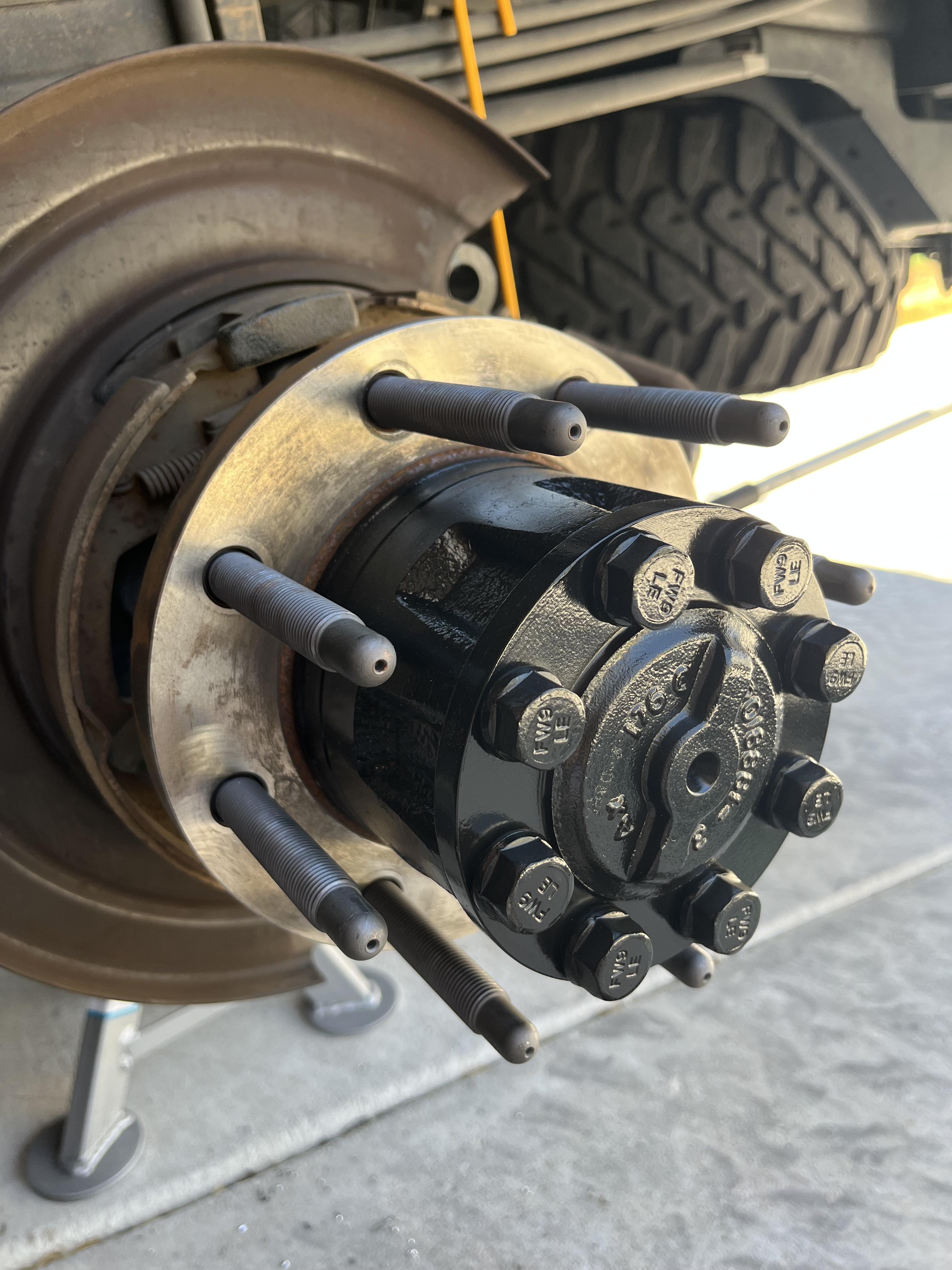
Do you need longer studs with the 1/2” spacers?

Thinking the 37x12.5 Toyo AT3 (good down to 8” W wheels) on stock 8” W wheels will solve the wheel/tire feedback loop conundrum I’ve been on these last few months. That plus black lugs and a black rattlecan job on the front hub rings.
 
Do you need longer studs with the 1/2” spacers?

Thinking the 37x12.5 Toyo AT3 (good down to 8” W wheels) on stock 8” W wheels will solve the wheel/tire feedback loop conundrum I’ve been on these last few months. That plus black lugs and a black rattlecan job on the front hub rings.
No need for longer studs. If I recall I had 8 full turns/thread engagement. Honestly, if going with 12.5 wide, you could probably get away with 3/8 spacer.

I too need black lugs and some rattle can love on my hubs!
 
Do you need longer studs with the 1/2” spacers?

Thinking the 37x12.5 Toyo AT3 (good down to 8” W wheels) on stock 8” W wheels will solve the wheel/tire feedback loop conundrum I’ve been on these last few months. That plus black lugs and a black rattlecan job on the front hub rings.
I went longer, rounded nose studs for peace of mind, as I wasn't comfortable with the amount of threads sticking passed the lug nut. I also like the dark gray color of them. (intentionally not running hub caps)

LrybKPa.jpg


wsM8Nr5.jpg
 
Last edited:
Do you need longer studs with the 1/2” spacers?

I’m with bronco on this one. With 1/2 inch spacers i would get the longer studs for a piece of mind. 3/8 are safe on current studs, i heard from folks they end up with 11 turns. Bora even has 1/4 inch spacers which are “just” enough to clear the sway bar on the 23/24s with stock rims and toyo at3 37/12.50s. My logic is, if 1/4 inch is enough to clear what you need it to, why opt for more?

Personally, i was able to clear toyo at3s 37/12.50s by simply shifting the sway bar 1/4 inch to the driver side for an even alignment between wheels, no rub at full lock either way, so i’m holding off on spacers for now.
 
You don't need to change the spare. The factory spare will still work just fine until you get the bigger one fixed - just turn off the Traction Control.
It'll work unless you get a flat somewhere that you need to use 4x4, that's why I opted for a fullsize spare (in addition to carrying a tire repair kit in the toolbox). I also run aftermarket wheels with conical lug nuts so unless I want to carry around a spare set of the factory lugs I cant even use the factory spare anymore.
 
I also run aftermarket wheels with conical lug nuts so unless I want to carry around a spare set of the factory lugs I cant even use the factory spare anymore.

I did just that the last time around, 8 extra lugs nuts in the bed seriously wasn’t that big a deal😉
 
I’m with bronco on this one. With 1/2 inch spacers i would get the longer studs for a piece of mind. 3/8 are safe on current studs, i heard from folks they end up with 11 turns. Bora even has 1/4 inch spacers which are “just” enough to clear the sway bar on the 23/24s with stock rims and toyo at3 37/12.50s. My logic is, if 1/4 inch is enough to clear what you need it to, why opt for more?

Personally, i was able to clear toyo at3s 37/12.50s by simply shifting the sway bar 1/4 inch to the driver side for an even alignment between wheels, no rub at full lock either way, so i’m holding off on spacers for now.
My truck is a 2021 and my tires are 13.5 wide so 1/2” spacers were needed.
 
It'll work unless you get a flat somewhere that you need to use 4x4, that's why I opted for a fullsize spare (in addition to carrying a tire repair kit in the toolbox). I also run aftermarket wheels with conical lug nuts so unless I want to carry around a spare set of the factory lugs I cant even use the factory spare anymore.
If I were going 4-wheeling, I would probably have an extra wheel/tire and just throw it in the bed.
BTW, I wonder what would happen if you did use the smaller OEM spare in 4x4.
 
BTW, I wonder what would happen if you did use the smaller OEM spare in 4x4.
On the rear, regardless of 4x4, your differential would be constantly making up the difference in wheel speed. So some amount of additional wear, but likely only meaningful if the size difference was substantial. Your differential is constantly making up speed differences as the vehicle turns.

Would not want to enable the rear locker with mismatched tire sizes on the rear, though. Especially if there’s any chance of high traction.

On the front it would be fine with the hubs unlocked. Once the hubs are locked (either manually or automatically) the risk is the LSD. Like the rear diff the front would be trying to make up the speed difference due to tire size differential.

What I don’t know is if the clutches in the LSD would be engaged for the amount of size (and therefore speed) difference being talked about. Maybe?
Just adding, that with 4x4 engaged, even with open difs front and rear, the driveshaft of the axle with one smaller tire would be turning faster than the other driveshaft. Since our trucks dont have a center differential in the transfer case and front/rear are always locked together, it would be the same as having mismatched gear ratios front to rear. How much damage it causes would depending on how much traction you had.

Trophy hitch is expensive... so I just throw my fullsize spare in the bed when Im headed somewhere that I might need it.
 
Just adding, that with 4x4 engaged, even with open difs front and rear, the driveshaft of the axle with one smaller tire would be turning faster than the other driveshaft. Since our trucks dont have a center differential in the transfer case and front/rear are always locked together, it would be the same as having mismatched gear ratios front to rear.
I’m trying to work out in my brain why that’s true. Does driveshaft speed correlate to the speed difference between the tires?

If the driveshaft turns with rate X when both tires are turning the same speed, if one tire is held stationary, the driveshaft now needs to spin at X/2? Or something to that effect?

But that doesn’t make sense to me because then that would require engine speed to change to maintain the same speed when turning a corner, since turning a corner requires one wheel to turn faster than the other. Is that what happens and I’ve just never noticed?

(Normally when I think of driveshaft binding in 4x4 I’m ignoring the individual tires and just considering the overall distance traveled by the front and rear ends. For example, front travels farther than rear in a corner. So this is interesting!)
You are thinking about it the right way, if you were able to look inside the differential while turning it would look like the inside tire is moving in revers and the outside tire is moving forwards, you dont notice this in a normal scenario because this differential motion is offset because both tires have the same radius. If you put a smaller tire on one side of the axle, the differential equalizes the difference between the two and the driveshaft speed would be approximately the same as if the axle had two tires the same size roughly the average between the bigger and smaller tire. When you add back in the other axle that has two correctly size tires on it the net effect is that whichever axle has the smaller tire is traveling a shorter distance per revolution of the driveshaft than the axle with the two correctly sized tires. I have no idea how much you have to be off by before this becomes noticeable to the driver.
 
You don't need to change the spare. The factory spare will still work just fine until you get the bigger one fixed - just turn off the Traction Control.
Was this response implying that you can run a different diameter tire as a spare so long as traction control is turned off?
 
Was this response implying that you can run a different diameter tire as a spare so long as traction control is turned off?
Yes.
 
There will absolutely be people here that will argue that they've done this without negative consequences, that's fine, continue to do this at your own risk. But as a mechanical engineering that worked at an OEM for 20 years, I would advise those that are looking to this forum for guidance not to do this. Traction control aside, this will cause issues with ABS function on road in 2WD, as you're talking about a wheel speed sensor difference of ~6% between wheels on the same axle. You shouldn't even run different tread patterns on either side of an axle, let alone different tire diameters. Off road, if 4x4 is required, this will absolutely result in more driveline stress given the lack of a center differential on these trucks as the axles will be trying to turn at different speeds. That's before we consider LSD risk. Will it certainly break? No, it's dependent on the traction and how long you drive like that, but if you do go ahead and use a significantly different diameter spare, then just be aware that you're causing damage that was not accounted for in all the OEM's durability testing.
 

Latest Discussions

Back
Top Bottom